The most effective distressed seller outreach strategies combine three things: stacked lead lists that overlap multiple distress signals, prioritized multi-channel contact with strict speed-to-lead SLAs, and empathetic first-touch messaging that leads with help instead of a hard sell. Investors and agents who skip any one of these three legs get fewer conversations, worse appointments, and more compliance risk.
Three actions to take before the end of today:
- Pull a stacked lead list that overlaps at least two distress indicators (for example, tax delinquency plus absentee ownership) rather than working a single-signal list.
- Set a 24-hour speed-to-lead SLA for every Tier 1 contact, since pre-foreclosure leads convert fastest when contacted within days of the filing.
- Write one empathetic first-touch script per lead type that references a specific, verifiable public record detail instead of a generic “we buy houses” line.
Do this consistently and you should see a measurable lift in contact rate within two to three weeks, along with fewer wasted appointments because the leads reaching your calendar are pre-qualified by signal strength, not just volume.
Key Takeaways
Distressed seller outreach works best when stacked, verified lead lists are combined with tiered SLAs, empathetic first-touch scripts, and strict TCPA compliance.
| Point | Details |
|---|---|
| Stack before you dial | Overlap two or more distress signals per lead to raise response rates and avoid wasted touches. |
| Tier and time-box outreach | Contact Tier 1 leads (three or more signals) within 24 hours; slower tiers follow a standard weekly cadence. |
| Match channel to lead type | Use calls and AI dialers for pre-foreclosure, mail for absentee owners, and driving for dollars for vacant properties. |
| Plan for five to twelve touches | Most conversions happen after multiple contacts over 45 to 90 days, with diminishing returns past six touches. |
| Fund the close fast | CR Equity Ai Inc offers asset-based underwriting with decisions in as little as four hours to keep qualified deals moving. |
Table of Contents
- What Are the Best Strategies for Reaching Distressed Sellers?
- How Should You Score and Route Distressed Seller Leads?
- Which Outreach Channel Works Best for Each Lead Type?
- How Do You Write an Empathetic First-Touch Script?
- How Many Touches Does It Take to Convert a Distressed Seller?
- How Do You Keep Outreach Data Clean and Scalable?
- What Legal Rules Apply to Distressed Seller Outreach Beyond TCPA?
- What Are Common Objections From Distressed Sellers, and How Should You Respond?
- What This Means for How You Run Outreach
- Sources
- FAQ
What Are the Best Strategies for Reaching Distressed Sellers?
Reaching distressed property owners starts with knowing which distress signals to track and how to layer them so you’re not chasing every absentee owner in the county with the same generic postcard.
Six signals matter most: pre-foreclosure or lis pendens filings, property tax delinquency, probate or inherited property, vacant or boarded structures, active code violations, and long-term absentee ownership (owners who haven’t lived in the property for two or more years). Each signal alone produces a mediocre response rate. Stacked together, they produce something different.
List stacking means pulling multiple distress lists and layering them with AND logic, keeping only the addresses that appear on two or more lists. A property in pre-foreclosure that is also absentee-owned and has an open code violation is a fundamentally different lead than a property with just one of those flags. Overlapping distress indicators this way can produce two to five times higher response rates than working single-signal lists in isolation, because the seller is more likely to actually be under pressure, not just theoretically eligible for a list.
Before any outreach goes out, run a basic verification pass:
- Confirm the filing or record is recent, ideally within the last 30 to 60 days, since stale filings often mean the situation already resolved.
- Pull county recorder or assessor data to confirm current ownership and mailing address.
- Screen for estimated equity position, since a leveraged, underwater owner needs a fundamentally different offer than a high-equity owner.
Equity screening deserves its own mention. Matching outreach and offer structure to the owner’s equity tier prevents wasted calls to underwater sellers who can’t accept a cash offer below their mortgage balance, and it shapes whether your first conversation should mention subject-to financing, seller carry, or a straight cash close.
Pro Tip: Run your stacked list through a de-duplication pass before you touch it. A “high-priority” lead that turns out to be a duplicate you already called last week erodes trust fast, both with the seller and with your own team’s confidence in the list.
How Should You Score and Route Distressed Seller Leads?
Not every lead on a stacked list deserves the same urgency. A simple three-tier rubric keeps your team from burning speed and attention on marginal contacts.
- Tier 1: Three or more overlapping distress signals. These get contacted within 24 hours, no exceptions.
- Tier 2: Two overlapping signals. Contact within 48 to 72 hours.
- Tier 3: One signal. Fold into a standard weekly or biweekly outreach cadence.
Add equity modifiers to each tier. A Tier 2 lead with strong equity often outperforms a Tier 1 lead with negative equity, so scoring should weight opportunity, not just signal count. Time pressure varies by scenario too: non-judicial foreclosure states have shorter auction windows, which means a pre-foreclosure Tier 1 lead in one state might need contact within hours, not days, while a probate lead can often tolerate a slightly longer runway since court timelines move slower.
A workable assignment flow looks like this: an assistant or SDR fields the first call, vets interest and basic facts, logs consent and preferred contact method, then hands qualified appointments to a senior closer for the offer conversation. This division of labor matters more than most teams assume, since operators who separate first-contact vetting from closing consistently see higher appointment-to-contract conversion than founders trying to do both.

Pro Tip: Log every opt-out the moment it happens, in a shared field visible to the whole team, not just in one person’s notes. A missed opt-out that gets called again is both a compliance exposure and a fast way to burn a referral relationship.
Realistic time-to-contract windows differ by tier: Tier 1 pre-foreclosure leads can close in 14 to 30 days when contacted quickly, while probate and Tier 3 leads often run 60 to 120 days from first contact to signed contract.
Which Outreach Channel Works Best for Each Lead Type?
No single channel outperforms the others across every lead type. The channel has to match the signal.
Calls and AI dialers work best for pre-foreclosure leads, where urgency is high and a live conversation moves faster than paper. Pre-foreclosure leads paired with rapid phone contact convert in as little as 14 to 30 days, a window that direct mail alone rarely hits because of print and delivery lag.
Direct mail fits absentee owners and long-term distressed situations better than calls. Response is slower, often measured in weeks, but it scales cheaply and doesn’t require the owner to answer an unfamiliar phone number, which absentee owners often screen aggressively.
Driving for dollars remains one of the few channels that finds inventory public records miss entirely, particularly vacant and boarded properties that haven’t shown up on a tax or code-violation list yet. Pairing a driving-for-dollars route with an instant skip-trace and owner-append tool turns a windshield survey into an actionable contact list the same day, instead of a spreadsheet of addresses with no owner name attached.
A practical channel map:
- Pre-foreclosure: phone calls and AI dialers first, mail as a backup touch.
- Absentee ownership: direct mail as the primary channel, calls as a follow-up once you have a working number.
- Vacant/boarded property: driving for dollars plus mail, since these owners are hardest to reach any other way.
- Probate: mail and email first, since a cold call to a grieving heir often lands poorly.
- Code violations: mail paired with a courthouse or county record cross-check.
SMS and AI cold-calling deserve a specific caution. Both channels increase exposure under the FTC’s TCPA guidance, which requires prior express consent for automated messages and honoring the National Do Not Call Registry. Violations can result in significant financial penalties per incident, which turns an unscreened SMS blast into a real financial liability rather than a minor compliance footnote.
Bandit signs still work in some markets for vacant and absentee inventory, but they carry local solicitation-ordinance risk that varies block to block, so check municipal code before posting at scale.
Statistic Callout: Best-fit pairing beats single-channel outreach almost every time. Investors who run parallel channels against a stacked Tier 1 list, rather than committing to one channel exclusively, generally see faster first contact because they’re not waiting on a single point of failure like an unanswered phone number.
How Do You Write an Empathetic First-Touch Script?
The opening line decides whether a distressed seller keeps talking or hangs up. Four principles hold across every scenario: lead with help, not an offer; reference one verifiable public fact so the owner knows you did your homework; keep the message concise; and never use pressure language that implies urgency you can’t back up.
Here’s how that plays out by scenario:
- Pre-foreclosure: “I saw a filing on file for your property at [address]. I help owners in this exact situation understand their options, including ones that don’t involve losing everything to auction. Do you have a few minutes?” Follow with three qualifying questions: Are you current on any repayment plan? What’s your timeline before the sale date? Would a fast cash sale or a workout option matter more to you right now?
- Probate: “I understand you may have recently inherited the property at [address]. I work with families in this situation to figure out whether keeping, renting, or selling makes the most sense.” Qualifying questions: Has the estate cleared probate yet? Are there other heirs involved in the decision? Is the property occupied or vacant right now?
- Absentee owner: “I noticed you own the property at [address] but the mailing address is different. I wanted to check whether it’s something you’re actively managing or would consider selling.” Qualifying questions: How long have you owned it? Is it currently rented? What would make selling worth considering?
- Vacant property: “I drove past [address] and it looks like it may be vacant. I wanted to check in directly rather than assume.” Qualifying questions: Is the property currently unoccupied? Are there repairs needed you’re aware of? Would you consider an as-is sale?
Close every script the same way: propose one specific next step, like a 15-minute call or a property walkthrough, rather than a vague “let me know if you’re interested.”
Red flags to avoid entirely: promising a specific legal outcome, implying you can stop a sheriff’s sale or control auction timing, or giving a misleading timeline to create false urgency. These aren’t just ethically wrong, they’re the fastest way to lose a referral relationship and invite a complaint. Document the seller’s consent and preferred contact method during that first call, since it protects both the relationship and your compliance record.
How Many Touches Does It Take to Convert a Distressed Seller?
One call rarely closes a distressed deal. Best-practice sequences treat three touches over 45 days as a 2026 minimum, with most conversions actually landing between five and twelve total contacts.
A workable 45 to 90 day sequence:
- Day 1: phone call (Tier 1) or mail piece (Tier 2/3).
- Day 3: SMS follow-up, only with documented consent.
- Day 10: second mail touch with a different angle (equity focus vs. timeline focus).
- Day 21: second phone call.
- Day 35: email with a simple FAQ or options sheet.
- Day 60 to 90: final check-in call or mail piece before re-tiering.
Returns diminish sharply after six touches. If a Tier 1 lead hasn’t engaged by touch six, drop it to a slower nurture cadence rather than continuing at the same intensity.
Once a seller agrees to an appointment, prep matters as much as the pitch. Ask for:
- Mortgage statement or payoff amount, if applicable.
- Recent tax bill and any code-violation notices.
- Basic property condition details (roof age, foundation issues, occupancy status).
Frame the conversation around seller net, meaning what actually lands in the owner’s pocket after payoff, closing costs, and any repair credits, rather than a headline purchase price. Log every touch and outcome in your CRM, and re-tier or age out any lead that goes cold past 90 days with no response.
How Do You Keep Outreach Data Clean and Scalable?
Bad data undermines every strategy above. Overlapping list sources without de-duplication routinely creates redundant records, and duplicate outreach measurably hurts response rates and professionalism when the same owner gets contacted twice by the same team.
A practical hygiene workflow: import every new list, run owner-name and address matching to catch duplicates, suppress historical do-not-call and closed-deal records, then export with tier tags attached so each contact routes to the right channel automatically.
Your CRM should capture, at minimum: consent status, last-contact date, preferred contact method, and opt-out flag. These four fields alone prevent most compliance headaches.
Tool categories to evaluate rather than specific vendors: a distress-data provider for pulling pre-foreclosure, tax, and probate records; a de-duplication tool for matching and suppression; a skip-tracing service for owner contact discovery; a CRM for tracking touches and consent; and an AI dialer for scaled first-contact calling. Push every Tier 1 lead into your fastest available channel immediately, log opt-outs centrally across the whole team, and refresh your master list daily so stale filings don’t waste a call.
What the Field Actually Teaches About Outreach
Empathy and speed aren’t opposing priorities. They work together, since a seller who feels rushed by a robotic script disengages just as fast as one who gets a call three weeks too late. The clearest operational lesson: teams that route first contact through an assistant or SDR, then hand qualified conversations to a senior closer, consistently book more appointments than founders trying to do both jobs at once.
Distressed sellers can tell the difference between a script written to close them and a script written to help them decide. The data-stacking and SLA work only pays off if the words on the other end of the phone respect that difference.
When a deal reaches the offer stage and needs fast execution, readers can review how to prepare documents for fast real estate funding approval so financing doesn’t become the bottleneck after months of careful outreach.
What Legal Rules Apply to Distressed Seller Outreach Beyond TCPA?
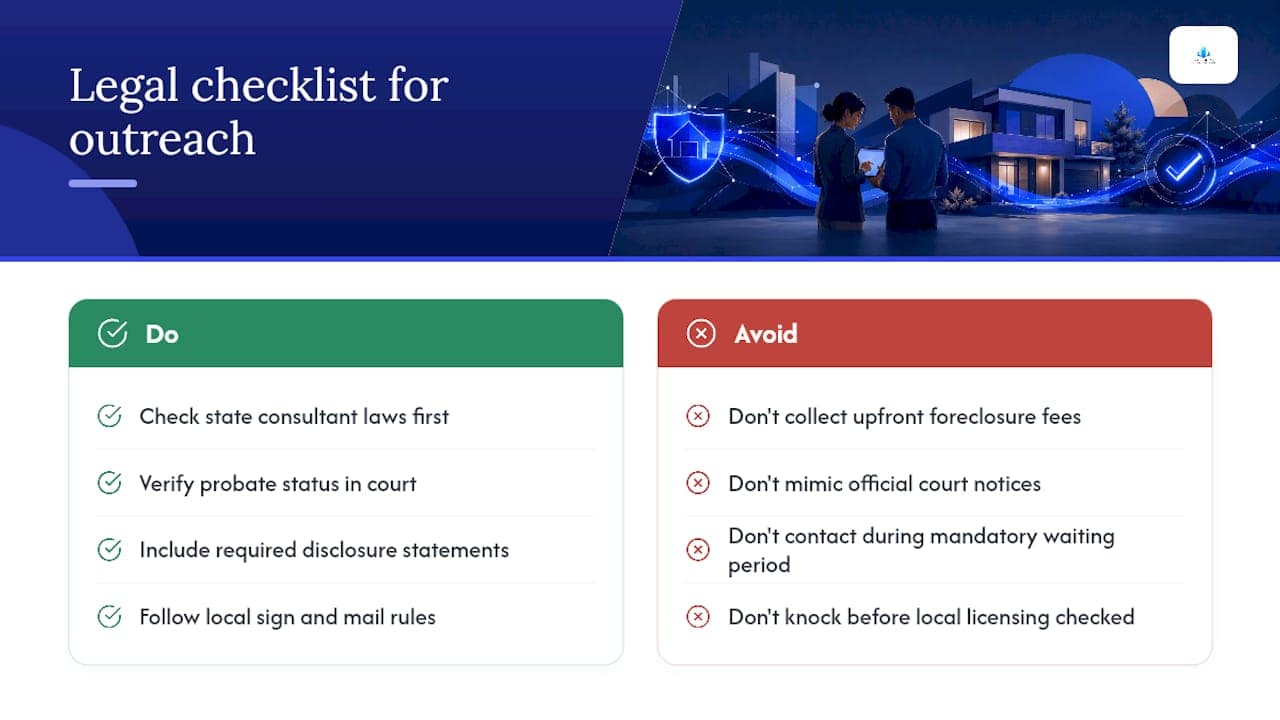
Compliance with TCPA and Do Not Call rules covers phone and text contact, but it doesn’t cover every legal exposure in distressed seller outreach. Several states and municipalities regulate solicitation of homeowners facing foreclosure specifically, sometimes requiring a mandatory disclosure statement on any written communication, a waiting period after a notice of default before contact is allowed, or a ban on collecting upfront fees tied to foreclosure rescue services. These “foreclosure consultant” or “equity purchaser” statutes vary significantly by state, and some carry criminal penalties, not just civil fines, for violations.
Direct mail to distressed owners can also trigger local solicitation ordinances if it’s franked to look like an official government or court notice, a practice several states have specifically outlawed because it misleads owners into thinking the mail is legally required correspondence.
Probate outreach carries its own sensitivity. Contacting heirs before an estate has legal standing to sell, or before a personal representative has been appointed, can produce a contract with no enforceable seller. Confirm probate status through the court file before treating a probate lead like a standard distressed contact.
Driving for dollars and bandit signs intersect with local sign ordinances and, in some jurisdictions, licensing rules for unlicensed solicitation of homeowners. None of this replaces legal advice specific to your state, but the baseline rule holds everywhere: know your state’s foreclosure-consultant and homeowner-solicitation statutes before your first mail piece or knock goes out, not after a complaint arrives.
What Are Common Objections From Distressed Sellers, and How Should You Respond?
Distressed sellers push back in fairly predictable ways, and each objection usually signals a specific underlying concern rather than a flat no.
“I’m not interested” often means the owner doesn’t yet see how you’re different from the dozen other postcards they received. Respond by naming the specific public record detail that prompted your call and asking one direct question about their timeline, rather than repeating your pitch.
“How did you get my information?” is a trust question, not a complaint. Answer honestly: county records, tax rolls, or public filings, depending on the source. Transparency here builds more credibility than deflecting.
“I need to think about it” frequently means the seller doesn’t understand the tradeoffs between a fast cash sale and a traditional listing. Offer a simple side-by-side of net proceeds and timeline for both paths instead of pressuring for an immediate decision.
“Someone else already offered more” deserves a direct, non-defensive response: ask whether that offer accounted for repair costs, closing timeline, and financing contingencies, since a higher number with a shakier close often nets less in practice.
“I don’t want to be scammed” surfaces most often with elderly owners or probate heirs. Slow down, offer to put terms in writing early, and suggest they involve a family member or attorney in the review. Sellers who feel rushed past this objection rarely come back, even if they were genuinely motivated.
What This Means for How You Run Outreach
The conventional “I buy houses” playbook treats speed and volume as the whole game. That’s backward. Speed without list hygiene just means you’re calling the wrong people faster, and volume without empathy burns leads that could have converted with a better first sentence.
The judgment this research actually supports: stacking and scoring your list correctly matters more than any single channel decision, because a well-stacked Tier 1 lead will often convert regardless of whether you reach them by call or mail first. Where most operators go wrong is chasing channel novelty (a new dialer, a new texting tool) instead of fixing the list quality feeding every channel.
Prioritize in this order: clean, stacked data first; documented consent and SLA discipline second; script quality third. Teams that reverse this order, polishing scripts on top of a messy, duplicate-riddled list, end up with better conversations and the same mediocre close rate. Compliance and empathy aren’t the soft parts of this business. They’re the parts that determine whether a seller refers you to their neighbor or reports you to the FTC.
How CR Equity AI Helps You Move Fast Once a Distressed Deal Is Qualified
Outreach only pays off if you can actually close what it produces. CR Equity Ai Inc underwrites the asset and the deal itself, not just your paperwork, with a soft credit pull and no income verification on most real estate programs, so a qualified distressed lead doesn’t stall in underwriting while a competing cash buyer moves faster.
For rehab-ready acquisitions, the Fix & Flip loan program funds up to 100% LTV for qualified sponsors, with rehab financing funded in as little as 24 to 48 hours. Advance-rate grids are published before you apply, so you know your numbers before you commit to an offer conversation with a seller. If a deal needs bridge capital to secure a property while financing details finalize, our funding programs are built for exactly that speed. Once you’re working a live lead and need a number to bring to the table, get a loan quote and know your financing terms before your next appointment.
Sources
- How to Find Motivated Sellers: 8 Proven Methods (2026) | REmail
- How to Find Motivated Sellers: 2026 Investor Playbook
FAQ
What Is the 3-3-3 Rule in Real Estate?
The 3-3-3 rule generally refers to giving buyers three days to review financing, three weeks to close inspections, and three months to fully settle into a purchase; in outreach contexts, some investors also apply a version tracking three touches within the first three weeks of contact.
What Is the Hardest Month to Sell a House?
Winter months, particularly December and January, are typically the slowest for traditional home sales, which is also when distressed sellers facing foreclosure or tax deadlines may be most motivated to consider off-market offers.
What Is the 70% Rule in Wholesaling?
The 70% rule caps an investor’s offer at 70% of the after-repair value minus estimated repair costs, a formula used to protect margin when structuring cash offers to distressed sellers.
What Is the 80/20 Rule for Realtors?
The 80/20 rule, an application of the Pareto principle, holds that roughly 80% of results come from 20% of effort, which in outreach terms means most conversions come from a small share of well-stacked, high-signal leads rather than the full list.
How Fast Should You Contact a Pre-Foreclosure Lead?
Contact Tier 1 pre-foreclosure leads within 24 hours of identifying the filing, since faster contact is directly tied to shorter time-to-contract windows in these deals.
How Many Touches Does It Usually Take to Close a Distressed Deal?
Most conversions happen between five and twelve total touches over 45 to 90 days, with a three-touch sequence over 45 days serving as the minimum baseline.