Transactional funding is an ultra-short-term loan that lets a wholesaler or investor close on a property and immediately resell it without tying up personal capital. It fits double closings and simultaneous closings when an assignment isn’t possible or when the purchase price must stay hidden from the end buyer. The lender gets repaid from resale proceeds, typically within a short period, often just a few days, not from the borrower’s income or credit.
TL;DR:
- Transactional funding typically lasts one to five days and charges a flat origination fee along with daily holding costs if the closing is delayed.
- Lenders require signed purchase contracts, proof of end buyer funds, and confirmation from the title company that they can handle same-day or sequential closings before approving.
- Successful deals depend on vetting the end buyer’s financing beforehand, confirming the title company’s capabilities, and having a backup funding plan to avoid liabilities if the resale falls through.
- Fast approval is most likely when the lender underwrites the deal based on the asset and deal structure rather than income verification, often enabling decisions within hours.
- Avoid risks by ensuring the title company is capable of back-to-back closings, verifying the end buyer’s funding before closing, and preparing a fallback source of capital for the closing day.
Table of Contents
- How Transactional Funding Works: A-to-B, B-to-C, and Title Coordination
- What Transactional Funding Actually Costs
- Lender Requirements and the Documents You Need Ready
- Transactional Funding vs. Assignment vs. Hard Money
- The Real Risk in Transactional Funding: A Failed B-to-C Closing
- Step-by-Step: Securing Transactional Funding for a Double Closing
- A Direct Lender’s View: What Speeds Up Transactional Deals
- What Actually Separates a Clean Double Closing From a Disaster
- Get Fast, Asset-Based Funding for Your Next Double Closing
- Sources
- FAQ
How Transactional Funding Works: A-to-B, B-to-C, and Title Coordination
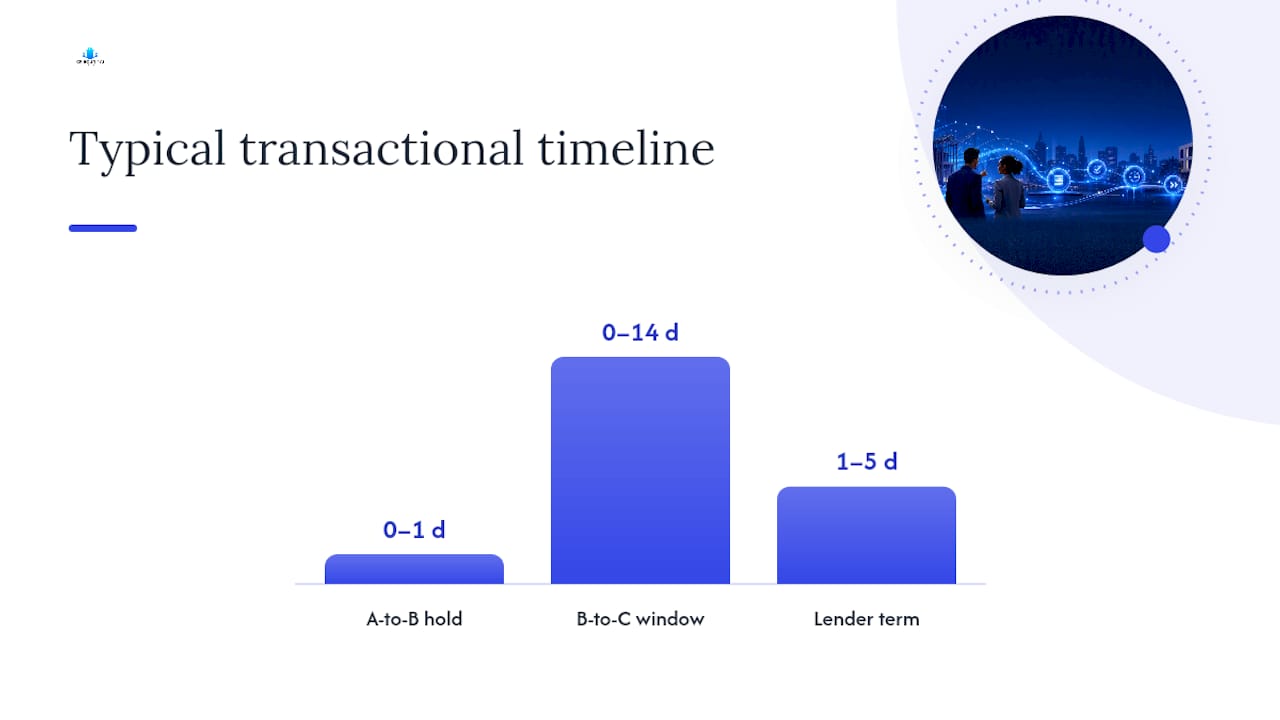
The mechanics run in a fixed sequence. The wholesaler locates a motivated seller and signs a purchase contract (the “A-to-B” leg). Before that closing, the wholesaler lines up an end buyer under a second contract (the “B-to-C” leg). A transactional lender funds the A-to-B purchase, the wholesaler briefly holds title, and the B-to-C sale closes right after, often the same day. Transactional funding lets the purchaser close and resell almost immediately, with the lender repaid straight out of resale proceeds.
The process depends heavily on the title company. Not every title company will handle back-to-back closings, and some refuse simultaneous closings altogether because of insurance and recording concerns. Some title companies won’t facilitate same-day double closings, so confirming that capability before you sign anything saves a deal from collapsing at the closing table.
A typical transactional funding timeline looks like this:
- Day 0: Wholesaler and lender finalize terms; funds are wired to escrow for the A-to-B closing.
- Day 0 to Day 1: A-to-B closing records; wholesaler briefly holds legal title.
- Same day to Day 14: B-to-C closing occurs, end buyer’s funds pay off the transactional loan.
Some specialty lenders fund in hours and structure loan terms of one to five days specifically for double closings, which keeps holding costs minimal when everything stays on schedule.
What Transactional Funding Actually Costs
Transactional funding is usually priced as a flat, one-time charge rather than a traditional interest rate. A typical structure includes:
- A one-time origination or transaction fee, often with a set minimum regardless of loan size
- Daily holding fees that kick in if the B-to-C closing slips past the agreed window
- Title, recording, and escrow fees, which the borrower usually covers out-of-pocket
Fees are commonly charged as a flat origination amount plus per-day holding charges if the closing runs long, which rewards tight scheduling and punishes delay.
Statistic Callout: Because the loan might last only 24 to 48 hours, a flat fee that looks reasonable in dollar terms can translate to a high annualized rate. That math scares people unfamiliar with the product, but such fees are often small relative to typical wholesale profits.
Full financing rarely covers every line item, so build a cash cushion before you rely on the loan to fund the entire deal.
Lender Requirements and the Documents You Need Ready
Transactional lenders underwrite the deal structure, not your credit score, but they still want a tight document package before they wire funds. Have these ready before you call a lender:
- Signed A-to-B purchase contract with the seller
- Signed B-to-C sale contract with the end buyer
- Proof of funds or a financing pre-approval letter from the end buyer
- Preliminary title report showing a clear or clearable title
- Confirmation from the title company that it can handle sequential or simultaneous closings
- Government ID, escrow instructions, and any lender-specific intake forms
Lenders commonly require the signed A-to-B and B-to-C contracts, plus documented proof the end buyer can actually fund the purchase, before they’ll approve the loan. A proof of funds letter from the end buyer’s lender is the single most common stumbling block wholesalers hit.
Pro Tip: Request the end buyer’s proof of funds the moment you sign the B-to-C contract, not the week of closing. A stalled POF is the most common reason a transactional funding request gets delayed.
Transactional Funding vs. Assignment vs. Hard Money
Choosing the right exit strategy comes down to three fast questions.
- Can the contract be assigned? If the seller’s contract allows assignment and you don’t need to conceal the purchase price from the end buyer, assignment is almost always cheaper. There’s no loan, no lender, no closing-cost duplication.
- Does the end buyer need you to hold title first? Some end buyers, particularly those using their own institutional financing, require the wholesaler to hold title before resale. That forces a double closing, which means transactional funding rather than assignment.
- How long will you hold the property? If the plan involves repairs, permitting, or a longer resale timeline, hard money or a bridge loan fits better than a same-day transactional product built for a one- or two-day hold.
Transactional funding earns its cost specifically when assignment is off the table and the timeline is measured in hours, not weeks.
The Real Risk in Transactional Funding: A Failed B-to-C Closing
The single biggest danger in any double closing is the end buyer’s financing falling apart after the A-to-B closing has already recorded. If that happens, the wholesaler is the legal owner of the property and is on the hook for it. A collapsed B-to-C closing can leave the wholesaler owning the property outright, with immediate obligations for the transactional loan, title insurance, and carrying costs.
Mitigate the risk this way:
- Vet the end buyer’s financing before signing the B-to-C contract, not after
- Pre-clear title issues through a full title search, not just a quick lien check
- Line up a hard-money or business lending fallback in case the resale falls through
- Schedule both closings for the same day whenever the title company allows it
Pro Tip: If your end buyer is using traditional mortgage financing rather than cash or private funds, build in a fallback plan before you close the A-to-B leg. Mortgage underwriting can collapse in the final 48 hours for reasons that have nothing to do with the property.
Step-by-Step: Securing Transactional Funding for a Double Closing
- Lock both contracts first. Get the A-to-B purchase contract and the B-to-C sale contract fully signed before approaching a lender.
- Collect the end buyer’s proof of funds or financing pre-approval and attach it to your submission package.
- Confirm the title company can handle sequential closings. Call ahead; not every office will process a same-day double closing.
- Submit the full deal package to the lender, including both contracts, the title report, and clear timing expectations for both closings.
- Coordinate closing appointments so the A-to-B closing records first, funds disburse, and the B-to-C proceeds repay the lender the same day or shortly after.
Following this order in sequence, rather than improvising once a lender is already engaged, is what separates a smooth double closing from a scramble against the clock.
A Direct Lender’s View: What Speeds Up Transactional Deals
Deal speed depends on how the lender underwrites, not just how fast paperwork moves. Some direct lenders underwrite the asset and the deal itself, using a soft credit pull and published advance-rate grids rather than income documentation, which can enable quicker decisions once the contract package and end-buyer proof of funds arrive complete.
The deals that move fastest are the ones where the title company, the contracts, and the end buyer’s funding are all confirmed before the lender ever sees the file. Underwriting the property and the structure, not the borrower’s tax returns, is what makes same-day turnarounds possible.
Choose an in-house capital lender over a brokered arrangement when timing is tight and you need a direct answer, not a forwarded application.
What Actually Separates a Clean Double Closing From a Disaster
Three rules hold up across every transactional deal I’ve studied: vet the end buyer’s funding before you sign anything final, confirm your title company actually handles back-to-back closings, and never enter a double closing without a fallback source of capital. Skip any one of those and you’re gambling with someone else’s money, not just your commission.
Call an in-house direct lender when timing is measured in hours and your contract can’t be assigned. Everything else is discipline: keep the paperwork clean, keep the schedule tight, and keep a backup plan in your pocket.
— Robert
Get Fast, Asset-Based Funding for Your Next Double Closing
When a contract can’t be assigned and the clock is running, some direct lenders fund deals with their own capital and publish advance-rate grids up front, so you can know terms before applying, rather than after.
That matters most in exactly the scenarios covered above: non-assignable contracts, urgent B-to-C closings, or situations where you need in-house capital instead of a broker relaying your file to someone else. Some direct lenders underwrite the asset and the deal, use a soft credit pull, and may require no income verification on many real estate programs, with decisions potentially in as little as four hours. If your next deal needs a same-day close or you want a proof-of-funds letter ready before you approach an end buyer, submit your deal directly and get a clear answer instead of a waiting list.
Sources
For deeper mechanics on double closings and lender documentation standards, review the transactional funding guide from Dealrun, the detailed breakdown from RealEstateSkills, and the risk-focused explainer from FortuneBuilders. For document preparation, see how to prepare for fast real estate funding approval.
- Transactional funding guide | Dealrun
- What Is Transactional Funding? The (ULTIMATE) Guide – 2025 | RealEstateSkills
- What Is Transactional Funding? Definition & FAQs | FortuneBuilders
- Transactional funding – Yieldi
FAQ
What Is Transactional Funding?
Transactional funding is a short-term loan, often lasting one day to two weeks, that lets an investor close on a property and resell it immediately, repaying the loan from the resale proceeds.
How Much Does Transactional Funding Cost?
Costs are usually a flat one-time origination fee plus daily holding charges if the closing runs long; borrowers typically also cover title and closing costs separately.
What Are the Three Types of Funding Used in Double Closings?
Investors generally choose between transactional funding, assignment of contract, and hard-money loans, selecting based on whether the contract is assignable, how long the hold will last, and whether the purchase price must stay hidden from the end buyer.
What Proof of Funds Do Transactional Lenders Require?
Lenders want documented proof that the end buyer can fund the B-to-C purchase, usually a bank statement, a lender pre-approval letter, or a formal proof of funds letter, submitted alongside both signed contracts.