AI underwriting uses machine learning and automation to ingest applicant data, score risk, and route decisions with minimal manual handling. It speeds up processing, expands underwriter capacity, and improves consistency across large volumes of submissions. None of that works without governance: audit trails, model versioning, and a human reviewer who can override the system remain non-negotiable for regulated risk decisions.
TL;DR:
- AI underwriting can reduce processing times by up to 97% and increase underwriter productivity by around 30 percent, especially in life insurance.
- Deployment timelines vary from two to six months depending on data readiness and architecture choice, with hybrid systems delivering 60 to 75 percent straight-through processing rates.
- Governance controls such as audit trails, model versioning, and documented human overrides are essential to meet regulatory requirements and ensure explainability.
- Risks include bias, data gaps, and model drift, which require ongoing fairness testing, provenance tracking, and scheduled model reviews to mitigate.
- Most carriers should treat AI as core infrastructure, investing equally in governance and change management to support scalable, trustworthy underwriting.
Table of Contents
- How AI Underwriting Works: The Pipeline and Core Use Cases
- What the Numbers Say: Measured Benefits and Impact Metrics
- Choosing an Architecture: From AUS to Agentic Systems
- Governance, Explainability, and the Regulatory Checklist
- Deployment Checklist: Data, Teams, KPIs, and Adoption
- Bias, Data Gaps, and Model Drift: What Can Go Wrong
- How CR Equity Ai Inc Applies AI Underwriting to Real Estate Lending
- Priorities for Underwriting Leaders
- Ready to Submit a Deal? What to Expect Next
- Sources
- FAQ
How AI Underwriting Works: The Pipeline and Core Use Cases
Every AI underwriting system follows a similar sequence: data ingestion, validation, enrichment, risk scoring, and a route decision. Raw application data gets pulled from forms, third-party databases, or connected APIs. Validation checks flag missing or contradictory fields before enrichment layers add context, such as property records, credit history, or claims data. A scoring model then assigns a risk tier, and the system routes the file, either to straight-through approval or to a human underwriter for review.
That pipeline supports several distinct use cases:
- Data prefill: automatically populating application fields from verified sources, cutting manual entry time.
- Triage and straight-through processing (STP): routing low-risk, well-documented files for automated approval.
- Risk scoring: producing a quantitative score that ranks applicants by expected loss or default probability.
- Fraud detection: flagging anomalies in documentation, identity data, or submission patterns.
- Virtual inspections: tools like LexisNexis Flyreel generate property condition reports without a physical site visit, expanding inspection coverage.
System architectures range from traditional automated underwriting systems (AUS) to business rules management system (BRMS) hybrids and newer AI-native platforms, a distinction covered in detail below.
What the Numbers Say: Measured Benefits and Impact Metrics
The productivity case for AI underwriting is no longer theoretical. Reported processing-time reductions run as high as 50% to 97%, depending on line of business and file complexity, with underwriters producing roughly 30% more gross written premium (GWP) per person once automation absorbs routine tasks.
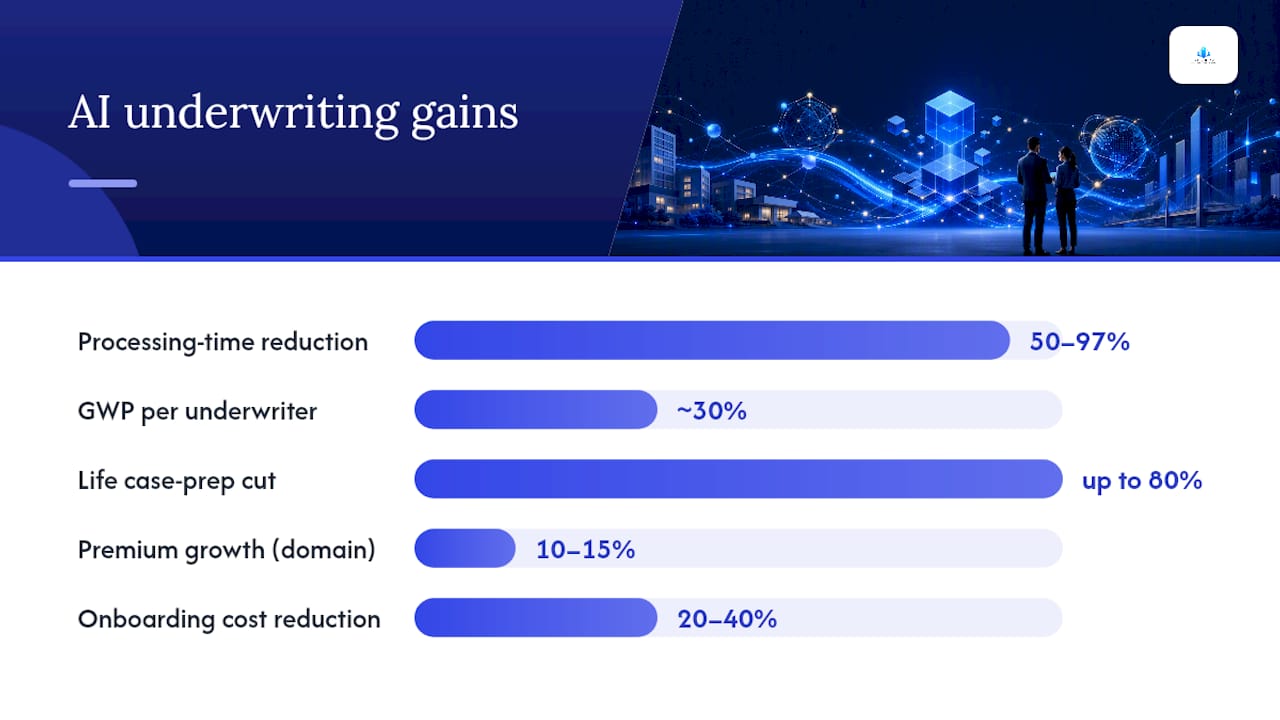
Statistic Callout: In life underwriting specifically, agentic AI handling validation work has cut case prep time by up to 80%, freeing underwriters to focus on complex or borderline files instead of data assembly.
Beyond raw speed, domain-level transformation, treating AI as core infrastructure rather than a bolt-on tool, has produced broader business gains: 10% to 15% premium growth and 20% to 40% lower onboarding costs in carriers that rewired entire domains around AI rather than automating single tasks.
To turn vendor benchmarks into internal targets, track these four figures before and after deployment:
- STP rate (percentage of files requiring zero human touch)
- Average time-to-decision
- GWP per underwriter
- Override rate on automated decisions
Choosing an Architecture: From AUS to Agentic Systems
Carriers generally choose among four implementation paths, each with different risk, cost, and speed trade-offs.
- Traditional AUS. Rule-based automated underwriting systems apply fixed logic trees. They are predictable and easy to audit but slow to update as risk appetite shifts.
- BRMS-powered hybrid. Machine learning models sit inside editable rule tables, combining predictive power with the auditability regulators expect. This approach delivers 60% to 75% straight-through processing rates in mature personal-lines deployments while keeping decision logic reviewable.
- AI-native platforms. Built around continuous learning models rather than static rules, these systems adapt faster but demand heavier monitoring infrastructure.
- Agentic assistants. Generative and agentic AI layers add contextual intelligence for unstructured inputs, adjuster notes, images, scanned documents, and support natural-language queries against underwriting evidence, per Deloitte’s analysis of generative AI in underwriting.
Integration typically touches the policy administration system (PAS), origination channels, and any third-party data feeds. Full rollouts for hybrid architectures commonly take two to six months depending on data readiness. How AI underwriting works in commercial real estate breaks down how this maps to asset-based lending specifically.
Governance, Explainability, and the Regulatory Checklist
Regulators and auditors expect underwriting decisions, automated or not, to be traceable. That means every automated decision needs a stored record of its inputs, the model version that produced it, the confidence score attached, and any human override with a documented reason, a pattern that satisfies examiner requests quickly without a manual reconstruction effort.
Baseline governance controls should include:
- Full audit trails tied to each decision, not just aggregate reporting
- Model version control with rollback capability
- Confidence scores attached to every automated output
- Logged human override reasons for regulatory review
The NAIC’s model bulletin on AI use and state-level insurance departments increasingly expect carriers to demonstrate explainability, not just accuracy, when a model influences a coverage or pricing decision.
Pro Tip: Build override logging into the workflow from day one rather than retrofitting it. Underwriters who can’t easily explain why they overrode a model score will avoid using the override function, which quietly erodes the audit trail you need most.
Deployment Checklist: Data, Teams, KPIs, and Adoption
A successful rollout depends less on model sophistication than on preparation. Work through these steps in order before go-live:
- Audit data readiness. Map every data source feeding the model and verify provenance. Gaps here surface later as bias or accuracy problems.
- Assign clear roles. Underwriters, data scientists, and compliance staff each need defined responsibilities for monitoring and override authority.
- Budget for change management. Training time and workflow redesign deserve as much planning attention as the technology itself.
- Set target KPIs before launch, not after: STP rate, time-to-decision, GWP per underwriter, and override rate.
- Run a parallel period. Compare automated decisions against manual ones for several weeks before fully trusting the system.
Pro Tip: Track override rate by underwriter, not just in aggregate. A spike from one person often signals a model gap; a spike across the whole team usually signals a genuine model flaw.
Machine learning in lending covers the operational controls CRE lenders specifically need around monitoring once a model goes live.
Bias, Data Gaps, and Model Drift: What Can Go Wrong
Every AI underwriting deployment carries three recurring risks, and each has a practical fix.
- Bias and disparate impact. Run regular fairness testing across protected classes and monitor outcome distributions, not just model accuracy, since a model can be accurate and still produce disparate impact.
- Data quality and provenance gaps. Trace every input feature back to its source; synthetic data used to fill gaps can quietly encode the same bias it was meant to avoid.
- Model drift and vendor lock-in. Schedule recurring model reviews and retain the contractual right to audit or replace a vendor’s model, since an unmonitored model degrades as real-world risk patterns shift.
Explainable-AI techniques that visually show why a model reached a conclusion have measurably increased underwriter trust and reduced rework in PwC’s auto insurance case work, a reminder that transparency tools pay for themselves in adoption speed alone.
How CR Equity Ai Inc Applies AI Underwriting to Real Estate Lending
CR Equity Ai Inc underwrites the asset and the deal, not just the borrower’s paperwork. That distinction matters for real estate investors who don’t fit conventional income-verification models: most real estate programs use a soft credit pull with no income verification, and decisions can come back in as little as four hours.
This works the same way domain-focused AI underwriting works elsewhere in financial services: automation shortens data prep and prefill, while judgment on the deal itself stays with the underwriting team.
- Soft credit pull instead of a hard inquiry on most real estate programs
- Decisions in as little as four hours on qualifying files
- Transparent advance-rate information provided before application
- Support for ITIN and foreign national investors alongside US borrowers
Providing advance-rate information before application removes the guesswork brokers and sponsors usually face when comparing lenders, and it gives every submitted deal a transparent, checkable benchmark from the first conversation.
How CR Equity AI is transforming archaic lending processes walks through this workflow in more detail.
Priorities for Underwriting Leaders
The mistake most carriers make is treating AI underwriting as a series of pilots rather than infrastructure. Domain-based rewiring, not isolated automation projects, produces the premium growth and cost reduction that justify the investment. Adoption spend deserves the same budget line as development spend; a model nobody trusts to override correctly is a model that quietly gets ignored. Build modular components and governance controls before scale, not after.
*— Robert
Ready to Submit a Deal? What to Expect Next
CR Equity Ai Inc gives real estate investors and business owners a faster path than a traditional bank underwriting cycle and evaluates the deal on the asset, not just tax returns or income documentation.
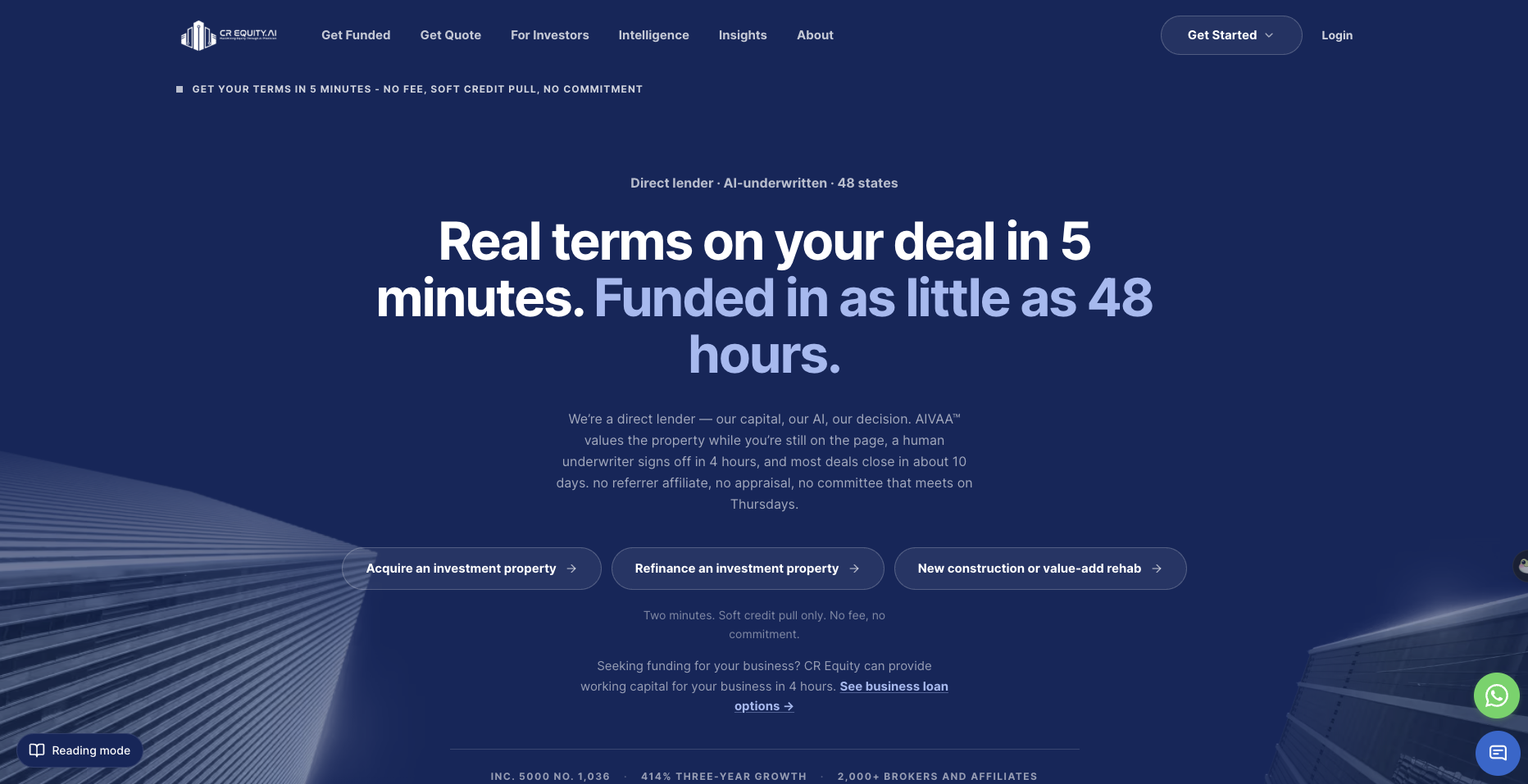
When you submit a deal, expect a soft credit pull, no income verification on many real estate programs, and a decision timeline measured in hours rather than weeks, along with various financing options including emergency bridge financing, construction loans, and small balance commercial loans in a wide range of amounts. If you’re a broker or sponsor ready to move, submit a deal and get a transparent read on structure and pricing before you commit to anything.
This article is general information, not a substitute for advice from a qualified financial advisor. Consult a qualified financial professional about your own circumstances before acting on anything here.
Sources
- Markel’s underwriting productivity skyrockets with AI
- The future of AI for the insurance industry | McKinsey
- Automated underwriting system for lenders — Higson
FAQ
What Is the “30% Rule” in AI?
There’s no single established “30% rule” specific to AI underwriting; if you’ve seen it referenced, it likely traces to a specific vendor’s benchmark rather than an industry standard, so treat any such figure with context rather than as a fixed rule.
What Are the Three Main Types of Underwriting?
Underwriting generally falls into manual underwriting (a human reviews the full file), automated underwriting (a rules engine or model makes the decision), and hybrid underwriting, where AI scores and routes files but a human reviews flagged or borderline cases.
Can AI Be Used to Underwrite Real Estate Deals?
Yes. AI underwriting in real estate lending can score property and deal data, prefill application fields, and flag risk factors, which is how CR Equity Ai Inc evaluates the asset and the deal itself rather than relying solely on borrower income documentation.
What Does the Highest-Paid Underwriting Work Typically Involve?
The highest-compensated underwriting roles tend to sit in commercial and specialty lines, such as complex commercial real estate or large-balance business lending, where deal structuring expertise and risk judgment carry more weight than volume processing.
Does AI Underwriting Replace Human Underwriters?
No. AI underwriting handles data validation, scoring, and routing at scale, but human-in-the-loop review, audit trails, and override authority remain required for regulated risk decisions, particularly on complex or borderline files.