Tokenized Debt: Solving CRE’s Oldest Liquidity Problem
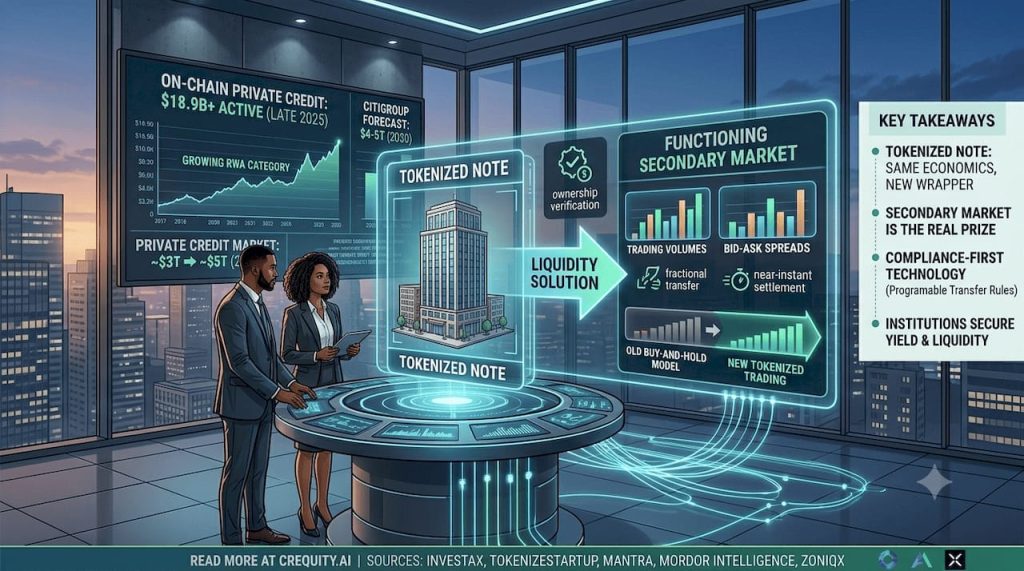
Tokenization is revolutionizing commercial real estate (CRE) debt, transforming one of finance’s most illiquid asset classes into a dynamic market. With over $18.9 billion in active on-chain private credit, the shift towards tokenized notes is not just a trend—it’s a game changer. Imagine a world where ownership is easily verified, divided, and transferred, unlocking liquidity and enabling price discovery. As institutional investors seek yield without sacrificing liquidity, the demand for compliant, tokenized debt is surging. Discover how this innovative approach is reshaping the landscape of private credit and what it means for the future of investment.
Federal Credit Retreats: The Opening for Private Capital in CRE

Federal lending eligibility is undergoing significant change. Recent SBA citizenship rules are already in effect, while proposed federal legislation could further restrict access to government-backed mortgage financing. Together, these policy shifts are reshaping how many commercial real estate investors and small-business owners access capital. This article examines what has changed, why multifamily and hospitality sectors are particularly affected, and how private lenders are positioned to fill the financing gap. It also explores how Crequity.ai’s AI-powered underwriting platform, AIVAA™, enables faster valuation, institutional-grade risk analysis, and rapid lending decisions for borrowers seeking alternatives to traditional government-backed programs.
AI-Driven CRE Valuation: MAI-Grade Analysis in Minutes
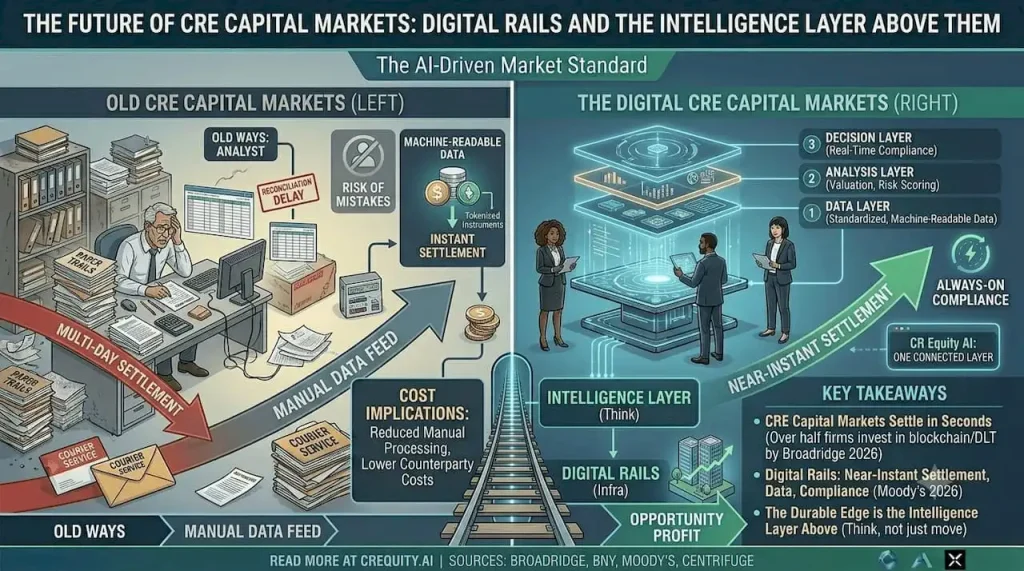
A traditional commercial appraisal is a slow, expensive necessity. Industry pricing guides put a typical commercial appraisal at roughly $2,000 to $6,000, with turnaround commonly running two to six weeks depending on complexity and data availability. For a single asset that is an inconvenience. Across a pipeline, it is a structural drag on how fast […]
One Intelligence Layer: Unifying CRE Valuation, Compliance & Capital
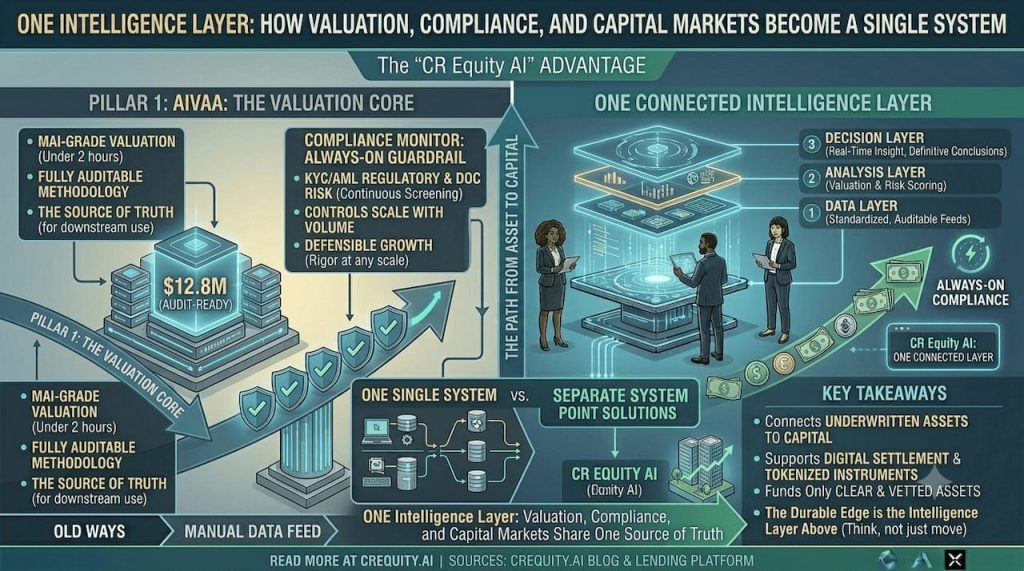
Over the past several articles, we have examined the forces remaking commercial real estate finance one at a time: real-time stablecoin settlement, cross-border capital flows, digital due diligence, AI valuation, tokenized debt, private credit, distress cycles, and the modernization of capital-markets infrastructure. Each is significant on its own. But the real advantage is not any […]
$10M Preferred Equity Opportunity in Real Estate Lending
A senior-secured $10M preferred equity allocation for accredited investors — 8–10% target IRR, 3–5 year term, backed
by $2.6B+ in vetted transactions.
AIVAA: Closing the Mortgage Speed-to-Funding Gap in 2026
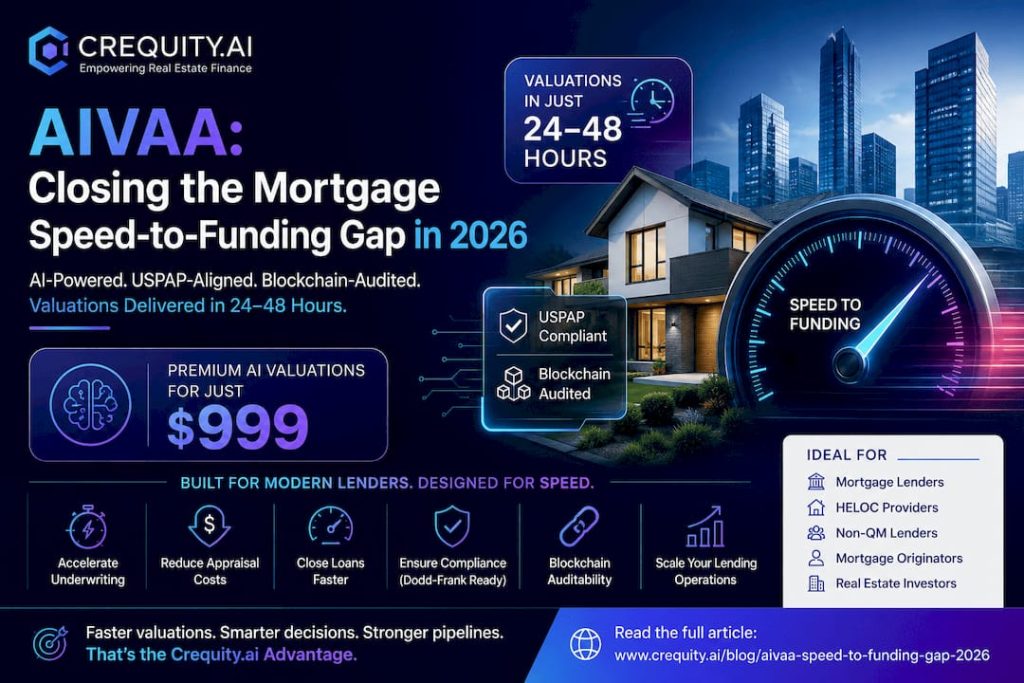
AIVAA delivers USPAP-aligned, blockchain-audited property valuations in 24–48 hours for $999 — closing the speed-to-funding gap in modern mortgage lending.
Cross-Border CRE Financing: How Automation Moves Global Capital
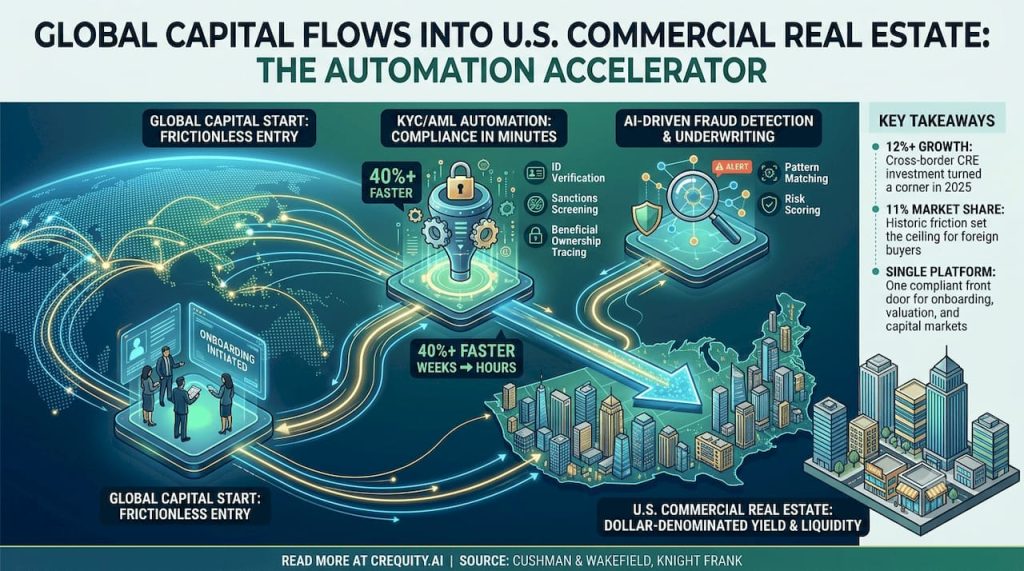
Foreign capital has always wanted a seat at the U.S. commercial real estate table. The appetite was never the constraint. What held it back was friction — unfamiliar rules, slow onboarding, and the difficulty of underwriting an asset from the other side of the world. That friction is now being dismantled by automation, and the […]
AIVAA vs. MAI Appraisal: AI Collateral Valuation at $999 in 24h
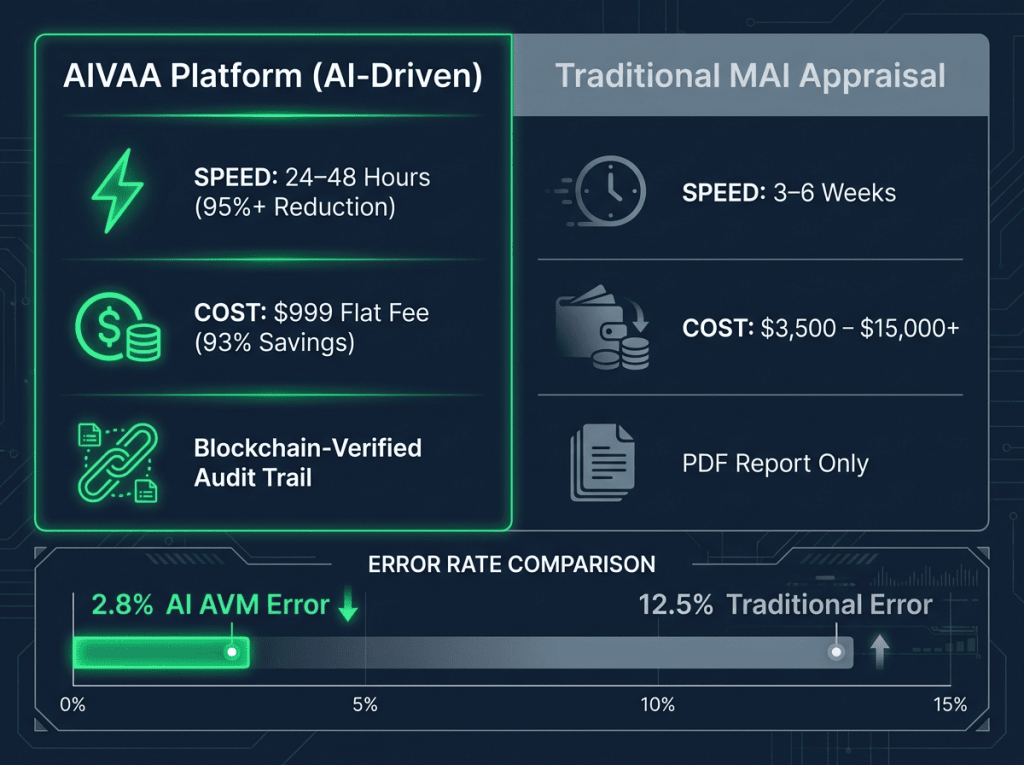
Comparative analysis of AIVAA vs. traditional MAI appraisals — 24–48 hr delivery, $999 flat fee, 2.8% AI median error, full Dodd-Frank AVM Rule and USPAP AO-41 compliance.
Private Credit Tokenization in 2026: The $3.2 Trillion Shift

Institutional Briefing · 2026 Private Credit Tokenization in 2026: Impact, Infrastructure, and the AI Underwriting Layer An institutional briefing from CR Equity AI · Updated 2026 Private credit tokenization moved from pilot to infrastructure in 2026. Tokenized private credit is now the largest real-world-asset (RWA) segment after Treasuries, the biggest balance sheets on Wall Street […]
The Agentic AI Revolution in Real Estate Brokerage

Agentic AI is restructuring real estate brokerage at the deepest level in a century — compressing 2-to-4-week MAI
appraisals into 2 hours, replacing 30-to-90-day underwriting with 4-hour loan decisions, and putting the 5.44%
commission standard under siege. Inside: a complete 12-month, 3-year, and 5-year forecast for agents, brokerages, and
CRE professionals.