Hard Money Lenders: How They Work and How CR Equity AI Compares
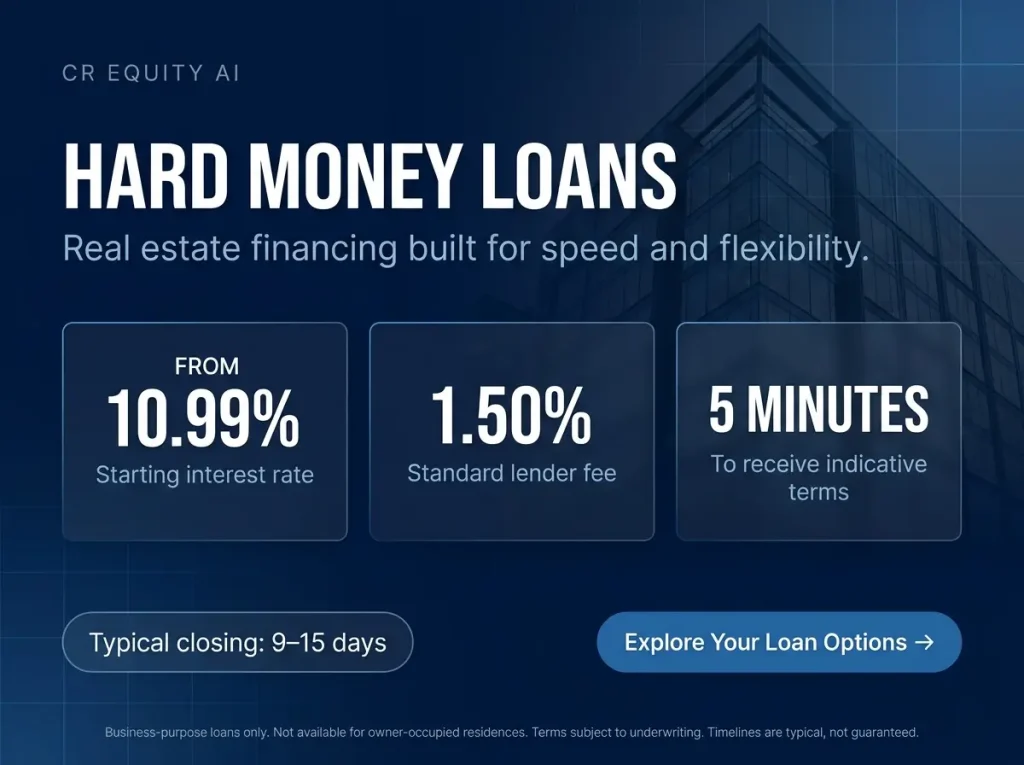
Hard money lenders make short-term real estate loans based mainly on property value, usually interest-only for 6–24 months with a balloon at maturity. This guide covers what hard money really costs, when it’s the right tool, and how CR Equity AI compares as a direct lender: rates from 10.99%, terms in about 5 minutes on a soft pull, and a typical close in 9–15 days.
Fix and Flip Loans: The 70% Rule, Loan-to-Cost and How CR Equity AI Funds Rehabs
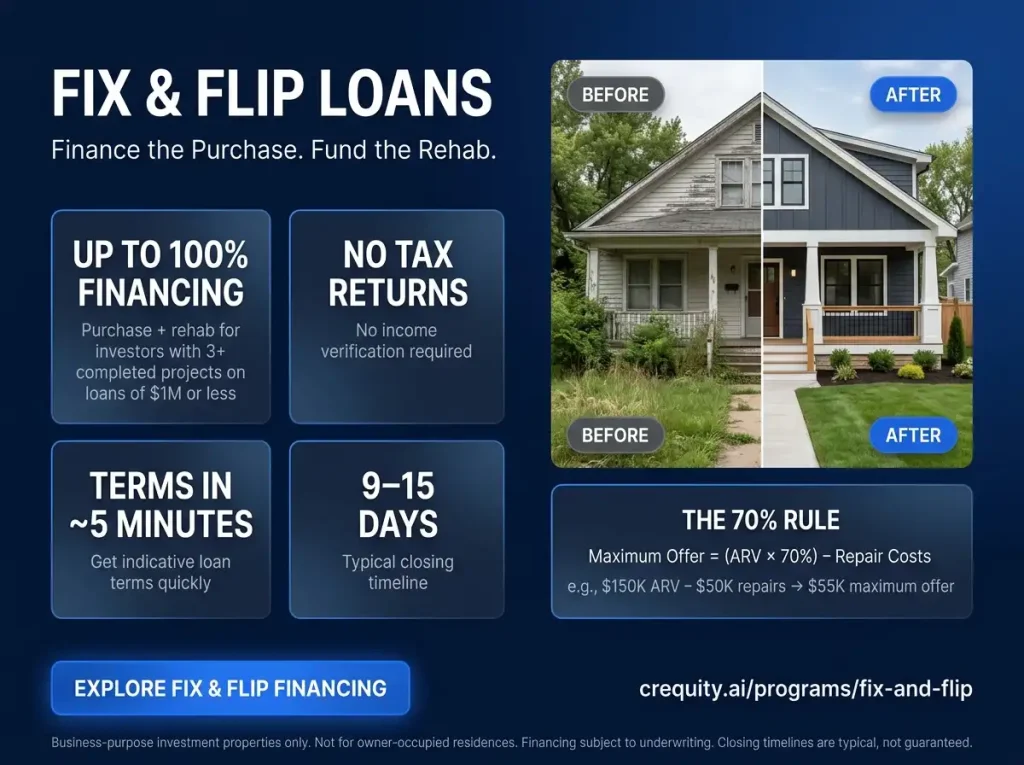
The 70% rule caps your offer at 70% of after-repair value minus repair costs, and the remaining 30% has to cover commissions, closing costs and lender fees, not just profit. Learn how fix and flip loans use loan-to-cost and ARV, see CR Equity AI’s leverage grid by experience and credit score, and find out how first-time flippers qualify with no tax returns.
What Is a DSCR Loan? Formula, Requirements and Examples

The debt service coverage ratio (DSCR) is net operating income divided by annual debt service, and a DSCR loan uses it to qualify investors on the property’s income instead of personal income. See the formula, a worked 1.45x example, ways to improve coverage, and CR Equity AI’s DSCR terms: 1.00x floor, no tax returns, and a typical close in 9–15 days.
Commercial Real Estate Loans: Types, Requirements and How CR Equity AI Lends

Most commercial real estate loans run 65%–80% LTV with a DSCR of 1.20–1.50 and 25–30 year amortization on a 5–10 year term. Here’s how the main loan types compare, what lenders require, and how CR Equity AI funds small balance commercial, bridge and DSCR loans with a decision in about 4 hours.
Direct Lender vs. Broker: Which One Actually Closes Faster?

Direct lender vs. broker: understand how underwriting, handoffs, fees, and funding structure affect closing speed on business-purpose real estate deals.