The six primary alternative lending categories for asset-backed, nonbank financing are bridge loans, fix-and-flip loans, ground-up construction loans, DSCR (Debt Service Coverage Ratio) cash-out refinance, small-balance commercial loans, and asset-based business loans. Asset-backed private credit focuses on collateral and deal economics rather than borrower income, making these products the right tool for transitional, non-stabilized, or time-sensitive deals that fall outside conventional bank guidelines.
Match your deal to the right product:
- Acquisition before rehab: Fix-and-flip or bridge loan, underwritten to after-repair value (ARV)
- Ground-up construction: Construction loan with milestone draws, sized to loan-to-cost (LTC)
- Portfolio scaling or buy-and-hold: DSCR loan, qualified on rent income rather than tax returns
- Short-term liquidity or emergency capital: Emergency bridge financing, funded in 24–48 hours
- Small commercial acquisition or refinance: Small-balance commercial loan, up to 80% LTV
- Business capital without real property: Asset-based business loan, up to $10M
Immediate next steps:
- Identify your deal type and confirm which metric governs sizing (LTV, LTC, or LTARV)
- Pull the lender’s published advance-rate grid before submitting any documents
- Prepare a written stabilization or exit plan — lenders price risk against it
Key Takeaways
Asset-backed private credit is the right financing tool when deal speed, asset condition, or borrower profile falls outside conventional bank guidelines.
| Point | Details |
|---|---|
| Match product to deal type | Use LTV for stabilized assets, LTC for construction, and LTARV for fix-and-flip underwriting. |
| Verify the capital source | Direct lenders control timing and terms; brokers add a layer that can delay or reprice your deal. |
| Prepare before you apply | A complete doc package — contract, scope, rent roll, entity docs — compresses funding timelines materially. |
| Model conservative DSCR | Permanent programs typically require 1.20–1.40 DSCR; underwrite to that floor before you close a bridge. |
| CR Equity Ai Inc | Offers published advance-rate grids, decisions in as little as 4 hours, and direct capital across six program types. |
Table of Contents
- What are the main alternative lending options clients should compare?
- How do asset-backed alternative lenders actually underwrite deals?
- What does private credit pricing actually look like?
- Which loan type fits your specific deal scenario?
- How do you evaluate and choose an alternative lender?
- What documents do you need, and how long does funding take?
- What are the primary risks of asset-backed alternative lending?
- Private lending fills a gap that banks were never designed to cover
- CR Equity Ai Inc: direct lending with published terms and fast decisions
- Sources
- FAQ
What are the main alternative lending options clients should compare?
The table below covers each loan type by primary use, typical term, and illustrative leverage band. These are market-representative ranges, not program-specific quotes.
| Loan Type | Primary Use | Typical Term | Illustrative Advance Rate / LTV Band | Recourse |
|---|---|---|---|---|
| Bridge Loan | Acquisition or refinance of transitional assets | 12–36 months | Up to 80% LTV | Often non-recourse |
| Fix-and-Flip | Purchase + rehab of residential investment property | 6–18 months | Up to 90% LTC / 70%–75% LTARV | Usually recourse |
| Ground-Up Construction | New construction, milestone draws | 12–24 months | 65%–75% LTC | Recourse or non-recourse |
| DSCR Cash-Out Refinance | Stabilized rental, qualified on rent | 30-year or 5/1–7/1 ARM | Up to 80% LTV | Usually non-recourse |
| Small-Balance Commercial | Multifamily, mixed-use, retail acquisition | 3–10 years | Up to 80% LTV | Varies by lender |
| Asset-Based Business Loan | Working capital, equipment, receivables | 1–5 years | Based on asset or receivable value | Usually recourse |
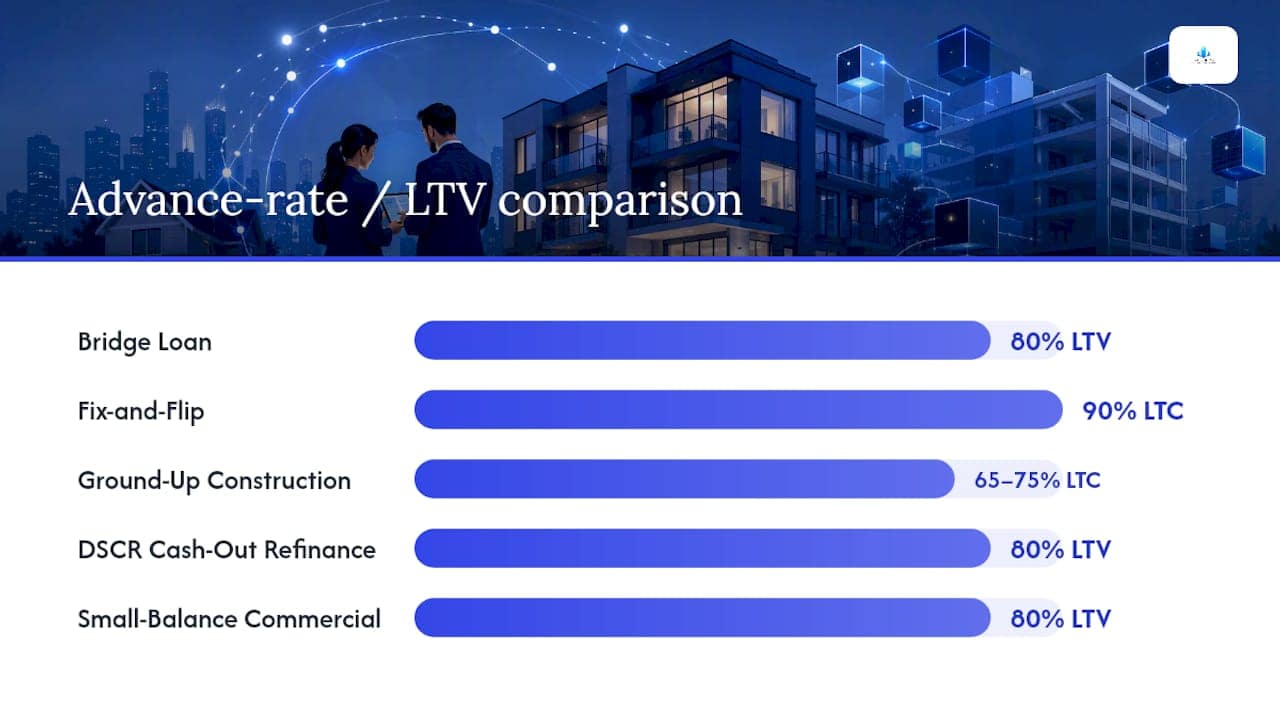
Private credit in CRE has scaled from 7% of market share in 2017 to 14% by H1 2025, with bridge loans commonly structured as 24–36 month, floating-rate facilities.
Pro Tip: An advance-rate band in a generic table is a starting point, not a commitment. Always request the lender’s published program grid — a direct lender publishes exact LTV ceilings, pricing floors, and eligibility criteria before you submit a single document.
Non-recourse terms are most common on bridge and DSCR products. Fix-and-flip and construction loans typically carry personal recourse, though carve-outs for bad acts apply in both structures.
How do asset-backed alternative lenders actually underwrite deals?
Underwriting is asset-and-plan-first. The collateral value and the borrower’s exit strategy carry more weight than W-2 income or tax returns. Asset-based finance loans secured by tangible assets shift financing activity to specialty institutional lenders who evaluate the deal on its own merits.
Primary underwriting lenses:
- LTV / LTC / LTARV: Determines the maximum advance; private lenders size advances differently across products — fix-and-flip emphasizes ARV, construction emphasizes LTC
- DSCR (in-place vs. pro-forma): In-place cash flow for stabilized assets; projected cash flow with a credible stabilization plan for transitional ones
- Borrower track record: Number of completed projects, exit history, and liquidity reserves
- Contractor / GC strength: License, insurance, and prior project completion for construction draws
- Market comps and appraisal: Third-party valuation or desk review to confirm collateral basis
- Title and environmental: Clear title chain and Phase I environmental where required
Process flow from inquiry to funding:
- Soft credit pull and initial deal review (no hard inquiry)
- Preliminary term sheet issued against submitted deal summary
- Third-party appraisal or valuation ordered
- Full underwriting: title, insurance, scope of work, rent roll, or pro-forma review
- Loan documents issued and signed
- Funding wired
Pro Tip: Submit a one-page deal summary with your purchase price, ARV or stabilized value, scope of work cost, and exit plan before the lender asks. Underwriters move faster when the story is already organized.
What does private credit pricing actually look like?
Private credit pricing is higher than bank paper. That premium buys speed, higher leverage, and flexibility on asset condition — three things conventional lenders rarely offer simultaneously.
Pricing levers to understand:
- Index + spread: Bridge loans are commonly priced at a spread over 1-month Term SOFR; DSCR loans may use fixed rates or a Treasury index
- Origination points: Typically 1.5–3 points on fix-and-flip and bridge; lower on stabilized DSCR
- Exit or maturity fees: Some bridge programs charge 0.5–1 point at payoff
- Interest reserve: Lenders may escrow 3–6 months of interest at closing on construction and bridge loans
- Extension fees: 0.25–0.5 point per extension period if the loan does not pay off at maturity
- Prepayment penalties: Step-down or yield-maintenance structures on longer-term DSCR products
Market examples show bridge and fix-and-flip rates often in the 9%–13% range, DSCR rental loans roughly 7%–9%, with origination fees of 1.5–3 points. These are illustrative market ranges, not guarantees.
Pro Tip: Ask lenders whether origination points can be financed into the loan rather than paid at closing. On a high-leverage fix-and-flip, rolling points into the advance preserves working capital for the rehab.
Which loan type fits your specific deal scenario?
The right product depends on asset condition, hold period, and your exit. These decision rules compress the selection process.
Fix-and-flip vs. bridge:
Use a fix-and-flip loan when the property needs material rehab and you plan to sell within 12–18 months. LTARV underwriting lets you borrow against the improved value, not the distressed purchase price. Use a bridge loan when the asset is lightly transitional — occupancy is low but the physical condition is sound — and you need time to stabilize before a permanent takeout.
Heavy rehab vs. light rehab:
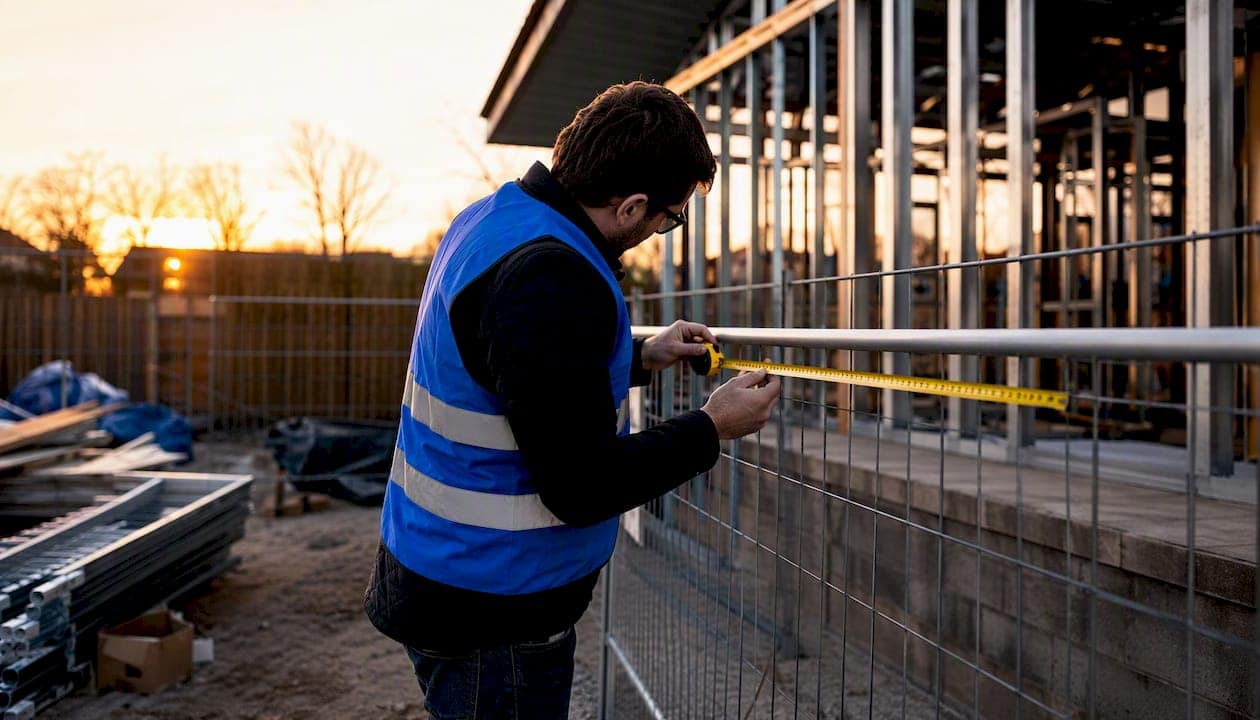
Heavy rehab (gut renovation, structural work) calls for a construction draw schedule tied to LTC. Light rehab with a clear ARV and a short timeline fits a fix-and-flip structure with fewer draw milestones.
Portfolio scaling and rental acquisitions:
DSCR minimums vary by program — bridge lenders often accept in-place DSCR around 1.00–1.10 with a stabilization plan, while permanent programs typically require 1.20–1.40. Once a property stabilizes above 1.20 DSCR, a DSCR cash-out refinance lets you pull equity without income documentation.
Short use-case examples:
- Buy distressed single-family, renovate, sell: fix-and-flip loan, LTARV underwriting
- Acquire vacant multifamily, lease up, refinance: bridge loan into DSCR cash-out refi
- Build new residential units on owned land: ground-up construction loan, milestone draws
- Purchase stabilized retail strip: small-balance commercial loan, up to 80% LTV
- Fund equipment purchase or receivables gap: asset-based business loan, no property required
- Emergency capital against owned real estate: F.L.E.X. 50™ bridge, funded in 24–48 hours
How do you evaluate and choose an alternative lender?
Prioritize published program grids, confirmed capital source, decision speed, and underwriting alignment with your exit plan. A lender who cannot show you their advance-rate grid before you apply is asking you to commit time without information.
Top selection criteria:
- Published LTV/LTC/LTARV grids available before application
- Direct funder vs. broker (direct funders control timing and terms)
- Decision timeline: hours vs. days vs. weeks
- Recourse terms and carve-out structure
- Draw administration process for construction and rehab loans
- Servicing reputation and extension policy
Questions to ask every prospective lender:
- Do you lend your own capital, or do you broker to a third party?
- What is your average time from complete application to term sheet?
- Are your advance-rate grids published, and will you share them now?
- What triggers a covenant default, and what is the cure period?
- What are your extension terms if the project runs long?
Red flags to watch:
- No published program terms — only verbal quotes
- Guaranteed approval language (no legitimate lender guarantees approval)
- Upfront fees before a signed term sheet
- Vague answers about who actually funds the loan
Institutional-grade ABF programs require disciplined underwriting and continuous collateral monitoring — a lender who cannot describe their monitoring process is not operating at that standard.
Pro Tip: Request two or three funded deal references in your asset class. A direct lender with a track record will provide them without hesitation.
What documents do you need, and how long does funding take?
Preparation cuts decision time. Lenders who receive a complete package on day one can issue a term sheet in hours rather than days.
Core documents for most programs:
- Executed purchase contract or refinance summary
- Property address, legal description, and current photos
- Scope of work and itemized rehab budget (fix-and-flip and construction)
- Rent roll and current leases (DSCR and small-balance commercial)
- Entity documents: operating agreement, articles of organization, EIN
- Government-issued ID; ITIN accepted for eligible foreign-national borrowers
- Title commitment or prior title policy
- Contractor license and insurance (construction draws)
Realistic milestone timeline:
- Initial quote: same day to 24 hours with a complete deal summary
- Appraisal or valuation: 3–7 business days depending on asset type
- Underwriting review: 2–5 business days after appraisal
- Loan documents: 1–2 business days after approval
- Funding: same day to 48 hours after signed docs and clear title
Your commercial lending checklist should be assembled before you contact a lender, not after the term sheet arrives.
Pro Tip: Order your title commitment the same day you go under contract. Title delays are the single most common reason a fast-close deal misses its target date.
What are the primary risks of asset-backed alternative lending?
Higher cost and covenant sensitivity are the primary trade-offs for speed and leverage. Asset-based finance carries concentration, liquidity, and legal risks that require thorough due diligence on both the lender and the deal structure.
Key risks:
- Liquidity and roll risk: Short-term loans must be refinanced or sold; a market dislocation can compress exit options
- Covenant triggers: LTV maintenance covenants can require paydown if collateral value drops
- Floating-rate exposure: Bridge loans indexed to Term SOFR move with rate cycles
- Concentrated collateral: A single-asset loan has no diversification buffer if the property underperforms
- Valuation variance: Appraisal disputes can reduce the advance at closing
| Risk | Practical Mitigation |
|---|---|
| Liquidity / roll risk | Model a 6-month extension scenario; confirm extension terms before closing |
| Covenant trigger | Underwrite to conservative LTV with a cushion below the covenant ceiling |
| Floating-rate exposure | Build an interest reserve at closing; model rate stress conservatively |
| Concentrated collateral | Maintain cash reserves equal to 3–6 months of debt service |
| Valuation variance | Order an independent desk review before submitting to the lender’s appraiser |
Private lending fills a gap that banks were never designed to cover
The post-GFC contraction in bank appetite for transitional and construction lending created a structural gap that private credit now fills by design. Banks underwrite to stabilized income and regulatory capital ratios. Private lenders underwrite to the asset and the plan. Those are fundamentally different disciplines, and the distinction matters most when a deal is time-sensitive, asset-condition-challenged, or structured in a way that falls outside the conventional credit box.
The argument that private lending is a last resort misreads the market. For a self-employed investor with strong deal flow but irregular W-2 income, a DSCR loan is not a fallback — it is the correct product. For a developer who needs to close a land acquisition in ten days, a bridge loan is not expensive; it is the only tool that closes in that window. The cost premium is real, but so is the optionality it purchases.
CR Equity Ai Inc: direct lending with published terms and fast decisions
CR Equity Ai Inc lends its own capital across the full deal lifecycle, with decisions in as little as 4 hours and published advance-rate grids available before you apply. That combination — direct capital plus transparent terms — is what separates a genuine lending partner from a broker who reprices at the last minute.
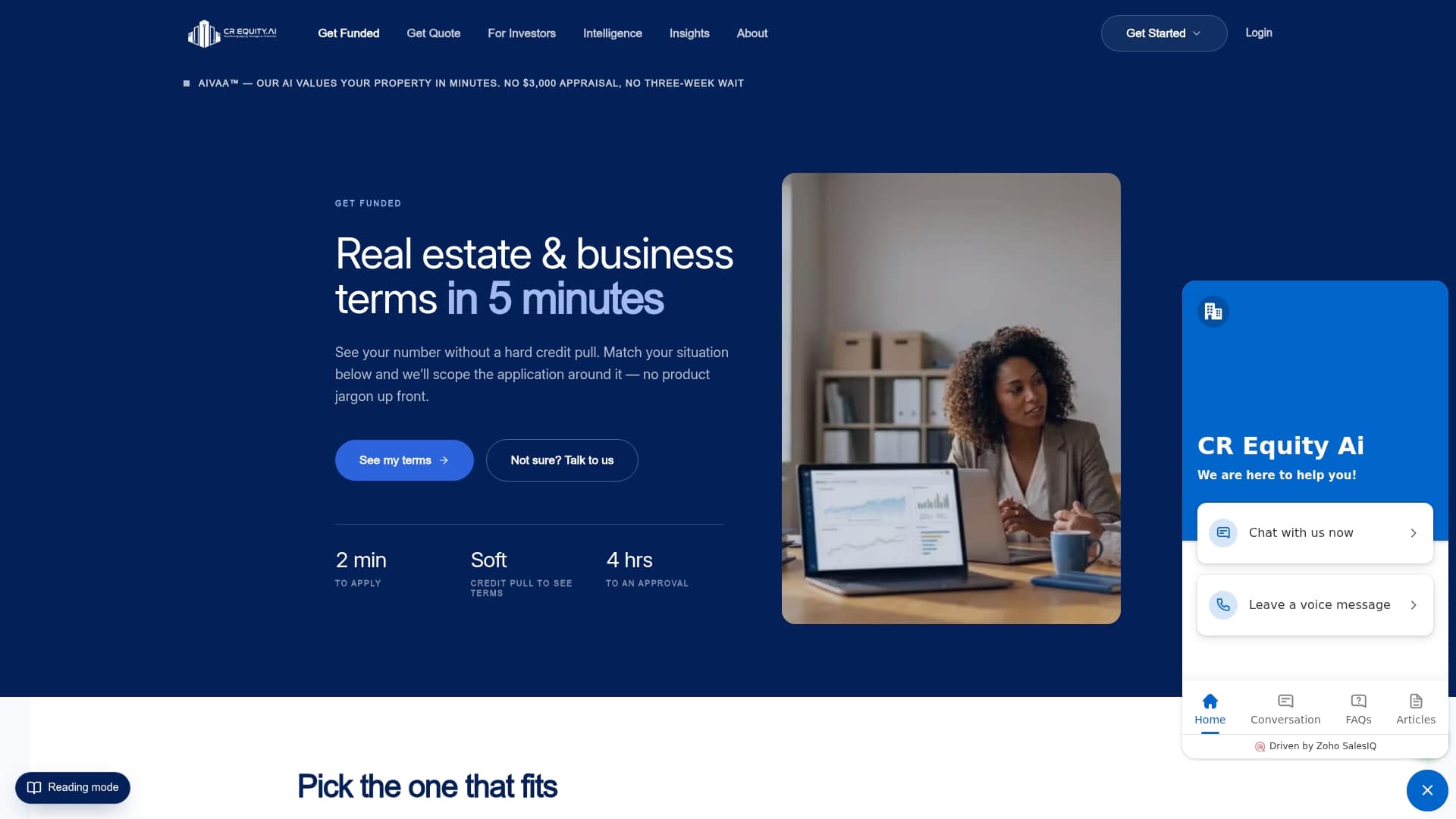
Programs span fix-and-flip financing (up to 100% LTV for qualified sponsors, funded in 24–48 hours), ground-up construction loans with milestone draws on direct capital, DSCR cash-out refinance with no income verification, small-balance commercial lending from $100K to $100M at up to 80% LTV, and business funding up to $10M with no property required. ITIN and foreign-national investors are eligible alongside U.S. borrowers. Run your numbers on the quick-quote calculator to see program eligibility and indicative pricing for your deal.
Sources
- Private credit: Asset-backed finance explained – Janus Henderson Investors – US Advisor
- Understanding asset-based finance – PIMCO
- What Is Private Lending? A Complete Guide for Real Estate Investors | Baseline
This article is general information, not a substitute for advice from a qualified financial advisor. Consult a qualified financial professional about your own circumstances before acting on anything here.
FAQ
What is the difference between a bridge loan and a fix-and-flip loan?
A bridge loan finances transitional assets where the physical condition is sound but occupancy or cash flow is below stabilized levels. A fix-and-flip loan finances the purchase and renovation of a property underwritten to its after-repair value, with draws released against completed work.
Do alternative lenders require income verification?
Most asset-backed real estate programs do not require income verification. DSCR loans qualify on rental income, and bridge and fix-and-flip loans underwrite to collateral value and exit plan rather than borrower tax returns.
How fast can an alternative lender fund a deal?
Decision timelines range from 4 hours to a few business days depending on deal complexity and document completeness. CR Equity Ai Inc issues decisions in as little as 4 hours, with emergency bridge financing funded in 24–48 hours for qualified borrowers.
What DSCR do I need to qualify for a permanent loan?
Permanent programs typically require a DSCR of 1.20–1.40 depending on asset class. Bridge lenders often accept in-place DSCR around 1.00–1.10 when a credible stabilization plan supports a higher projected ratio at takeout.
Can foreign nationals and ITIN borrowers access these programs?
Yes. Several direct private lenders, including CR Equity Ai Inc, explicitly support ITIN and foreign-national investors alongside U.S. borrowers, provided the collateral is domestic and the deal meets standard underwriting criteria.