A capital provider is any individual or institution that supplies financing to a business, project, or asset — acting as the counterparty to whoever needs that capital. The two organizing categories are debt providers, who evaluate credit risk and repayment capacity, and equity providers, who assess growth potential, governance quality, and return upside. Knowing which type you are approaching before you make contact is the single most consequential preparation step you can take.
The immediate action: prepare a two-page teaser and a one-page financial snapshot before any outreach. Those two documents let providers assess fit in under ten minutes and determine whether a full diligence conversation is warranted.
Common provider categories in the U.S. include:
- Commercial and community banks — senior debt, asset-backed lending
- Venture capital and private equity firms — equity and growth capital
- Family offices — flexible mandates, debt or equity, often relationship-driven
- Pension funds and endowments — institutional allocators, typically via funds or direct credit
- Insurance companies — long-duration capital, often private credit or ILS structures
- Alternative capital vehicles — hedge funds, crowdfunding platforms, specialty finance
Pro Tip: Match the provider type to your stage before building your materials. A seed-stage startup and a commercial real estate borrower need entirely different documents, different provider targets, and different pitch framing.
Table of Contents
- What a capital provider is and why the role matters in U.S. finance
- What types of capital providers operate in the U.S.?
- What do capital providers actually look for?
- How are deals structured, and what terms should you expect?
- How to prepare and approach capital providers
- Sector-specific notes for CRE, startups, and insurance capital
- How AI and platform underwriting are changing capital access
- Key Takeaways
- What most entrepreneurs get wrong about capital providers
- How CR Equity Ai Inc shortens the path from application to funded deal
- Useful sources for further reading
What a capital provider is and why the role matters in U.S. finance
A capital provider is any entity that transfers financial resources to an issuer — a business, project, or government body — in exchange for a return, whether that return is interest, dividends, equity appreciation, or a risk premium. The economic function is capital allocation: moving money from parties with surplus capital to parties that can deploy it productively.
In the U.S., that transfer rarely happens directly. Investment banks, fund managers, broker-dealers, and digital lending platforms serve as intermediaries, connecting providers to issuers and pricing the risk in between. The flow looks like this: a pension fund allocates to a private credit fund, the fund underwrites a commercial real estate loan, and the property developer receives proceeds. Each layer adds structure, pricing, and risk management.
“Capital markets lower the cost of funding for enterprises and allow investors to identify appropriate, risk-adjusted deployment opportunities when markets operate efficiently. Efficient capital markets help businesses access growth capital and support job creation and infrastructure investment.” — SIFMA Capital Markets Fact Book
Institutional providers — pension funds, endowments, insurers — typically invest through funds or direct allocations governed by liability-matching constraints and regulatory capital requirements. Private sources — family offices, angel investors, high-net-worth individuals — operate with fewer constraints and often move faster, but their mandates vary widely. One family office may behave like a bank; another may take equity-like risk on early-stage deals. The U.S. capital markets framework, with its disclosure expectations and SEC oversight, shapes how all of these providers document and report their positions.
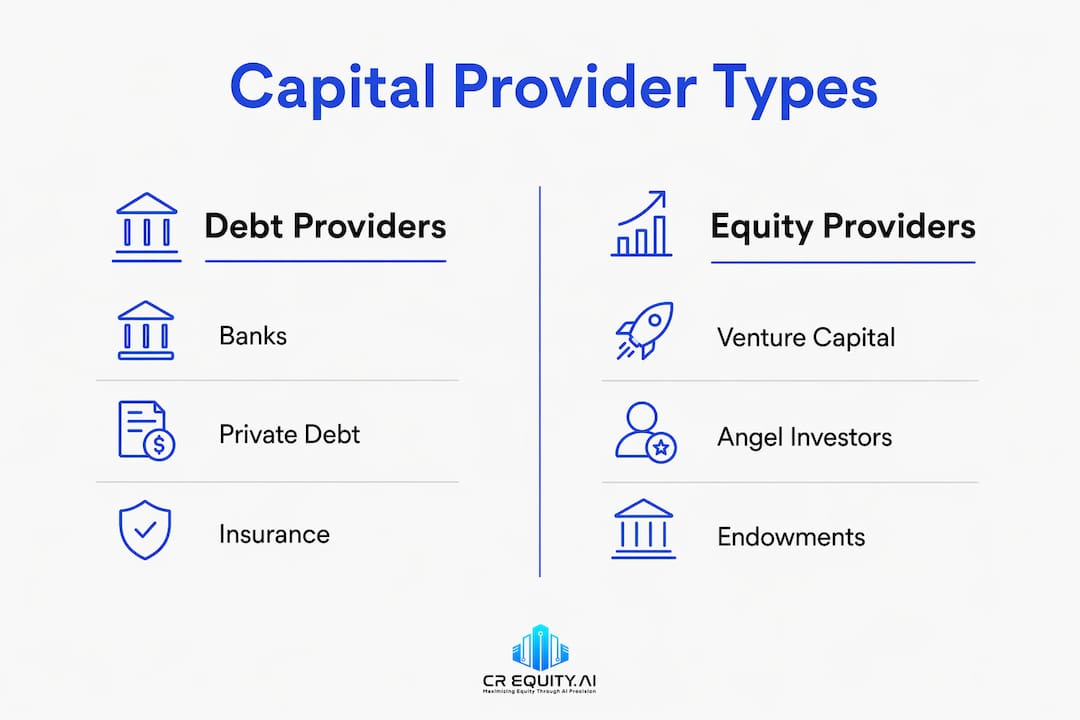
What types of capital providers operate in the U.S.?
Debt and equity are the two organizing categories, and they carry fundamentally different risk and return expectations. Debt providers want predictable cash flows and collateral coverage; equity providers want upside participation and governance rights. Most providers specialize narrowly in one mandate, which is why targeting the right type from the start saves significant time.
Primary provider types and what they are best for:
- Commercial banks — senior secured debt for established businesses with two or more years of operating history and documented cash flow
- Community banks and credit unions — relationship-driven lending for small businesses and local commercial real estate
- Venture capital — equity for high-growth startups that lack access to bank loans, trading higher risk for higher potential returns
- Private equity — equity or buyout capital for mature businesses with EBITDA and a clear exit path
- Family offices — flexible mandates; can provide debt, equity, or hybrid structures depending on the relationship and deal size
- Hedge funds — opportunistic credit, distressed debt, or structured products; typically shorter duration
- Insurance companies and ILS vehicles — long-duration private credit, catastrophe bonds, and collateralized reinsurance structures
- Pension funds and endowments — institutional allocators that favor private equity or private credit for return premiums and liability matching
- Crowdfunding and online platforms — smaller deal sizes, faster processing, broader borrower access
Stage-to-provider mapping:
| Stage | Typical Capital Providers |
|---|---|
| Seed / Pre-revenue | Angel investors, venture capital, friends and family |
| Early growth | Venture capital, SBA lenders, community banks |
| Expansion | Private equity, growth equity, commercial banks |
| Acquisition / Buyout | Private equity, mezzanine lenders, senior debt funds |
| Commercial real estate | Banks, debt funds, CMBS, C-PACE, bridge lenders |
| Infrastructure | Pension funds, insurance companies, infrastructure funds |

A startup seeking its first institutional round targets venture capital, not a commercial bank. A commercial real estate developer acquiring a stabilized asset targets a senior debt fund or CMBS lender, not a venture firm. The mismatch between deal type and provider mandate is one of the most common reasons deals stall before they start.
What do capital providers actually look for?
Providers prioritize clear alignment to their mandate above everything else. For debt providers, that means creditworthiness, cash flow coverage, and collateral. For equity providers, it means growth trajectory, management quality, and a credible exit scenario. The evaluation process differs, but the underlying discipline is the same: providers are assessing whether the risk they are taking is appropriately priced.

Financials and cash flow are the first filter. Debt providers want to see DSCR (debt service coverage ratio) above their threshold, typically 1.20x or higher for commercial real estate. Equity providers want revenue growth, gross margin trends, and a path to profitability or a strategic exit. Both want three years of historical financials and a forward-looking pro forma.
Management team and track record carry significant weight, particularly for equity providers. A strong team with relevant experience can compensate for a weaker market position; a weak team with a strong market rarely closes institutional equity. For debt deals, the sponsor’s prior repayment history and asset management experience matter more than the team’s growth narrative.
Market and competitive positioning determine whether the business or project is defensible. Providers evaluate concentration risk — customer, tenant, geographic — and want to understand what protects the cash flow from competitive erosion.
Collateral and legal structure close the underwriting for debt deals. Lenders review title, liens, environmental reports, and operating agreements before committing. Equity providers review the cap table, governance documents, and any existing investor rights that could complicate a new round.
Documents to have ready before outreach:
- Two-page executive teaser (deal summary, ask, use of proceeds)
- Three years of audited or reviewed financial statements
- Current-year YTD financials
- Pro forma with assumptions clearly labeled
- Cap table (equity deals) or rent roll / property schedule (CRE deals)
- Operating agreement or corporate governance documents
- Any existing debt schedules or lien summaries
Pro Tip: Designate one person inside your organization as the primary diligence contact — ideally your CFO or a senior finance lead. Providers read disorganized document delivery as a management risk signal. Pre-answering the ten most common diligence questions in a one-page FAQ attached to your teaser can cut the first-round review cycle by weeks. The most effective sponsors surface known issues before providers find them, which builds credibility and speeds underwriting.
How are deals structured, and what terms should you expect?
Debt trades cost predictability for ownership retention; equity trades dilution for growth capital and strategic support. That tradeoff is the core of every financing decision, and understanding it before you sit across from a provider is non-negotiable.
Core terms you will encounter:
- Interest rate — the cost of debt, fixed or floating, expressed as a spread over a benchmark (SOFR, prime)
- Covenant — a financial or operational condition the borrower must maintain (minimum DSCR, maximum leverage)
- Amortization — the scheduled repayment of principal over the loan term
- Maturity — the date by which the full balance must be repaid or refinanced
- Security / collateral — the asset pledged to secure a debt obligation
- Preferred equity — an equity class with priority distributions and often a fixed return before common equity participates
- Liquidation preference — the right of preferred shareholders to receive proceeds before common shareholders in a sale or wind-down
- Board seats — governance rights granted to equity investors, typically one seat per meaningful ownership tranche
- Anti-dilution — provisions protecting equity investors from dilution in down rounds
Debt vs. equity tradeoffs:
| Dimension | Debt | Equity |
|---|---|---|
| Cost profile | Fixed or floating rate; predictable | Variable; tied to exit valuation |
| Control implications | Covenants constrain operations; ownership retained | Board seats and governance rights transferred |
| Reporting obligations | Periodic financial reporting; covenant compliance | Investor updates, board meetings, cap table management |
| Timeline to close | 30–90 days for standard deals | multiple weeks for institutional equity rounds |
Timeline and cost expectations: A straightforward commercial bank loan may close within a couple of months. Bridge or specialty debt deals can take slightly longer, and institutional equity rounds often require several months from initial meeting to close. Common fee categories include origination fees (0.5%–2% of loan amount for debt), legal fees on both sides, third-party reports (appraisal, environmental, audit), and advisory or placement fees for intermediary-assisted raises. For scalable capital solutions in commercial real estate, deal complexity and lender type drive the fee range more than deal size alone.
How to prepare and approach capital providers
Prepare materials that match provider preferences before making any contact. The standard package is a two-page teaser, a 10–12 slide deck, a financial model with clearly labeled assumptions, and the core legal documents. Providers who receive a complete, organized package move faster and ask fewer preliminary questions.
Preparation and outreach sequence:
- Readiness audit — assess financials, legal structure, and collateral; identify and resolve gaps before outreach
- Materials pack — build the teaser, deck, model, and document folder; version-control everything
- Target list — map your deal to the stage-to-provider table; identify 10–15 providers whose mandate fits your deal type and size
- Intro meetings — send the teaser first; request a 30-minute call to assess fit before sharing the full deck
- Term negotiation — compare term sheets across multiple providers; negotiate on rate, covenants, and governance before exclusivity
- Diligence — respond to data room requests promptly; assign one internal contact for all provider communication
- Close — coordinate legal, title, and third-party reports in parallel to compress the final timeline
Typical durations:
- Intro to Letter of Intent (LOI): a few weeks depending on provider type
- LOI to close: several weeks for debt; multiple weeks for institutional equity
Budget for these cost categories:
- Legal fees can vary widely depending on deal complexity
- Accounting and audit fees depend on the scope and level of review required
- Advisory or placement fees are typically a percentage of capital raised for intermediary-assisted deals
- Third-party reports such as appraisal, environmental, and title insurance incur variable costs depending on the property and services required
Questions to ask providers in the first meeting:
- What is your typical check size and hold period for this deal type?
- What DSCR or coverage ratio do you require at close?
- How many active deals are you currently underwriting?
- What does your diligence process look like, and who leads it?
- Have you closed deals in this sector or geography in the last 12 months?
These questions signal preparation and help you qualify the provider as quickly as they are qualifying you.
Sector-specific notes for CRE, startups, and insurance capital
The sector in which a deal sits changes the provider set and underwriting rules materially. A commercial real estate lender and a venture capital firm use entirely different metrics, documents, and decision timelines — even when the dollar amount is identical.
Commercial real estate (CRE):
- Loan-to-value (LTV) and DSCR are the primary underwriting metrics; most senior lenders cap LTV at 65%–75%
- Appraisal, environmental Phase I, and title insurance are standard requirements before close
- C-PACE financing requires working within program administrators’ eligibility rules and involves a distinct documentation and approval workflow separate from standard commercial lending
- Bridge lenders move faster than banks but price higher; they are appropriate for transitional assets or time-sensitive acquisitions
Startups:
- Traction metrics (ARR, MoM growth, churn, NPS) replace cash flow as the primary underwriting input at early stages
- Cap table cleanliness matters; messy ownership structures or conflicting investor rights slow or kill institutional rounds
- SAFEs (Simple Agreements for Future Equity) and convertible notes are common seed instruments that defer valuation until a priced round
- Venture debt is available post-Series A for companies with institutional equity backing, but it is covenant-light and priced accordingly
Insurance and reinsurance capital:
- Alternative capital vehicles — catastrophe bonds, collateralized reinsurance, sidecars — provide capacity when traditional reinsurance tightens
- Capital adequacy and collateral posting requirements differ significantly from standard commercial lending
- Lloyd’s of London structures involve Funds at Lloyd’s (FAL) as the capital backing mechanism, which is distinct from any U.S. commercial lending framework
Regulatory or program-specific requirements vary by sector: C-PACE programs operate under state and municipal rules, SBA lending follows federal eligibility criteria, and insurance capital structures are subject to state insurance department oversight.
How AI and platform underwriting are changing capital access
AI-driven underwriting and platform matchmaking compress time-to-offer and allow borrowers to receive multiple competing proposals faster, but they do not change core underwriting priorities. Providers still require sound economics, clean governance, and accurate documentation. What changes is how quickly that information is processed and how many providers can evaluate a deal simultaneously.
Platform-driven lender matching works by ingesting standardized financial data, running it through credit models, and routing the deal to providers whose mandate parameters match. Automated document intelligence extracts key figures from financial statements, rent rolls, and operating agreements without manual re-entry. The result is a shorter intake cycle and faster preliminary scoring. For complex collateral situations, regulatory review requirements, or deals outside standard parameters, human underwriters still govern the final decision.
Pro Tip: Present your financials in machine-readable formats — Excel models with clearly labeled tabs, tagged PDFs, and standardized rent rolls. Algorithmic underwriters score deals faster when data is structured and consistent. Inconsistent formatting or scanned documents without OCR add friction and delay preliminary scoring.
Realistic limits of AI underwriting:
- Model outputs depend on data quality; incomplete or inconsistent inputs produce unreliable scores
- Algorithmic systems can reflect historical bias in training data, particularly for non-standard asset types or underserved markets
- Complex deals with unusual collateral, cross-border elements, or regulatory nuance still require experienced human underwriters
- AI underwriting in commercial real estate speeds the selection and matching process, but final approval authority remains with the lender’s credit committee
The practical implication: use platform tools to accelerate the front end of the process and to access a broader provider set, but do not expect automation to substitute for a well-prepared deal package.
Key Takeaways
Matching your deal to the right provider mandate is the single most important step in any capital raise — preparation and targeting determine outcome more than any other variable.
| Point | Details |
|---|---|
| Debt vs. equity distinction | Debt providers evaluate credit risk and repayment; equity providers assess growth potential and governance. |
| Provider mandate alignment | Most providers specialize narrowly; targeting the wrong type wastes time and signals poor preparation. |
| Top evaluation criteria | Financials, management track record, collateral, and a clear repayment or exit scenario are universal filters. |
| Preparation drives speed | A complete materials pack (teaser, deck, model, legal docs) compresses provider review cycles significantly. |
| CR Equity Ai Inc | CR Equity Ai Inc’s AI-driven platform matches borrowers to lenders and automates document intake, reducing time-to-offer for CRE and business financing deals. |
What most entrepreneurs get wrong about capital providers
Transparency wins deals. That is the core observation from practitioners who work across both sides of the capital table. Sponsors who disclose known structural issues early — a lease expiration, a covenant breach, a cap table complication — close faster than those who let providers discover problems during diligence. The instinct to hide a weakness is understandable, but experienced providers have seen every variation. What they are actually evaluating is whether the sponsor can be trusted to manage problems, not whether problems exist.
The second mistake is treating all providers as interchangeable. A commercial bank and a private debt fund may both offer senior secured loans, but their covenant structures, reporting requirements, and relationship expectations differ significantly. Approaching a bank with a deal that requires speed and flexibility, or approaching a private fund with a deal that fits neatly inside a bank’s credit box, wastes time on both sides. The U.S. capital market structure rewards entrepreneurs who understand provider mandates and present deals accordingly.
The third mistake is underestimating the timeline. Entrepreneurs frequently assume that a strong deal closes quickly. In practice, even well-prepared deals encounter legal, title, or third-party report delays. Building a realistic timeline into your capital plan — and communicating that timeline proactively to your provider — is a signal of operational maturity that providers notice and value.
How CR Equity Ai Inc shortens the path from application to funded deal
For entrepreneurs and investors who have their materials ready, the gap between a complete application and a funded deal often comes down to how many qualified lenders see the deal and how fast they respond. CR Equity Ai Inc’s platform addresses that gap directly: machine-learning underwriting scores deals against lender mandates in real time, automated document intelligence processes financial statements and asset schedules without manual re-entry, and lender matching routes pre-underwritten opportunities to providers whose parameters fit the deal.
The platform covers commercial real estate loans, bridge and construction financing, business term loans, working-capital solutions, and asset-based credit lines. It is best suited for deals where standard documentation is ready, deal size falls within commercial ranges, and the borrower wants multiple competing offers rather than a single-lender negotiation. Automated KYC/AML and digital verification keep the process compliant without adding friction.
If your deal is ready and you want to see what lenders will offer, explore CR Equity Ai Inc’s financing options or get a preliminary quote through the loan calculator to start the process.
This article is general information, not financial or legal advice. Confirm current program rules, rates, and eligibility with a qualified professional or the relevant primary source before making financing decisions.
Useful sources for further reading
Authoritative U.S. sources for entrepreneurs who want to verify claims or go deeper:
- SIFMA Capital Markets Fact Book — the primary statistical reference for U.S. capital market structure, provider categories, and market size data
- Trade.gov U.S. Capital Market Guide — a practical government-published overview of how to raise capital in U.S. markets, including provider mandates and presentation expectations
- Harvard Law Library: Private Equity and Venture Capital — curated research guide covering equity provider structures, fund mechanics, and deal terms
- Mortgage Professional America: Deal Preparation — practitioner perspective on what commercial capital providers expect from brokers and sponsors at the deal preparation stage
- CT Green Bank: C-PACE Capital Providers — program-specific guidance on how C-PACE financing works and what providers operate within that structure
- Insurer Brain: Capital Provider Definition — concise reference covering alternative capital vehicles in insurance and reinsurance markets, including ILS and catastrophe bond structures