An asset-based credit line (ABL) is a revolving working-capital facility secured by a company’s assets — primarily accounts receivable, inventory, and equipment — where borrowing capacity expands and contracts with the value of eligible collateral through a formula called the borrowing base. According to the OCC Comptroller’s Handbook, the primary repayment source for revolving ABL facilities is the conversion of collateral to cash over the business cycle, not projected earnings. Bank of America confirms that the borrowing base drives availability, meaning your credit limit moves with your assets, not a fixed approval amount.
Before reading further, take two immediate steps:
- Check your eligible collateral: Pull your most recent accounts receivable aging report and inventory schedule. Receivables over 90 days and obsolete inventory typically do not count.
- Assess your reporting readiness: ABL lenders require frequent borrowing-base certificates and periodic field exams. If your financial records are not current, start there.
CR Equity Ai Inc supports asset-based credit lines as part of its broader business financing programs, using AI-driven underwriting to match borrowers with lenders faster than traditional processes allow.
Table of Contents
- What is an asset-based credit line and how does it differ from ordinary loans?
- How asset-based credit lines work: borrowing base, advance rates, and a worked example
- Assets lenders commonly accept — and what they often exclude
- What does an asset-based credit line actually cost?
- Advantages and disadvantages of asset-based credit lines
- Who benefits most from an asset-based line of credit?
- What lenders will ask for and how long underwriting takes
- How ABL compares with factoring and cash-flow lending
- How to choose an ABL lender: questions to ask and red flags to watch
- How technology is changing asset-based lending underwriting
- Key Takeaways
- The operational discipline ABL demands is often its most underrated benefit
- CR Equity Ai Inc brings AI-driven speed to asset-based credit decisions
- Curated sources and further reading
What is an asset-based credit line and how does it differ from ordinary loans?
Asset-based lending (ABL) is a specialized credit product that provides fully collateralized facilities to borrowers whose cash flows may be erratic, highly leveraged, or insufficient to support conventional underwriting. The OCC describes ABL as structured to provide a flexible source of working capital by monetizing balance-sheet assets. The most common structure is a revolving line of credit, though term components are sometimes added for longer-term capital needs.
Understanding asset-based lending means recognizing how it differs structurally from the two alternatives most business owners consider:
- vs. cash-flow loans: Cash-flow lenders underwrite based on EBITDA, debt-service coverage, and financial covenants. ABL lenders underwrite based on collateral quality and the borrowing base. ABL typically carries fewer maintenance covenants but imposes tighter reporting and operational controls, such as lockboxes and regular borrowing-base certificates.
- vs. factoring: Factoring is the outright sale of invoices at a discount. ABL is a borrowing facility. The SBA notes that ABL typically offers a lower overall cost of capital than factoring, though factoring requires no ongoing reporting infrastructure.
The borrowing base is the principal determinant of how much you can draw at any moment. It is not a fixed credit limit. It rises when you generate more eligible receivables or inventory, and it falls when those assets age out or are collected.
How asset-based credit lines work: borrowing base, advance rates, and a worked example
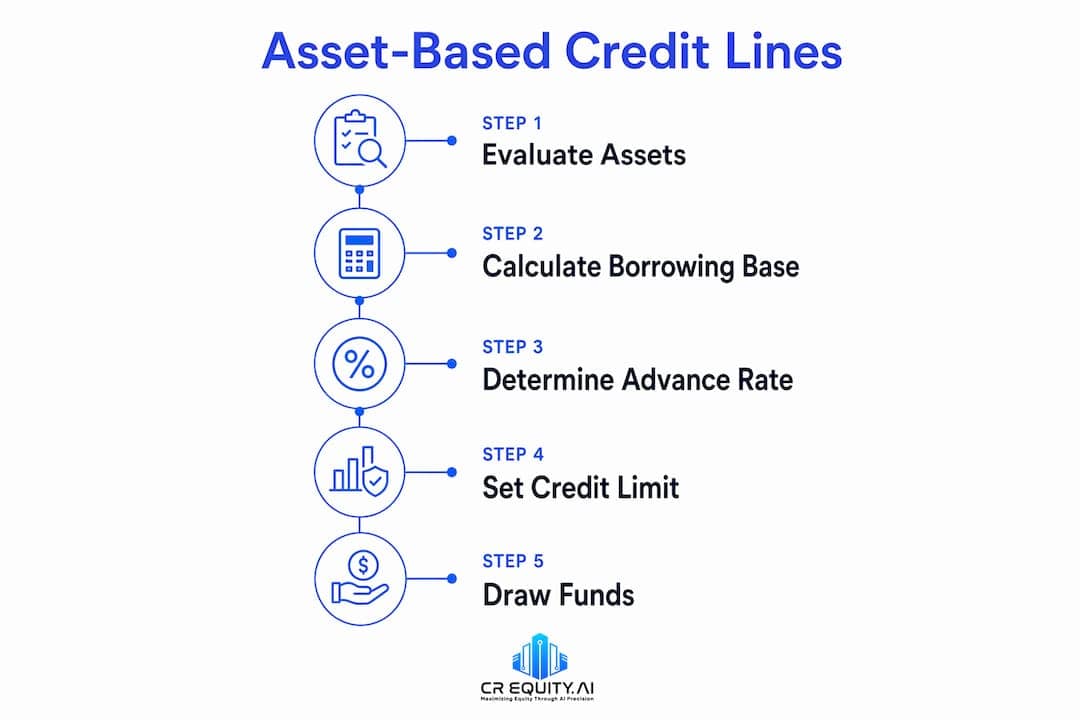
The borrowing base formula is straightforward: Advance Rate × Eligible Collateral Value = Available Credit. The practical complexity lies in what “eligible” means and how lenders apply haircuts and reserves.

Advance rates by collateral type
| Collateral Type | Typical Advance Rate | Notes |
|---|---|---|
| Accounts receivable (current) | 70%–90% | Excludes AR over 90 days; concentration caps apply |
| Finished goods inventory | — | Lower for perishable or specialized goods |
| Raw materials / WIP | 20% | Heavily discounted; WIP often excluded |
| Machinery and equipment | — | Requires formal appraisal; NADA or orderly liquidation value |
| Real estate | — | Less common; reduces overall borrowing-base liquidity |
LendingTree reports that advance rates for invoice financing commonly range between 70% and 90% of invoice value, with lenders then applying haircuts and excluding overdue receivables.
Statistic callout: Invoice advance rates represent the gross advance before reserves and eligibility exclusions reduce actual availability. Many borrowers find their net eligible borrowing base is substantially lower than the theoretical maximum once haircuts and concentration caps are applied.
Worked borrowing-base example
Assume a mid-market distributor with the following balance sheet items:
- Gross AR: substantial amount; AR over 90 days excluded; significant customer concentration excluded
- Eligible AR multiplied by advance rate yields a large eligible AR amount
- Gross finished goods inventory reduced by obsolete/slow-moving amounts
- Eligible inventory multiplied by advance rate yields sizable eligible inventory amount
- Gross borrowing base is the sum of eligible AR and inventory adjusted
- Lender reserve deducted from gross borrowing base
- Net available credit is lower than gross borrowing base after reserve deductions
The OCC notes that eligibility and haircuts are the practical battleground: book value consistently overstates bank-eligible value. Practitioners confirm that many borrowers underestimate how much concentration caps and aged-AR exclusions reduce their actual borrowing power.
Assets lenders commonly accept — and what they often exclude
Lenders evaluate collateral on quality and liquidity, not just existence on the balance sheet.
Commonly accepted assets:
- Accounts receivable from creditworthy, diversified customers (current, undisputed)
- Finished goods inventory with broad market demand
- Machinery and equipment with verifiable orderly liquidation value
- Owner-occupied or investment real estate (as a secondary or supplemental component)
- Select intellectual property, including patents and trademarks, in specific industries
Commonly excluded or heavily discounted assets:
- AR over 90 days past invoice date
- Receivables from a single customer exceeding concentration limits (often 10%–20% of total eligible AR per the OCC)
- Progress billings and retention receivables in construction
- Obsolete, slow-moving, or customer-specific inventory
- Work-in-process (WIP) inventory, particularly in job-shop manufacturing
- Intercompany receivables and government receivables (unless specifically approved)
The logic behind exclusions is straightforward: a lender needs to liquidate collateral quickly if a borrower defaults. Aged receivables are harder to collect; specialized inventory has a narrow buyer pool; progress billings depend on project completion. For asset-based lending in commercial real estate, the collateral mix and eligibility criteria shift further toward property values and lease income.
What does an asset-based credit line actually cost?
ABL pricing has several components beyond the headline interest rate. The SBA explicitly outlines higher origination and monitoring costs as a leading downside of asset-based lending.
Cost components:
- Interest rate: Typically a spread over SOFR (or prime), ranging from 1.5% to 5%+ depending on borrower risk and collateral quality. Rates are generally lower than unsecured loans because collateral reduces lender risk.
- Unused commitment fee: Usually 0.25%–0.50% per annum on the undrawn portion of the facility.
- Field exam fees: Recurring audits billed back to the borrower; frequency ranges from quarterly to annually depending on facility size and borrower risk profile.
- Appraisal fees: Required at origination and periodically thereafter for inventory and equipment; real estate appraisals add further cost.
- Administration and monitoring fees: Monthly or annual fees for borrowing-base certificate processing and lender oversight.
- Legal and closing costs: Drafting loan agreements, UCC filings, and lien searches.
| Fee Type | Typical Range | Frequency |
|---|---|---|
| Interest rate (spread over SOFR) | Variable range depending on risk and collateral | Ongoing |
| Unused commitment fee | Typical low percentage on undrawn portion | Ongoing |
| Field exam fee | Recurring significant cost per exam | Quarterly to annually |
| Appraisal fee | Required at origination and periodically with notable cost | |
| Administrative / monitoring fee | Recurring moderate monthly fees | Monthly |
Larger facilities with higher-quality collateral generally command better pricing. FILO (first-in, last-out) tranches, which provide additional availability beyond the standard borrowing base, carry higher rates to compensate for subordinated collateral risk.
Advantages and disadvantages of asset-based credit lines
Advantages
- Higher capacity for asset-rich firms: Borrowing power scales with receivables and inventory, not just EBITDA. A distributor with $5M in eligible AR can access capital a cash-flow lender would not approve.
- Fewer maintenance covenants: ABL facilities typically carry fewer financial maintenance covenants than cash-flow loans, giving management more operating flexibility.
- Counter-cyclical availability: J.P. Morgan describes ABL as a counter-cyclical tool: when earnings contract during downturns, asset-backed facilities may remain available if asset quality holds.
- Seasonal scalability: Preapproved seasonal over-advances allow borrowers to build inventory ahead of peak periods without renegotiating the facility.
- Discipline benefit: The reporting infrastructure ABL requires often improves a company’s receivables collection and inventory controls over time.
Disadvantages
- Reporting burden: Borrowers must submit borrowing-base certificates weekly or monthly, maintain accurate AR aging, and keep inventory records current.
- Recurring field exams: J.P. Morgan notes that field exams are recurring, intrusive audits billed back to the borrower; discrepancies can tighten advance rates or trigger defaults.
- Cash dominion / lockbox: Customer payments are redirected into lender-controlled accounts and automatically applied to the outstanding balance. This enforces cash discipline but reduces the borrower’s direct control of receipts.
- Higher administration costs: The SBA identifies higher origination and ongoing monitoring costs as a primary downside.
- Concentration and obsolescence risk: A single large customer or a shift in inventory demand can rapidly reduce availability.
Pro Tip: Negotiate “springing dominion” rather than hard lockbox at closing. Springing dominion activates cash control only when availability falls below a defined threshold, preserving your day-to-day cash management until a stress event actually occurs.
Who benefits most from an asset-based line of credit?
ABL fits a specific borrower profile. The clearest candidates are businesses that are asset-rich, working-capital intensive, and either growing rapidly or navigating volatile cash flows.
Ideal borrower profiles:
- Wholesalers and distributors with large, diversified AR books
- Retailers carrying substantial finished goods inventory
- Manufacturers with equipment and raw material collateral
- Staffing companies with high-volume, short-cycle receivables
- Businesses in turnaround or recapitalization where cash-flow lending is unavailable
- Seasonal businesses that need to build inventory before peak revenue periods
Industry examples: A regional food distributor with $8M in monthly AR and thin margins is a classic ABL borrower. A contract manufacturer with $4M in equipment and $2M in WIP inventory can use a blended facility. Some commercial real estate borrowers use ABL-adjacent structures for bridge financing.
ABL is generally not the right fit for asset-light service firms with stable, predictable EBITDA and strong credit profiles. Those businesses typically access cash-flow revolvers at lower all-in cost with less reporting friction. For a broader look at small business funding options, including when ABL competes with term loans or SBA products, the choice depends heavily on asset composition and cash-flow predictability.
What lenders will ask for and how long underwriting takes
Documentation checklist
- AR aging report (current, within 30 days) — broken out by customer, invoice date, and aging bucket
- Inventory schedule — by SKU or category, with cost basis and location
- Equipment list — with purchase dates, book value, and any existing liens
- Two to three years of audited or reviewed financial statements
- Year-to-date interim financials (balance sheet and income statement)
- Two to three years of business and personal tax returns
- Corporate documents — articles of incorporation, operating agreement, ownership structure
- Customer contracts — particularly for large or concentrated accounts
- Insurance certificates — property, liability, and key-man where applicable
- Existing lien searches and UCC filings
Practical tips for each stage:
- Clean your AR aging before submitting: remove intercompany balances, credit memos, and disputed invoices.
- Reconcile inventory records to the general ledger; discrepancies discovered during field exams can reduce advance rates immediately.
- Prepare a customer concentration analysis upfront — lenders will build one anyway, and presenting it proactively signals operational maturity.
Field examinations and borrowing-base reporting
Field exams are on-site audits of AR and inventory conducted by the lender or a third-party examiner. They verify that the collateral reported on borrowing-base certificates actually exists and is eligible. Frequency typically ranges from quarterly (for higher-risk or larger facilities) to annually (for well-performing, smaller facilities). Borrowing-base certificates are submitted weekly or monthly, depending on facility terms.

Typical timeline
Application to funding generally takes several weeks to a few months for mid-market ABL facilities, with complex cases taking longer. Factors that accelerate the process include clean financial records, a single-entity borrower structure, and an experienced ABL lender with an established field-exam network. Disorganized records, multiple subsidiaries, or first-time ABL borrowers slow it considerably. For practical guidance on speeding the approval process, document preparation is the single highest-leverage step.
How ABL compares with factoring and cash-flow lending
| Dimension | Asset-Based Credit Line | Factoring | Cash-Flow Loan |
|---|---|---|---|
| Repayment source | Collateral conversion to cash | Invoice collection by factor | Operating cash flow / EBITDA |
| Credit limit driver | Borrowing base (eligible assets) | Invoice face value | EBITDA multiple or DSCR |
| Ownership of AR | Borrower retains | Sold to factor | Borrower retains |
| Cost of capital | Moderate (lower than factoring) | Higher (discount + fees) | Lower for strong credits |
| Reporting burden | High (weekly/monthly BBC) | Low to moderate | Low to moderate |
| Financial covenants | Fewer maintenance covenants | None | More restrictive |
| Ideal borrower | Asset-rich, working-capital intensive | Needs immediate cash, limited admin capacity | Stable EBITDA, strong credit profile |
The SBA notes that ABL typically offers a lower overall cost of capital than factoring. However, factoring requires no ongoing borrowing-base infrastructure, making it preferable for smaller businesses that lack the reporting capacity ABL demands.
Decision guidance — ask yourself:
- Do you have at least $1M–$2M in eligible AR or inventory? If not, factoring or a small-business term loan may be more accessible.
- Can your team submit accurate borrowing-base certificates weekly or monthly? If not, the reporting burden will create friction.
- Is your EBITDA volatile or negative? ABL may be available where cash-flow lending is not.
- Do you need covenant flexibility to execute an acquisition or turnaround? ABL’s lighter covenant structure is a genuine advantage.
When factoring is still preferable: a startup with no financial reporting infrastructure, a business with a single large customer (concentration risk disqualifies much of the AR under ABL anyway), or a company that needs to outsource collections entirely. For a comparison of commercial loan vs. SBA loan structures, SBA products often make more sense for smaller borrowers with limited collateral.
How to choose an ABL lender: questions to ask and red flags to watch
Questions to ask every lender
- How do you define eligible receivables? What aging threshold, concentration cap, and customer-type exclusions apply?
- What advance rates do you offer for each collateral type, and under what conditions do you adjust them?
- How frequently will you require borrowing-base certificates, and what format do you accept?
- How often do you conduct field exams, who conducts them, and what do you charge per exam?
- What triggers cash dominion, and can we negotiate springing dominion instead of hard lockbox?
- What are your default remedies, and how quickly can you accelerate or liquidate collateral?
- Do you offer preapproved seasonal over-advances, and what are the conditions?
Red flags
- Borrowing-base definitions that are vague or heavily qualified in the term sheet — clarity here protects you at renewal.
- Field exam frequency exceeding quarterly without a clear risk-based justification.
- Advance rates materially below market without explanation tied to your specific collateral quality.
- Aggressive liquidation remedies with short cure periods.
- Lenders with no established field-exam network in your geography.
Negotiation tips
- Push for carve-outs on specific customer concentrations if one large customer is creditworthy and well-documented.
- Negotiate reserves down by providing additional collateral support or a personal guarantee.
- Request springing dominion triggers tied to a specific availability threshold (e.g., availability falls below 15% of the commitment).
- If the facility is large enough, bring in an independent ABL advisor or legal counsel with ABL experience — the loan agreement is complex and lender-drafted.
How technology is changing asset-based lending underwriting
Automation is reducing friction at several points in the ABL lifecycle, though it has not eliminated the need for human judgment on lower-quality collateral.
Where automation helps:
- Automated borrowing-base reporting: Platforms that integrate directly with accounting systems (QuickBooks, NetSuite, SAP) can generate borrowing-base certificates in near real time, reducing the manual burden on borrowers and the verification burden on lenders.
- Document intelligence: Machine-learning models extract AR aging data, inventory schedules, and financial statements from uploaded documents, cutting underwriting time from weeks to days.
- Real-time lender matching: AI-driven platforms can match a pre-underwritten borrower profile to multiple lenders simultaneously, generating competing offers faster than traditional relationship-based processes.
- Faster field-exam scheduling: Digital collateral verification tools can supplement or partially replace on-site exams for higher-quality, well-documented collateral.
Practical caveats: Automation reduces friction but does not eliminate field exams for lower-quality collateral or first-time ABL borrowers. Data quality is the binding constraint — garbage-in produces inaccurate borrowing-base calculations regardless of how sophisticated the platform is. Lenders still require human review for complex collateral structures, multi-entity borrowers, and distressed situations.
CR Equity Ai Inc positions itself in this space as an AI-driven lending platform that combines machine-learning underwriting with automated document intelligence and real-time lender matching, reducing time-to-offer for borrowers across commercial real estate and business financing.
Pro Tip: When evaluating any technology-driven ABL platform, ask specifically whether their borrowing-base automation integrates with your accounting system natively or requires manual uploads. Native integration is the difference between a genuine efficiency gain and a repackaged spreadsheet.
Key Takeaways
Asset-based credit lines give asset-rich businesses a revolving facility sized by collateral quality, not earnings, making them a practical working-capital tool when cash flows are volatile or EBITDA-based lending is unavailable.
| Point | Details |
|---|---|
| Borrowing base drives availability | Eligible AR and inventory, after advance rates and haircuts, determine how much you can draw at any time. |
| Invoice advance rates: 70%–90% | Gross advance rates on receivables range 70%–90%, but net availability is typically 20%–30% lower after reserves and exclusions. |
| Reporting burden is real | Weekly or monthly borrowing-base certificates and recurring field exams are non-negotiable requirements, not optional add-ons. |
| ABL holds up in downturns | When EBITDA contracts, asset-backed availability can remain intact if collateral quality is maintained, per J.P. Morgan. |
| CR Equity Ai Inc for faster decisions | CR Equity Ai Inc’s AI-driven underwriting platform matches ABL borrowers with lenders in real time, reducing time-to-offer across business financing products. |
The operational discipline ABL demands is often its most underrated benefit
Most commentary on asset-based lending focuses on the reporting burden as a pure cost. That framing misses something important. The weekly borrowing-base certificate, the field exam, the lockbox arrangement — these controls force a level of financial discipline that many growing businesses lack and genuinely need. Companies that run ABL facilities for two or three years consistently report tighter AR collection cycles and better inventory visibility, not because they wanted those outcomes, but because the lender required them.
The counter-cyclical availability point deserves more emphasis than it typically receives. A cash-flow lender will reduce or pull a revolver when EBITDA deteriorates. An ABL lender, by contrast, is watching your receivables and inventory, not your income statement. If your assets remain solid during a downturn, your facility remains available. For businesses in cyclical industries — distribution, manufacturing, retail — that distinction can be the difference between surviving a contraction and not.
Where ABL fails borrowers is when they enter the facility without understanding the operational requirements. A business that cannot produce accurate AR aging on a weekly basis, or whose inventory records are unreliable, will find the field exam process adversarial rather than routine. The lender’s response to discrepancies is not patience; it is tightened advance rates or a default notice. Prepare your reporting infrastructure before you apply, not after you close.
CR Equity Ai Inc brings AI-driven speed to asset-based credit decisions
Faster document intake, automated borrowing-base calculations, and real-time lender matching are the three areas where AI-driven underwriting platforms deliver the most measurable improvement over traditional ABL processes. CR Equity Ai Inc applies machine-learning credit models and automated document intelligence across the full credit lifecycle, from application intake through lender selection and offer optimization.
For business owners evaluating asset-based credit lines, the practical advantage is speed and transparency: multiple lender offers generated from a single pre-underwritten application, with terms presented clearly rather than buried in lender-specific term sheets. CR Equity Ai Inc supports working-capital solutions and asset-based credit lines alongside commercial real estate and business term financing, with automated KYC/AML and digital verification built into the platform.
When you are ready to assess your borrowing base and match with ABL lenders, use the CR Equity Ai Inc loan calculator to get a quote and see what your eligible collateral supports.
Curated sources and further reading
The following primary sources informed this article and are recommended for readers who want to review original guidance:
- OCC Comptroller’s Handbook: Asset-Based Lending — the definitive regulatory reference for ABL structure, borrowing-base mechanics, field exams, and lender controls
- SBA: Asset-Based Lending — What’s the Upside and Downside — practical overview of ABL advantages, costs, and the factoring comparison
- J.P. Morgan: Asset-Based Loans — How They Work for Businesses — institutional perspective on field exams, cash dominion, and counter-cyclical availability
- Bank of America: What Is Asset-Based Lending and How Does It Work — accessible definition and borrowing-base explanation with covenant comparison
- LendingTree: Asset-Based Lending 101 — advance-rate ranges and eligibility overview for small and mid-market borrowers
- CR Equity Ai Inc: Funding Options — platform overview for borrowers evaluating AI-assisted ABL and working-capital solutions
This article provides general information about asset-based lending and is not legal, financial, or tax advice. Confirm current terms, eligibility requirements, and regulatory standards with a qualified lender or financial professional for your specific situation.