Marketplace lending matches you with outside investors or partner banks that fund your loan, while a direct lender funds your loan from its own balance sheet. If you are a borrower weighing speed against cost, a direct lender usually wins on speed and certainty; if you are shopping to discover your best rate across many offers, a marketplace is the better starting point. The rest of this guide breaks down the trade-offs and gives you a decision checklist for either path.
TL;DR:
- Direct lenders fund loans from their own capital, enabling faster decisions and more transparent upfront disclosures compared to marketplace platforms.
- Marketplaces match borrowers with outside investors or bank partners, often requiring multiple underwriting steps and offering limited resale liquidity.
- Borrowers should compare total repayment cost, including fees and penalties, and verify who services the loan before committing.
- Investors must assess credit risk, originator retention, and liquidity, as marketplace notes rely on borrower repayment and may lack secondary markets.
- For speed and transparent terms, direct lending platforms like CR Equity AI offer faster, asset-based underwriting with published rate grids and minimal secondary sale risk.
Table of Contents
- How marketplace lending and direct lending actually work
- Borrower checklist: what to compare before you accept an offer
- Investor checklist: risk, liquidity, and real yield
- Key differences at a glance
- How to choose: a decision framework and the questions to ask
- What CR Equity AI’s direct-lending model looks like in practice
- What underwriters and brokers get wrong most often
- Where to go next if speed and transparency matter to you
- FAQ
- Sources
How marketplace lending and direct lending actually work
Marketplace lending and direct lending solve the same problem, getting money to a borrower, through different plumbing. Understanding which pipes your money runs through tells you who holds the risk, who sets the price, and who you call when something goes wrong.
A marketplace platform does not usually lend its own money. Instead, it matches you with investors or a partner bank that originates the loan, then may sell that loan or issue notes tied to its payments. The CFPB’s explainer on online marketplace lending describes this structure directly: platforms connect borrowers with investors, often through a bank partner that handles the actual origination, and the platform earns fees for the match rather than interest income. The CFPB also notes that marketplace lending has a shorter regulatory track record than traditional banking. Therefore, it urges borrowers to look past the interface and compare the underlying terms.
SEC filings from marketplace issuers confirm this mechanics. A recent marketplace prospectus shows loans originated through a bank partner, then sold or repackaged into payment-dependent notes that investors buy. The prospectus is explicit that investors depend entirely on borrower repayment: if you stop paying, the note stops paying. That single sentence in a legal filing explains why marketplace investing carries different risk than buying a bond backed by a company’s full balance sheet.
Direct lenders skip the matching layer. We underwrite, fund, and often service the loan ourselves, using our own capital rather than investor pools or bank partners. This structure means the rate you are quoted is close to final, because no secondary buyer needs to approve the terms first. It also means the lender who approved your loan is usually the same party who answers your servicing questions later, which borrowers often find more predictable than a marketplace hand-off.
Underwriting and verification sit in different places depending on the model. A marketplace typically runs an initial, lighter screen to generate a match, then your actual underwriting happens with whichever bank or lender accepts the loan, meaning you may submit documentation twice. A direct lender runs underwriting once, on its own criteria, which can mean faster decisions but less room to shop for a second opinion once you are in the pipeline.

This structural difference also drives what disclosures you will see. Marketplace transactions involving investor notes can trigger securities-style prospectus disclosures, the kind referenced above, because investors are buying a financial instrument, not just funding a loan. Direct lender transactions are typically governed by standard lending disclosures, including Truth in Lending Act APR statements, since there is no secondary security being issued. Knowing which disclosure regime applies tells you what protections and plain-English terms you are entitled to see before signing.
Borrower checklist: what to compare before you accept an offer
Matching with a lender is not the finish line. The CFPB’s guidance on comparing loan estimates recommends comparing loan amount, term, whether the rate is fixed or variable, all fees, late and prepayment penalties, APR, and total repayment cost, not just the advertised monthly payment. A lower monthly figure can hide a longer term or higher fees that cost you more over the life of the loan.
- Total cost: Compare APR and all fees side by side, not just the headline interest rate.
- Term and rate type: Confirm whether the rate is fixed or variable and how long the term runs.
- Penalties: Check for prepayment penalties and late fees before you sign, not after you miss a payment.
- Servicing: Find out who services the loan after funding, since that party handles your payments and any hardship requests.
- Documentation: Ask what verification is required, income statements, tax returns, bank statements, since this varies widely between marketplaces and direct lenders.
Underwriting methods matter as much as the price. Many platforms now use automated models and alternative data, beyond a traditional credit file, to approve borrowers faster. A joint regulatory statement on alternative data notes that these models can expand access to credit but also introduce model risk, meaning regulators expect lenders to test for errors and discriminatory outcomes before relying on them. If a platform cannot explain in plain terms what data drives its decision, that is worth asking about directly.
Credit pulls are another practical difference. Marketplaces commonly use a soft credit inquiry during the initial matching stage, which does not affect your score, and shift to a hard pull only once you formally apply with a specific lender. A direct lender may pull credit earlier in the process since there is no separate matching step. If you are rate shopping, understanding when the soft-to-hard transition happens helps you avoid unnecessary score dings.
Pro Tip: Submit similar loan applications within a focused shopping window so multiple hard pulls for the same loan type count as one inquiry on your credit report.
A marketplace tends to make sense when you are uncertain about your eligibility or want to see a spread of offers before committing. A direct lender tends to make more sense when you know roughly what you qualify for and value speed and a single point of contact over comparison shopping.
Investor checklist: risk, liquidity, and real yield
Investors face a different set of questions, because the thing they are buying, a note, a loan, or a slice of a pool, carries its own risk profile depending on structure.
Marketplace investors typically participate through one of a few structures: buying payment-dependent notes tied to a specific loan, buying into a securitized pool of many loans, or purchasing whole loans directly. The SEC prospectus described earlier is a useful reference point here, since it spells out that note holders are paid only if and when the underlying borrower pays, meaning principal loss is a real possibility if the borrower defaults.
- Credit risk: Confirm whether you are exposed to one borrower, a pool, or a note whose payout depends entirely on repayment.
- Originator retention: Ask whether the platform keeps any stake in the loans it sells, since retained exposure gives the originator a reason to underwrite carefully.
- Liquidity: Check whether a secondary market exists for your position, since many marketplace notes and whole loans have limited or no resale market.
- Net yield: Calculate your return after platform fees, servicing fees, and expected defaults, not the headline rate quoted at purchase.
Direct lender debt works differently for investors who fund or participate alongside a lender’s own capital. Because the lender holds the loan on its own balance sheet rather than passing it through to a note structure, underwriting discipline tends to matter more directly to the lender’s own outcomes, which can align incentives differently than a sell-and-forget marketplace model.
Vintage performance, how loans originated in a given period actually performed over time, is one of the more reliable ways to judge underwriting quality on either model, though investors should ask any platform or lender directly for that data rather than assume it is published.
Key differences at a glance
The practical gap between these two models shows up across a handful of axes that matter to both borrowers and investors.
- Funding source and credit risk: Marketplaces pass credit risk to investors or note holders; direct lenders hold the risk themselves, since they fund from their own capital.
- Speed: Marketplaces take time to match and route your file to an originating lender; direct lenders can decide and fund faster since there is one underwriting step.
- Transparency: Direct lenders can disclose rate and fee grids upfront since there is no secondary buyer to negotiate with; marketplace terms may shift once a bank partner’s underwriting finishes.
- Underwriting flexibility: Marketplaces aggregate many lenders’ criteria, which can surface options for unusual borrower profiles; a single direct lender’s flexibility depends on that lender’s own policy.
- Fees: Both models charge fees, but marketplace fee structures can include platform fees on top of the originating lender’s own charges.
- Investor access and liquidity: Marketplace notes and loans often have thin or no secondary markets; direct lender debt participation depends on the lender’s own structure.
- Typical loan size and terms: Varies by platform and lender rather than by model type, so this should be confirmed case by case rather than assumed.
The total repayment figure, not the advertised monthly payment, is the number that determines whether a loan is actually affordable, according to the CFPB’s loan comparison guidance. A loan with a lower monthly payment but a longer term or higher fees can cost more overall than one with a higher payment and a shorter runway.
How to choose: a decision framework and the questions to ask
Match your top priority to the model that tends to serve it best, then confirm with direct questions before you commit.
- If cost comparison across many offers is your priority, start with a marketplace to see a spread of terms, then verify the winning offer’s full disclosures before signing.
- If speed and certainty matter most, go directly to a lender that can underwrite and fund without a matching or resale step.
- If your financial profile is unusual, non-traditional income, foreign national status, or limited documentation, ask both models directly whether their underwriting criteria accommodate your situation before applying.
- Ask who the actual lender is, since a marketplace match may route to a bank partner whose name differs from the platform you applied through.
- Ask whether the APR is disclosed upfront and whether it reflects all fees, not just the base interest rate.
- Ask whether your loan will be sold or securitized, since that affects who services it and who you contact with problems later.
- Ask what verification happens before funding, since this determines how long the process will actually take versus the marketing timeline.
Watch for red flags: a missing or unclear APR, an unwillingness to name the actual originating lender, origination fees that are unusually high relative to the loan size, or a lender that cannot produce a written underwriting policy when asked.
Pro Tip: Prequalify with more than one source and compare total repayment figures side by side before submitting a full application, so you only take a hard credit pull once you have narrowed to a real finalist.
Once you have your finalist, confirm the term, rate type, all fees, and penalty structure in writing, and consolidate your hard credit inquiries within a short shopping window to limit the score impact.
What CR Equity AI’s direct-lending model looks like in practice
Our platform, CR Equity AI, illustrates the direct-lender model described above. We lend our own capital rather than routing loans to outside investors or a marketplace structure, and we publish our advance-rate grids before you apply, which lets you see the terms you are working toward instead of waiting for a match to resolve.
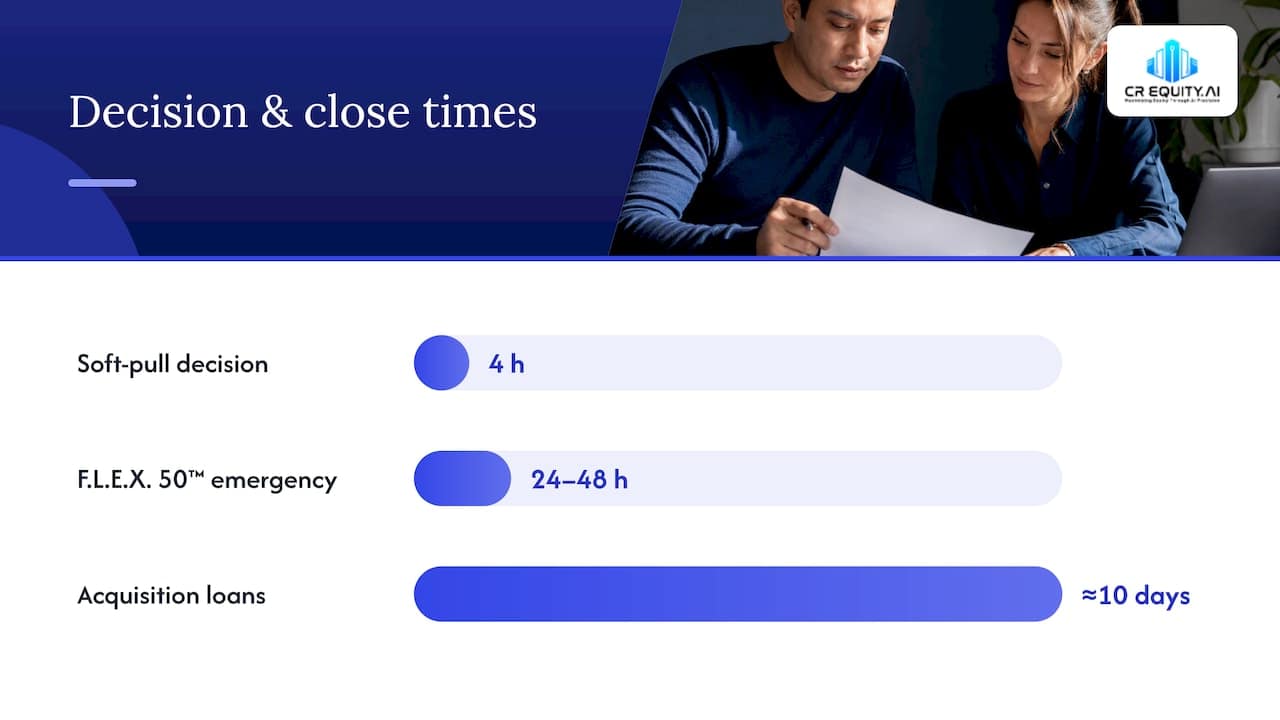
Our underwriting centers on the asset and the deal rather than only your paperwork: most real estate programs use a soft credit pull with no income verification, and we can return decisions in as little as 4 hours. Programs like F.L.E.X. 50™ are built for 24 to 48 hour emergency bridge funding, while our investment property acquisition loans target roughly a 10-day close, and our DSCR cash-out refinance program qualifies on rental income rather than tax returns, which suits self-employed and 1099 borrowers.
For borrowers, this translates into faster, more predictable decisions than a multi-party marketplace hand-off. For investors evaluating any direct lender, the questions from the checklist above still apply: confirm how much of the lender’s own capital is on the line and how its underwriting policy is documented. Verify current rates and program terms directly on the lender’s program pages before applying, as published figures can change.
What underwriters and brokers get wrong most often
In years of underwriting and brokering deals, the most common mistake I see is borrowers treating a marketplace match as a final approval instead of a starting point for comparison. Marketplaces are genuinely good at surfacing options you might not find on your own, but the match itself tells you little about final pricing until a lender completes real underwriting.
The second mistake is the mirror image: borrowers who need speed waste days shopping across platforms when a direct lender could have given them a firm answer the same day. My two practical rules: separate your shopping phase from your commitment phase, and never sign based on a monthly payment figure alone, always ask for the total repayment number first.
— Robert Stewart Jr
Where to go next if speed and transparency matter to you
If you have read this far because you value knowing your terms upfront and closing fast, that is exactly the gap our direct-lending model is built to close. Whether you need fix-and-flip capital, a DSCR cash-out refinance, a short-term bridge, or ground-up construction funding, we underwrite the deal itself and lend from our own capital rather than routing you through a marketplace match.
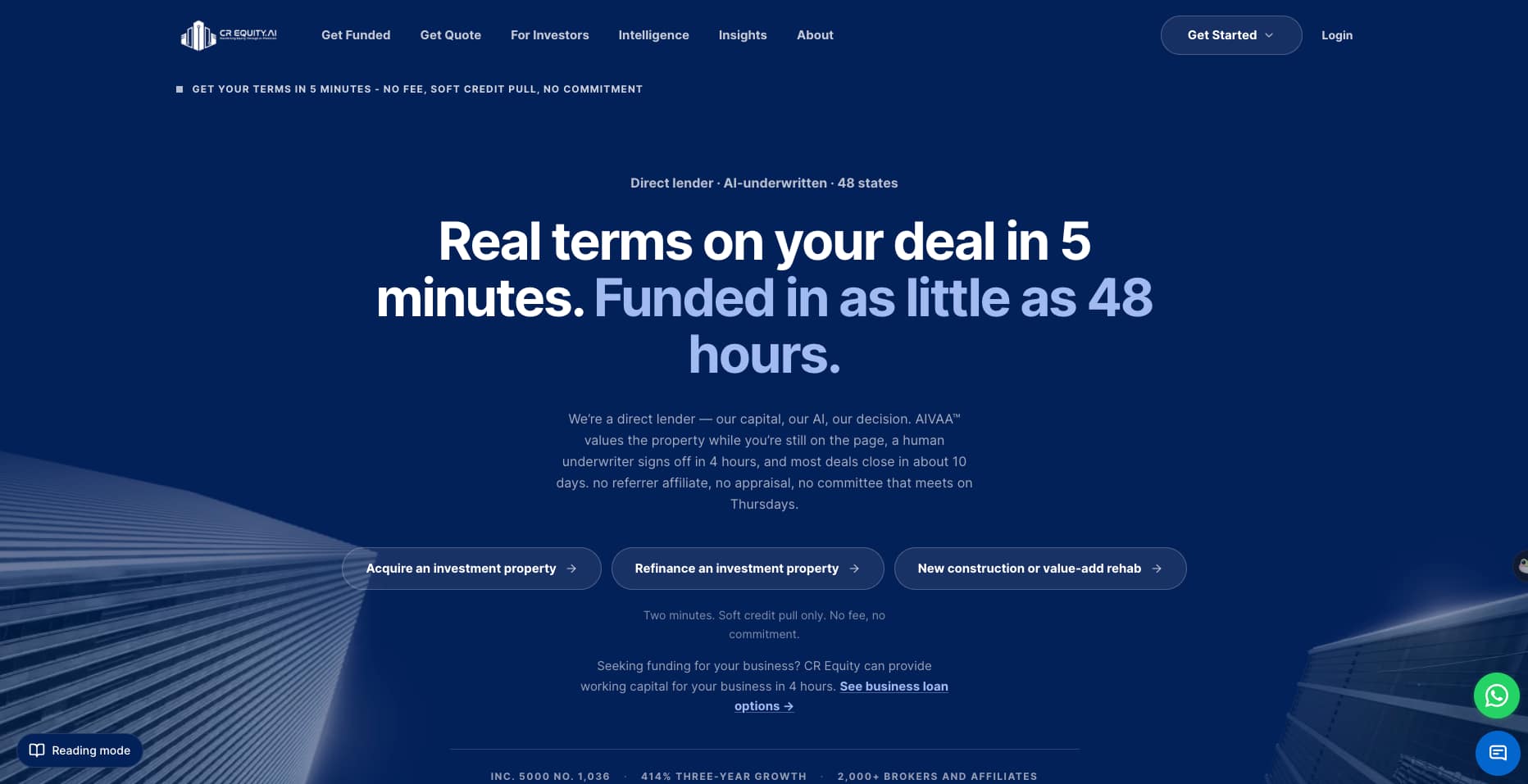
Compare our published advance-rate grid and submit your deal to see real terms without waiting on a secondary buyer’s approval.
This article is general information, not a substitute for advice from a qualified financial advisor. Consult a qualified financial professional about your own circumstances before acting on anything here.
FAQ
What is marketplace lending and how does it work?
Marketplace lending uses an online platform to match borrowers with investors or a partner bank that funds the loan, rather than lending its own capital. The platform earns fees for the match, and the loan or a note tied to it may later be sold to investors, as described in the CFPB’s marketplace lending explainer.
Is direct lending risky?
Direct lending carries the same general credit and repayment risks as any loan, but because the lender funds from its own balance sheet, there is no secondary note structure adding investor-dependent risk layers. Borrowers should still compare total cost and fees carefully, following the CFPB’s loan comparison guidance, since risk depends on specific terms, not the lending model alone.
What credit score is needed for a direct lender loan?
Credit score requirements vary by lender and program, since each direct lender sets its own underwriting policy. Some real estate-focused direct lenders, including our own programs, weigh asset value and deal performance alongside a soft credit pull rather than requiring a specific minimum score, so you should confirm requirements directly with the lender you are considering.
What are the three types of lenders?
Common categories include direct lenders, who fund loans from their own capital; marketplace or peer-to-peer platforms, who match borrowers with outside investors; and traditional banks or credit unions, who originate and often hold loans using depositor funds. Each category can differ meaningfully in speed, underwriting flexibility, and how risk is allocated, so the category name alone does not tell you everything about a specific lender’s terms.
Sources
- Compare loan estimates | Consumer Financial Protection Bureau
- Understanding online marketplace lending | CFPB (2016)
- Prospectus — marketplace credit issuer (SEC filing)