Six levers determine how diversified a real estate portfolio really is: asset-class mix, investment vehicle, geography, risk-profile blend, capital-stack position, and time horizon. Each one guards against a different failure mode, and treating them as one problem is the most common mistake investors make.
- Asset class (residential, multifamily, office, retail, industrial, special-purpose): protects against sector-specific demand collapse.
- Investment vehicle (direct ownership, REITs, private funds, syndications, crowdfunding): controls how much liquidity and control you trade for scale.
- Geographic spread: reduces exposure to one metro’s job market or regulatory shift.
- Risk-profile blend (core, core-plus, value-add, opportunistic): balances stable income against growth potential.
- Capital-stack position (senior debt, mezzanine, preferred or common equity): changes your downside protection and yield.
- Time horizon and liquidity: matches your holding period to how fast you might need cash.
Institutional voices including CFA Institute and KKR frame concentration risk as the single biggest driver of underperformance, and CR Equity Ai Inc underwrites deals across all six of these levers daily. A common starting framework is to split capital evenly across four asset types or strategies, though the right split depends on your income needs and risk tolerance.
Key Takeaways
Effective real estate portfolio diversification combines asset-class mix, vehicle choice, geography, risk-profile blending, capital-stack position, and time horizon into one coordinated plan, not six separate decisions.
| Point | Details |
|---|---|
| Diversify across six levers | Mix asset class, vehicle, geography, risk profile, capital stack, and time horizon together, not in isolation. |
| Watch correlation, not just count | Ten similar properties in one market is not diversification even though it looks like scale. |
| Use tranche-based deployment | Phase capital commitments and re-underwrite at each tranche to avoid concentration risk. |
| Match debt to holding period | Stagger loan maturities and align debt terms with your actual exit timeline. |
| Start with a simple allocation model | The 25/25/25/25 split, or an income or growth variant, gives structure before customizing further. |
This article is general information, not a substitute for advice from a qualified financial advisor. Consult a qualified financial professional about your own circumstances before acting on anything here.
Table of Contents
- Why Real Estate Portfolio Diversification Types Matter
- Diversifying Across Real Estate Asset Classes
- Choosing the Right Investment Vehicle for Diversification
- How Should You Diversify Geographically?
- Blending Risk Profiles: Core, Core-Plus, Value-Add, and Opportunistic
- Diversifying Across the Capital Stack
- Time Horizon, Liquidity Planning, and Sample Allocations
- Building a Diversified Portfolio Step by Step
- What Institutional Research Says About Concentration Risk
- Monitoring a Diversified Portfolio: KPIs and Red Flags
- Tax and Legal Considerations Across Vehicles and Markets
- How CR Equity Ai Inc Supports Execution Across These Strategies
- Sources
- FAQ
Why Real Estate Portfolio Diversification Types Matter
Concentration risk is the reason a landlord with multiple properties in one suburb can lose a large portion of net operating income from a single layoff announcement by a major employer in the area. Diversification exists to prevent one variable, one market, one tenant type, one loan structure, from determining your entire outcome.
Correlation is the technical term for how closely two assets move together. Office towers and industrial warehouses often respond to the same interest-rate environment but for different reasons: offices suffer from remote-work vacancy while industrial benefits from e-commerce demand. KKR’s institutional research identifies concentration, overexposure to a single market, theme, or holding period, as the primary reason portfolios underperform, and recommends deliberate, phased deployment as the fix rather than one-time allocation.
Real estate cycles do not move uniformly across sectors. Rising rates hit highly leveraged value-add deals faster than they hit stabilized core assets. A recession that cuts discretionary retail spending barely touches self-storage demand, since people downsizing still need somewhere to put their furniture.
- Concentration in one asset class means one downturn can erase years of gains.
- Concentration in one market ties your income to a single local economy.
- Concentration in one capital-stack position removes your flexibility when refinancing conditions shift.
The core statistic to remember: diversification does not eliminate risk, it redistributes it so no single failure point can sink the whole portfolio. REI Prime’s diversification research notes that combining geographic and asset-class diversification together produces more resilience across cycles than pursuing either strategy alone.
Diversifying Across Real Estate Asset Classes
Each real estate asset class responds to a different set of economic drivers, and mixing classes with low correlation is what actually reduces portfolio-level volatility, not just owning more buildings; the benefits of portfolio diversification highlight how combining assets with different behaviors reduces overall risk. SmartAsset’s breakdown of real estate asset classes frames residential as the stability anchor, office as the most cyclical, and industrial as the primary beneficiary of e-commerce growth.
It helps to separate two concepts investors often conflate: asset class describes use and return profile (residential, commercial, industrial), while property type describes physical configuration (single-family, garden-style multifamily, mid-rise office). Owning ten single-family rentals in the same submarket is not diversification even though it looks like “many properties.” True diversification requires assets that respond differently to the same economic shock.
| Dimension | Residential (SFR) | Multifamily | Office | Retail | Industrial | Special-purpose |
|---|---|---|---|---|---|---|
| Best for | Income + moderate growth | Income stability | Growth (cyclical) | Income, location-dependent | Income + growth | Income diversification |
| Liquidity | Moderate | Moderate | Low | Low to moderate | Moderate | Low |
| Required capital | Low to moderate | Moderate to high | High | Moderate to high | Moderate to high | Moderate to high |
| Risk/volatility | Low to moderate | Low to moderate | High | Moderate to high | Low to moderate | Moderate |
| Yield vs. appreciation | Balanced | Yield-leaning | Appreciation-leaning | Balanced | Yield-leaning | Yield-leaning |
| Typical timeframe | 5-10 years | 5-10 years | 7-10+ years | 5-10 years | 5-10 years | 7-10+ years |
Residential single-family (SFR): Tracks household formation and wage growth, tends to hold value in recessions because people need shelter regardless of the economy, but carries higher per-unit management overhead than multifamily.
Multifamily: Benefits from consistent rental demand and staggered lease expirations that reduce vacancy shock, though new supply pipelines in growth metros can compress rents faster than investors expect.
Office: The most cycle-sensitive class right now, with valuation dependent almost entirely on tenant credit quality, lease term, and return-to-office trends in the specific metro.
Retail: Splits sharply between necessity-based retail (grocery-anchored centers) that performs like a utility, and discretionary retail that suffers first in downturns.
Industrial: Warehouses and logistics facilities have ridden the e-commerce wave for a decade, with tenant demand driven by supply-chain reconfiguration rather than local population growth.
Special-purpose (self-storage, data centers, senior housing, hospitality): These assets often move independently of traditional office and retail cycles, which is exactly what makes them useful as a hedge, but they demand specialized operating knowledge most generalist investors lack.
Pro Tip: Before buying into any asset class, map its tenant base against the same macro factors already dominating your portfolio. If your existing holdings depend on tech-sector employment, adding another tech-heavy office building does not diversify anything, it doubles down on the same risk.
Choosing the Right Investment Vehicle for Diversification
Direct ownership and indirect vehicles solve different problems. Direct ownership gives full control and full operational responsibility; indirect vehicles like REITs, private funds, syndications, and crowdfunding platforms let you diversify across markets and asset classes without buying and managing dozens of buildings yourself.
Investopedia’s real estate primer draws a clear line here: publicly traded REITs are liquid and trade daily, but that liquidity comes with higher correlation to the broader stock market. Private REITs, syndications, and debt funds sacrifice liquidity for exposure that moves more independently of equity swings.
| Vehicle | Liquidity | Typical minimum | Control | Fee load |
|---|---|---|---|---|
| Direct ownership | Low | High ($50K+) | Full | None (operating costs only) |
| Publicly traded REITs | High (daily) | Low ($100s) | None | Low to moderate |
| Private REITs/funds | Low (lockups common) | Moderate to high | Minimal | Moderate to high |
| Syndications | Low | Moderate ($25K-$100K+) | Minimal | Moderate |
| Crowdfunding platforms | Low to moderate | Low ($10K) | None | Moderate |
| Debt funds | Low to moderate | Moderate | None | Moderate |
A Georgetown analysis on REIT diversification points out that REITs carry their own tax treatment, largely as ordinary income on distributions, distinct from the depreciation benefits direct owners capture. Syndications and many private funds also require accredited investor status under SEC rules, which limits access for some investors and shapes how much of a portfolio can realistically sit in that vehicle. None of this is one-size-fits-all guidance; a tax advisor should weigh in before you commit capital to any vehicle with lockup periods or pass-through complexity.
How Should You Diversify Geographically?
Geographic spread only reduces risk when the markets you add actually move differently from the ones you already own. Two Sun Belt metros with the same in-migration trend and the same industry concentration are not diversification, they are the same bet twice.
Selection criteria worth screening before entering a new market:
- Employment base diversity across at least three or four major industries, not one dominant employer.
- Population growth trends measured over 5-10 years, not a single strong year.
- New supply pipeline relative to absorption, since oversupply crushes rent growth even in growing metros.
- Landlord-friendly regulatory environment, since eviction timelines and rent control rules vary sharply by state and even by city.
- Climate risk exposure, insurance costs in coastal and wildfire-prone regions have risen fast enough to erode cap-rate assumptions built a few years ago.
- Cap-rate spreads relative to your home market, since a market trading 150 basis points wider often reflects real risk, not just opportunity.
The practical rule of thumb: prioritize markets with different primary economic drivers than your existing holdings. A portfolio anchored in a manufacturing-heavy Midwest metro gains real diversification from a tech or healthcare-driven Sun Belt market, not from another manufacturing town three states over.
Pro Tip: Cross-market ownership only works if you have eyes on the ground. Use a local property manager or a turnkey provider with a verifiable track record before buying in a market you cannot visit quarterly, remote ownership without local partners is how due diligence gaps turn into vacancy problems.
Blending Risk Profiles: Core, Core-Plus, Value-Add, and Opportunistic
Mixing risk profiles gives a portfolio optionality that a single strategy cannot. Each profile plays a distinct role: core assets anchor income, opportunistic deals drive growth, and the profiles in between that bridge the gap.
Core assets are stabilized, fully leased, institutional-grade properties with the lowest volatility and the lowest return ceiling. Hold periods run long, often 7-10 years, and operational intensity is minimal.

Core-plus properties are stabilized but carry modest upside through light renovation or lease-up of remaining vacancy, adding a slightly higher return with slightly more management involvement.
Value-add deals require active repositioning, renovation, re-tenanting, or operational turnaround, and typically target a 3-5 year hold with meaningfully higher return targets and higher execution risk.
Opportunistic investments include ground-up development and distressed acquisitions, carrying the highest potential returns alongside the highest volatility and the most demanding manager oversight.
| Profile | Expected volatility | Liquidity | Manager involvement |
|---|---|---|---|
| Core | Low | Low to moderate | Minimal |
| Core-plus | Low to moderate | Low to moderate | Light |
| Value-add | Moderate to high | Low | Active |
| Opportunistic | High | Very low | Intensive |
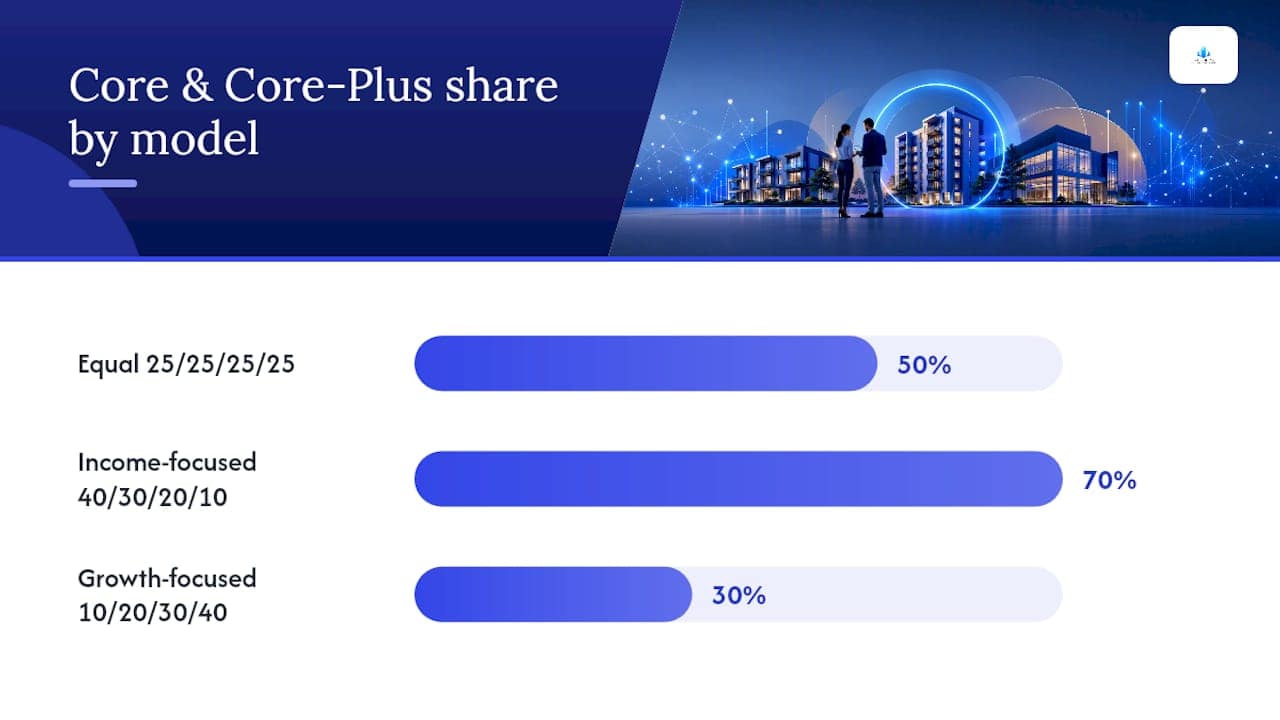
A conservative, income-focused investor might allocate 60% core, 30% core-plus, and 10% value-add. A balanced investor often splits close to evenly across all four, which is where models like real estate investment strategies built around tactical allocation become useful reference points. The right blend depends on how much active management time you have and how soon you need distributions.
Diversifying Across the Capital Stack
Where you sit in the capital stack changes how a deal behaves when interest rates rise or an asset underperforms, and spreading positions across the stack can smooth portfolio-level returns the same way spreading across asset classes does.
Senior mortgage debt sits at the top of repayment priority, earns the lowest yield, and suffers the least in a downturn since it gets paid before anyone else. Mezzanine debt sits below senior debt, earns a higher yield to compensate for that subordination, and typically converts to equity control if a borrower defaults. Preferred equity ranks above common equity in the capital stack and earns a fixed return before common equity holders see a dollar. Common equity absorbs the first losses and captures the most upside, making it the highest-risk, highest-reward position.
Practical steps for managing leverage risk across a diversified stack:
- Keep loan-to-value ratios conservative on any single asset, especially in variable-rate structures.
- Consider interest-rate hedges or rate locks on floating-rate debt tied to construction or bridge financing.
- Stagger loan maturities across different years so refinancing risk never concentrates in one rate environment.
- Monitor loan covenants actively; a breach on one property can trigger cross-default provisions on others tied to the same lender or fund.
Pro Tip: Match your debt maturity to your actual holding-period assumption, not the lowest available rate. A five-year fixed loan on an asset you plan to sell in three years just adds prepayment penalty risk you didn’t need to take on.
Time Horizon, Liquidity Planning, and Sample Allocations
Liquidity needs should drive allocation decisions before return targets do. An investor who might need capital within 18 months has no business locking it into a seven-year value-add fund, regardless of the projected return.
The 25/25/25/25 model splits capital into four equal buckets, often by asset class (residential, multifamily, commercial, industrial) or by strategy (core, core-plus, value-add, opportunistic). It works well as a starting template precisely because it forces discipline: no single bucket can dominate outcomes. Variants shift the weighting toward an investor’s actual goals. An income-focused variant might run 40/30/20/10, weighting core and core-plus heavily. A growth-focused variant might invert that to 10/20/30/40, weighting value-add and opportunistic.
| Model | Liquidity profile | Risk level | Likely vehicle mix |
|---|---|---|---|
| Equal 25/25/25/25 | Moderate | Balanced | Mix of direct ownership and REITs |
| Income-focused (40/30/20/10) | Higher | Lower | REITs, core direct ownership, debt funds |
| Growth-focused (10/20/30/40) | Lower | Higher | Syndications, value-add funds, direct development |
ManageCasa’s diversification framework identifies five practical levers smaller landlords can pull: property type, geography, asset class, hold-time strategy, and income structure (active versus passive). Prioritizing the one or two levers with the biggest marginal risk reduction for your current portfolio size matters more than trying to diversify across all five simultaneously.
Pro Tip: Deploy new capital in tranches rather than all at once. Committing a quarter of new capital every six months, rather than the full amount in a single quarter, reduces the odds you buy the top of a local cycle across your entire allocation. Financing tools like scalable capital solutions can help pace deployment without forcing an all-or-nothing commitment.
Building a Diversified Portfolio Step by Step
Portfolio construction is a repeatable process, not a one-time decision. The sequence matters: assess first, set targets second, size positions third, and monitor continuously after execution.
- Assess current exposure. List every asset by class, geography, risk profile, and capital-stack position to find where concentration already exists.
- Set target allocations. Decide your ideal split across asset classes, vehicles, and risk profiles based on income needs and time horizon.
- Size individual positions. Cap any single asset or market at a percentage of total portfolio value that won’t sink you if it underperforms.
- Run stress tests. Model a 20% rent decline, a 200 basis point cap-rate expansion, and a 90-day vacancy spike against each holding.
- Execute with discipline. Deploy capital in phases rather than concentrating purchases into a single quarter or single market cycle.
- Monitor and rebalance. Revisit allocations annually and adjust as markets, rates, and personal liquidity needs shift.
Due diligence differs by acquisition type. Value-add and opportunistic deals require deeper underwriting sensitivity analysis, testing return outcomes against slower lease-up or higher renovation costs than budgeted. Cross-market acquisitions need local legal and entitlement checks, since zoning and eviction law vary by jurisdiction. Every acquisition needs an exit plan before closing, not after.
- Walk away when cap-rate compression has already priced out your target return before you even close.
- Pivot when a market shows an oversupply pipeline exceeding three years of current absorption.
- Reconsider concentration when tenant mix in a single asset exceeds roughly 30% from one industry or one employer.
What Institutional Research Says About Concentration Risk
Institutional capital allocators treat concentration risk as a measurable, manageable variable, not an abstract warning. KKR’s research on real estate diversification frames concentration, in a single market, a single theme, or a single vintage year of deployment, as the leading cause of portfolio underperformance across cycles.
Overexposure to a single market, theme, or time period is the primary driver of underperformance in real estate portfolios; disciplined, phased capital deployment helps preserve target exposures as market conditions shift.
CFA Institute’s valuation framework reinforces this from a different angle, noting that valuation drivers differ meaningfully across property types, which is exactly why blending them lowers portfolio-level volatility rather than just adding more assets.
Practical phasing guidelines drawn from this research:
- Size individual commitments so no single tranche exceeds a set percentage of total planned capital.
- Hold reserves for follow-on capital rather than deploying 100% upfront.
- Re-underwrite the thesis at each new tranche rather than assuming initial assumptions still hold.
- Set performance gates, minimum occupancy, DSCR, or rent-growth thresholds, before releasing additional capital into a strategy or market. Structures like tiered credit facilities used to capture segments of the commercial real estate market apply this same tranche-based logic at an institutional scale.
Monitoring a Diversified Portfolio: KPIs and Red Flags
Diversification only protects you if you’re watching the right numbers. Small problems, one soft market, one over-leveraged asset, compound into portfolio-wide stress when nobody catches them early.
Core KPIs worth tracking monthly or quarterly:
- Occupancy and vacancy trends by property, compared against submarket averages.
- Net operating income (NOI) trajectory over trailing 12 months.
- Rent growth relative to market rent growth, not just year-over-year on your own units.
- Debt-service coverage ratio (DSCR), the ratio of net operating income to debt payments, with anything below 1.20x warranting close attention.
- Loan maturity schedule across the full portfolio, flagging any year with multiple maturities clustering together.
- Tenant concentration, both by individual tenant and by industry sector.
- Cap-rate movement in each market where you hold assets.
- Liquidity runway, how many months of reserves exist to cover a vacancy or capital-call shock.
Red flags that should trigger a defensive review: rising unemployment in your largest market, rent declines sustained more than two consecutive quarters, any covenant breach on existing debt, or lease expirations clustering in a single 12-month window across multiple properties. Remediation usually starts with reducing new commitments to the affected market or asset class until the trend reverses.
Tax and Legal Considerations Across Vehicles and Markets
Structure changes after-tax returns as much as the underlying asset performance does, which makes this the point where generic advice runs out and a professional advisor becomes necessary.
- Pass-through entities (LLCs, partnerships) tax income differently than REITs, which distribute largely as ordinary income.
- Depreciation recapture applies when you sell an asset you’ve depreciated, creating a tax event that catches many first-time sellers off guard.
- Owning property across multiple states can create state tax nexus, requiring separate filings even for passive ownership interests.
- REITs must meet specific qualification rules (income tests, distribution requirements) that affect how they’re taxed relative to direct ownership.
- Syndications and many private funds require accredited investor status, verified income or net worth thresholds under SEC rules.
Cross-state or cross-border diversification, and any fund or syndication participation, warrants a conversation with a tax advisor and a real estate attorney before you commit capital.
How CR Equity Ai Inc Supports Execution Across These Strategies
Diversification only works if the capital shows up when the deal requires it. CR Equity Ai Inc underwrites the asset and the deal itself, not just borrower paperwork, using a soft credit pull and no income verification on most real estate programs, with decisions in as little as four hours.
That speed matters most in value-add and opportunistic strategies, where a 10-day close on an acquisition or fast bridge funding through F.L.E.X. 50™ can be the difference between capturing a deal and losing it to a cash buyer. For investors extending into new asset classes, ground-up construction financing with milestone draws and small balance commercial loans up to $100M support diversification into multifamily, mixed-use, or built-to-rent without requiring a separate lender relationship for each asset type. Advance-rate grids are published before you apply, and ITIN and foreign national investors are supported alongside U.S. borrowers, which matters when geographic and vehicle diversification pulls in a wider range of capital partners.
Sources
FAQ
What Is the 3-3-3 Rule in Real Estate?
Definitions vary across sources, and the article’s research does not confirm a single standardized version, so treat any specific claim about this rule with caution and verify against a primary source before applying it to your strategy.
What Are the Four Types of Diversification?
In real estate, the four most commonly cited types are asset-class diversification, geographic diversification, vehicle diversification (direct versus indirect), and risk-profile diversification across core, core-plus, value-add, and opportunistic strategies.
What Is a 25/25/25/25 Portfolio?
What Is the 7% Rule in Real Estate?
The research behind this article does not confirm a standardized “7% rule” definition, so avoid relying on it without checking a primary, verifiable source first.
How Many Property Types Should a Diversified Portfolio Include?
There’s no fixed number, but combining at least two to three asset classes with genuinely different demand drivers, such as multifamily and industrial, typically reduces correlation more effectively than adding more properties within one class.