Automated approvals in commercial real estate (CRE) financing compress the credit lifecycle from weeks to hours by replacing manual document review, serial email chains, and inconsistent underwriting with governed, AI-driven decisioning that produces auditable, explainable outcomes. The bottom line: investors and originators who deploy automated approval systems gain faster time-to-offer, consistent policy enforcement, and the decision lineage institutional capital partners require. CR Equity Ai Inc is one platform built specifically for this workflow. Industry analysis estimates that roughly 37% of real estate tasks are automatable, representing a substantial efficiency opportunity for any firm still running approvals through spreadsheets.
TL;DR:
- Automated approvals handle intake, document extraction, risk scoring, and offer assembly; humans review exceptions.
- Decision lineage, KYC/AML automation, and explainability are non-negotiable for institutional-grade deployments.
- A 30–90 day pilot on a single loan product is the lowest-risk entry point.
Table of Contents
- What is the role of automated approvals in CRE financing?
- How do AI-driven approvals differ from rule-based systems?
- Primary benefits for investors, owners, and originators
- Limits, risks, and governance: when must automation defer to humans?
- What should you evaluate when choosing an automated approvals platform?
- Typical deployment timeline and cost drivers
- Which loan types benefit most from automated approvals?
- A practical 90-day pilot plan for CRE investors and originators
- Key Takeaways
- Why automated approvals matter more now than ever
- CR Equity Ai Inc: from pilot to funded deal, faster
- Further reading and sources
What is the role of automated approvals in CRE financing?
Automated underwriting decisioning, the industry term for what most practitioners call “automated approvals,” touches every stage of the credit lifecycle. The flow runs: application intake, automated document extraction (rent rolls, operating statements, title commitments), data enrichment with market comps and property valuations, AI-driven risk scoring, human review for exceptions, and finally offer issuance or funding.
Centralizing these workflows eliminates the re-entry errors and visibility gaps that accumulate when deal data lives across email threads and disconnected spreadsheets. At each stage, the system records the exact policy version and data inputs used, creating the decision lineage that lenders and capital partners will audit later.
“Automation is not about removing judgment; it is about embedding judgment into governed workflows where senior oversight remains for high-risk exceptions.” The most defensible deployments treat every approval as a governed operational event linked to a specific policy version, asset structure, and data snapshot.
Modern real estate ERP architecture formalizes this by standardizing routing logic across functions and tying each approval to budgets, contracts, and asset hierarchies. The practical result: a deal that clears defined thresholds moves automatically to offer assembly, while an outlier routes to a named senior reviewer with the full decision package already prepared.
How do AI-driven approvals differ from rule-based systems?
Legacy rule-based systems execute fixed “if-then” logic against structured data fields. They are fast and auditable, but they cannot interpret an unstructured rent roll, reconcile a PDF operating statement against a market comp, or adapt when underwriting assumptions shift.

AI approval stages go further: they analyze unstructured documents, return an approve/reject decision, and produce an explanation that supports human oversight. That explainability is what separates a defensible AI-driven approval from a black-box output.
The practical differences for CRE underwriting:
- Unstructured data interpretation. AI models extract and normalize data from PDFs, scanned documents, and inconsistent templates; rule engines require pre-structured inputs.
- Explainability. AI-driven platforms return a rationale alongside the decision; rule engines return a pass/fail with no narrative.
- Adaptiveness. AI models can be retrained as market conditions shift; rule sets require manual edits to every affected threshold.
- Model validation requirements. AI models carry higher governance overhead: they need documented test data sets, shadow-mode comparisons, and periodic drift monitoring that rule engines do not.
Rule-based logic still belongs in any deployment, specifically for hard stops: maximum LTV, minimum DSCR, prohibited asset types. AI handles the nuanced middle ground; rules enforce the non-negotiable boundaries.
Primary benefits for investors, owners, and originators
The most direct benefit is cycle-time compression. Automated workflows that pre-assemble offer packages with assumptions, comps, repair scope, and approval path reduce rework and deliver consistent offers without manual coordination.
Automated approval systems reduce approval cycle times by up to 75% while enforcing consistent application of business rules and maintaining complete audit trails for compliance requirements.
Beyond speed, the operational benefits compound:
- Consistent underwriting. Every deal runs through the same policy logic, eliminating the variance that appears when multiple analysts apply thresholds differently.
- Real-time portfolio visibility. Leaders see deal status, exception rates, and approval turnaround across the full pipeline, not just the deals on their desk.
- Scalability without linear headcount growth. High-volume workflows, bridge loan screening, acquisition underwriting, lease exception routing, processes at the same cost per unit regardless of volume.
- Reduced manual errors. Automated document extraction and prefilled offer packets cut the transcription mistakes that delay closings.
For real-time credit approvals, the borrower experience also improves materially: multiple offers in minutes rather than days, with transparent terms and a clear audit trail.
Limits, risks, and governance: when must automation defer to humans?
The most common failure mode is automating too much. Fully automated outbound offers, with no human review, expose lenders to policy drift, model errors, and regulatory liability. Practical guidance recommends that systems prepare decision packages but route offers and exceptions to named reviewers unless deals sit within tight, pre-approved tolerance bands.
Governance controls every deployment must include:
- Risk-based stop points. The action layer executes tasks; the control layer enforces permissions, logs every action, and halts processing when conditions are not met.
- Immutable audit logs. Every decision captures the policy version, data inputs, and approver identity at the moment of action.
- Automated KYC/AML checks. Identity verification and sanctions screening run before any credit decision, not after.
- Role-based escalation. High-LTV deals, construction commitments, and distressed asset decisions route automatically to senior reviewers.
Pro Tip: Set non-negotiable tolerance bands for LTV, DSCR, and asset type in your policy configuration before go-live. Any deal outside those bands should route to a named approver, never auto-approve. This single control prevents the majority of governance failures in early deployments.
What should you evaluate when choosing an automated approvals platform?
Pre-deployment checklist before any platform evaluation:
- Document your buy-box rules and exception criteria in writing.
- Define a canonical data model: required fields, acceptable formats, source-of-record for each data type.
- Assemble a representative sample data set covering clean approvals, borderline cases, and hard declines.
- Complete a privacy and compliance review covering GLBA, BSA/AML, and any state-specific requirements.
- Scope a pilot to one loan product or workflow.
| Feature | Why It Matters | Red Flags |
|---|---|---|
| Explainable AI decisions | Supports human review and regulatory defense | No rationale returned with decision |
| Immutable audit trail | Required for capital partner and regulatory audits | Logs editable post-decision |
| Model validation / testing | Prevents drift and false confidence | No shadow-mode or back-test capability |
| API and data integration | Connects to LOS, ERP, and data sources | Proprietary-only connectors |
| Role-based access and escalation | Enforces separation of duties | Flat permission model |
| Automated KYC/AML | Embeds compliance in the approval flow | Manual identity verification only |
CR Equity Ai Inc maps to every row in this table, with AI underwriting models, document intelligence, and automated KYC/AML built into a single cloud-native platform.

Typical deployment timeline and cost drivers
| Phase | Duration | Primary Activities |
|---|---|---|
| Discovery and policy mapping | 2 weeks | Document buy-box rules, map data sources, define escalation thresholds |
| Pilot | 30–90 days | Shadow-mode testing, threshold iteration, explainability review |
| Scale and integrations | 3 months | LOS/ERP connections, additional loan products, full audit configuration |
| Ongoing model governance | Continuous | Drift monitoring, policy version updates, performance reporting |
Primary cost drivers are data integration complexity, the number of distinct approval pathways, document intelligence coverage (how many document types the system must parse), and audit/compliance feature depth. The ROI lever is straightforward: cycle-time reductions free analyst capacity for higher-value work, and faster time-to-offer improves win rates on competitive deals. Understanding commercial mortgage automation components helps teams scope integrations accurately before committing to a timeline.
Which loan types benefit most from automated approvals?
High-value use cases where automation delivers the clearest gains:
- Bridge loans. High volume, repeatable underwriting criteria, and time-sensitive closings make bridge loan screening the highest-ROI pilot target.
- Acquisition underwriting. Automated comp pulls, rent roll extraction, and DSCR calculation compress the initial screen from days to hours.
- Construction draw approvals. Milestone-based draw reviews benefit from automated document checklists and inspector report parsing.
- Working-capital and asset-based credit. Recurring borrowing base calculations run on automated schedules without analyst intervention.
- Lease exception routing. Automated policy checks flag non-standard terms for legal review while clearing standard leases immediately.
Keep these workflows manual or human-in-loop: nonstandard legal exceptions, distressed asset capital commitments, and any deal requiring a material policy deviation. The mortgage underwriting roadmap for these complex cases still requires experienced judgment that no current model fully replaces.
A practical 90-day pilot plan for CRE investors and originators
Day 0–30: Map your highest-volume approval workflow, define the buy-box and exception rules in writing, and prepare a sample data set of 50–100 historical deals covering the full outcome range. Integrate one intake source, a loan origination system (LOS) or web form, so the system receives live deal data.
Day 30–60: Configure decision logic and run shadow-mode comparisons against historical decisions. Measure where the automated output agrees with human decisions and where it diverges. Iterate thresholds and review explainability outputs with the underwriting team.
Day 60–90: Run a gated live pilot with named approvers on every decision. Track three KPIs: time-to-underwriting, approval turnaround, and exception rate. Use the exception rate to calibrate whether tolerance bands are set correctly. At day 90, present results to stakeholders and define the scale-up scope.
Key Takeaways
Automated underwriting decisioning compresses the CRE credit lifecycle, enforces consistent policy, and produces the audit trail institutional capital partners require, but only when governance controls are built in from day one.
| Point | Details |
|---|---|
| Speed and consistency | Automated approvals reduce cycle times and enforce uniform policy across every deal. |
| Governance is mandatory | Immutable audit logs, role-based escalation, and KYC/AML automation are required, not optional. |
| AI outperforms rules on nuance | AI models interpret unstructured documents and return explainable decisions; rule engines cannot. |
| Pilot on bridge or acquisition first | High-volume, repeatable loan types deliver the fastest ROI and the clearest validation data. |
| CR Equity Ai Inc for scale | CR Equity Ai Inc provides the automated KYC/AML, document intelligence, and audit trail needed to move from pilot to full deployment. |
Why automated approvals matter more now than ever
The capital market environment in 2026 has made decision speed a competitive differentiator, not a convenience. Institutional lenders and debt fund managers are allocating to sponsors who can demonstrate governed, repeatable underwriting, not just fast closings. The firms that win capital relationships are the ones who can show a clean decision log, a documented policy version, and a consistent exception rate.
What most commentary on this topic underestimates is the organizational intelligence embedded in approval logs. Repeated escalations to the same senior reviewer do not just slow deals; they signal a misaligned authority threshold that is costing the firm money on every deal it touches. That diagnostic value is as important as the speed gain.
The governance argument is also frequently misread as a constraint on automation. It is the opposite. A well-governed automated approval system gives you the confidence to approve more deals faster, because every decision is defensible. The firms that treat governance as a checkbox will hit regulatory or capital partner friction. The firms that build it in from day one will scale without friction.
The agentic AI capabilities now available to CRE platforms make this infrastructure accessible at a cost and timeline that was not realistic three years ago. The window to build a durable competitive advantage here is open, but it will not stay open indefinitely.
CR Equity Ai Inc: from pilot to funded deal, faster
Faster approvals with full audit coverage are the concrete payoff CR Equity Ai Inc delivers to investors and originators who have outgrown manual underwriting. The platform combines automated document intelligence, machine-learning risk scoring, real-time lender matching, and automated KYC/AML verification in a single cloud-native workflow, so your team spends time on exceptions and relationships, not data entry.
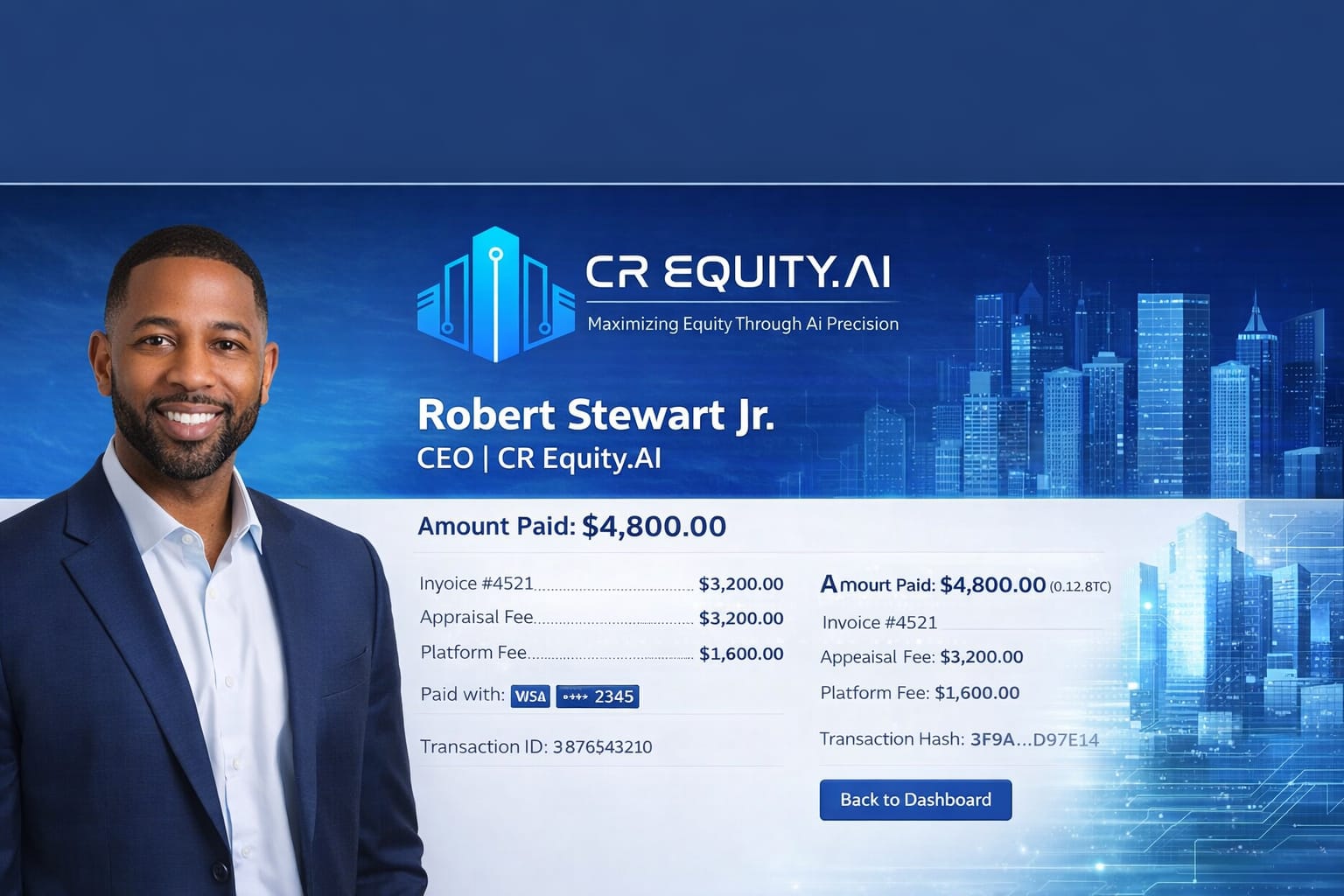
A typical pilot runs 30–90 days on one loan product. During that window, CR Equity Ai Inc configures your buy-box rules, connects to your intake source, and delivers shadow-mode comparison reports so you can validate decision quality before going live. The full service suite covers bridge, construction, acquisition, working-capital, and asset-based credit, with explainable AI decisions and immutable audit trails built into every approval. To see what your deal pipeline looks like with automated underwriting, request a loan quote and a pilot scoping call.
Further reading and sources
The sources below support policy design, model validation, and integration decisions for teams building or evaluating automated approval infrastructure.
Use this list to ground your internal policy documents, validate vendor claims, and brief stakeholders on industry benchmarks before committing to a platform or pilot scope.
- Morgan Stanley: AI in Real Estate 2025 — Industry-scale analysis of automation potential, including the 37% task-automatable estimate.
- Kissflow: Automated Approval Processes 2026 — Comprehensive guide to approval workflow design, cycle-time benchmarks, and audit trail requirements.
- SysGenPro ERP: Real Estate Approval Workflow Strategies — ERP architecture guidance for standardizing approval routing and decision lineage.
- PropLab: Real Estate Workflow Automation 2026 — Practitioner guide covering human-in-the-loop design, shadow-mode pilots, and offer-assembly best practices.
- ElixirData: AI Approval Agent — Technical explanation of action/control layer separation and risk-based stop points.
- NetSuite: Automation in Real Estate — Operational case for centralized workflows and real-time deal visibility.
- CR Equity Ai Inc: AI Underwriting in Commercial Real Estate — Platform-level detail on model governance, explainability, and underwriting validation.
- CR Equity Ai Inc: Risk Scoring in Real Estate — Guidance on threshold setting, tolerance bands, and KPI definitions for automated decisioning.