Underwriting turn times typically run from a few days on automated approval paths to several weeks on complex files, with a sub-48-hour first touch now the industry benchmark for an initial lender response. A fixed three-business-day waiting period applies before closing once the Closing Disclosure goes out. The single biggest lever a borrower controls is to submit a complete file up front and answer every condition within 24 to 48 hours.
TL;DR:
- Submitting a complete file and responding to conditions within 24 to 48 hours significantly accelerates underwriting timelines.
- Underwriting typically takes one to six weeks, depending on loan type, with USDA and self-employed files generally being the slowest.
- Queue time and third-party scheduling, such as appraisals and titles, account for most delays, which cannot be shortened by automation.
- Automating data extraction and eligibility checks reduces intake and initial review times but does not impact appraisal or regulatory review durations.
- Borrowers should proactively gather all required documents upfront and respond quickly to avoid unnecessary delays and reduce total processing time.
Table of Contents
- Typical underwriting timelines by loan type
- Underwriting stages: what happens at each step and how long each typically takes
- Most common causes of underwriting delays and who controls each one
- How lenders and technology shorten underwriting
- What borrowers and agents should do to shorten underwriting turn times
- Publisher perspective: how CR Equity AI shortens underwriting
- The gap between advertised speed and real timelines
- How to get started with CR Equity AI if you need a faster underwriting path
- Sources
- FAQ
Typical underwriting timelines by loan type
Underwriting duration depends heavily on program type and file complexity. Across mortgage products, underwriting itself typically takes one to six weeks, while the full application-to-closing process averages roughly 42 to 45 days.
Conventional loans with full W-2 documentation and a clean credit file tend to land on the faster end of that range, since automated underwriting systems can issue an eligibility finding almost immediately. FHA and VA files often take longer because they carry program-specific documentation and agency review layers on top of standard underwriting. USDA loans typically take the longest of the major programs, since applications route through an additional agency-level review after the lender’s own approval. Refinances generally move at a similar pace to purchases, though they skip some of the timing pressure tied to a purchase contract.
- Conventional purchase: fastest when the borrower has full income documentation and a straightforward credit profile.
- FHA and VA: added time for program-specific conditions and insuring or guaranty requirements.
- USDA: slowest on average due to a secondary agency review step.
- Self-employed or manually underwritten files: slower across every program due to income verification complexity.
Appraisal scheduling and title work are common added-time contributors regardless of program, since both run on third-party schedules outside the lender’s direct control.
Underwriting stages: what happens at each step and how long each typically takes
Underwriting is not one event. It is a sequence of stages, each with its own clock, and understanding where time actually goes helps a borrower spot a bottleneck instead of guessing at one. Process analysis of turnaround times stresses defining what starts and stops the clock before drawing conclusions about speed, since “first touch” and total elapsed time measure two different things: a lender can respond within 48 hours and still take weeks to reach a final decision.
- Intake and queue: the file enters the underwriting system and waits for an available underwriter; this stage is pure queue time, driven by lender volume rather than file complexity.
- Initial underwriting review: the underwriter checks income, assets, credit, and collateral against program guidelines and issues a set of conditions.
- Conditions cycle: the borrower supplies requested documents, and the underwriter reviews and clears each one; this cycle can repeat multiple times on complex files.
- Appraisal and title review: valuation and ownership checks run in parallel with underwriting but often set the pace for the whole file.
- Clear to close (CTC) issuance: the underwriter signs off once every condition is satisfied, triggering the closing disclosure timeline.
Touch time, the minutes an underwriter actively spends on a file, is usually a small fraction of total elapsed time. Wait time, driven by queue backlogs and third-party scheduling, accounts for most of the calendar days a borrower experiences. Process studies point to a small number of “time traps” concentrating most of the delay, and measuring stage-level process cycle efficiency is how a lender finds them.
Most common causes of underwriting delays and who controls each one
Delays cluster around a short list of causes, and each one sits with a different party.
- Incomplete documentation (borrower-controlled): missing pay stubs, bank statements, or explanation letters trigger new conditions and restart parts of the review.
- Appraisal or value issues (third-party-controlled): a low appraisal or scheduling delay pushes the whole file behind the valuation timeline.
- Title defects (third-party-controlled): liens, judgments, or ownership gaps require resolution before clear to close.
- Complex income or asset verification (shared): self-employed income, multiple funding sources, or large deposits require extra documentation and underwriter time.
- Program-level agency review (lender and agency-controlled): USDA, VA, and FHA files pass through insuring or guaranty steps beyond the lender’s own sign-off.
- Lender volume and staffing (lender-controlled): backlogs during high-volume periods slow queue and conditions-cycle time regardless of file quality.
Pro Tip: Keep a single running list of every document you have sent, with dates, and check it against your loan officer’s condition list weekly. That habit catches the “batched but unsent” files that quietly add days to a review.
How lenders and technology shorten underwriting
Automated Underwriting Systems (AUS), software that checks a loan file against program guidelines and returns an eligibility finding, can deliver a near-instant decision on straightforward, fully documented files. That speed comes from removing manual data entry and rule-checking, not from skipping any required review.
Intelligent document processing (IDP) and AI-assisted triage extract and validate information from pay stubs, bank statements, and tax forms automatically, which is part of how the industry has pushed toward a sub-48-hour first-touch response as a competitive baseline. Accelerated underwriting tools speed data ingestion and initial triage, which frees underwriters to spend more time on genuinely complex files.
- Automation shortens intake, data entry, and initial eligibility checks.
- It does not shorten appraisal scheduling, title search timing, or agency-level regulatory review.
- Lenders using machine learning in document processing reduce manual review time on the underwriting side specifically, not the third-party side.
Speed has become table stakes rather than a differentiator across underwriting generally, so a lender’s real advantage now comes from pairing speed with accurate, well-governed decisions.
What borrowers and agents should do to shorten underwriting turn times
A borrower’s own response speed is the single most controllable variable in the entire timeline.
- Assemble a complete document set before submission: two years of tax returns, recent pay stubs, two months of bank statements, and a photo ID, gathered before the file goes to underwriting rather than after.
- Pre-order property-specific documents early: HOA statements and condo questionnaires often take days to arrive and can be requested the same week as the appraisal order.
- Respond to every condition within 24 to 48 hours of the request, since each round of back-and-forth adds a full queue cycle on top of the review time itself.
- Coordinate directly with the appraiser and title company on access and document requests rather than routing every message through the loan officer.
- Escalate politely and specifically when a file stalls: ask for the exact outstanding condition and a target date rather than a general status check.
Pro Tip: Send documents as complete sets in a single message rather than one file at a time. Piecemeal submissions are a common source of the “incomplete file” delays that restart the conditions cycle.
Publisher perspective: how CR Equity AI shortens underwriting
The lender underwrites the asset and the deal rather than relying solely on borrower paperwork, using a soft credit pull and often no income verification on many real estate programs. Decisions can sometimes be made quickly, and advance-rate grids may be published before application to set pricing expectations.

Products like F.L.E.X. 50™ bridge financing are built for the fastest decisions, with funding windows of 24 to 48 hours on qualifying deals, while ground-up construction and larger commercial files generally require more underwriting time due to draw schedules and milestone verification.
When vetting any lender’s speed claims, ask:
- What is your first-touch response time on a new submission?
- Do you publish advance-rate grids before I apply?
- Do you use a soft credit pull or a hard pull?
- What specifically triggers your fastest decision window, and what does not qualify?
The gap between advertised speed and real timelines
The industry’s obsession with first-touch response time is useful but incomplete. A lender answering within 48 hours tells a borrower almost nothing about when the loan will actually close, since appraisal scheduling, title work, and agency review sit outside any lender’s response clock. Conventional advice on this topic tends to fixate on the wrong number: how fast a lender says yes, rather than how fast a borrower’s own file moves through conditions.
The evidence here points to a different priority. Complete documentation and a 24 to 48 hour response cadence on conditions do more to shorten a real timeline than any lender’s marketing claim about speed. Automation genuinely helps on the intake and triage side, but it cannot compress an appraisal order or a title search, and no fast-decision claim should be read as an exemption from those fixed steps. Borrowers who treat the first-touch number as the whole story routinely underestimate how much of the calendar is actually theirs to control.
— Robert Stewart Jr
How to get started with CR Equity AI if you need a faster underwriting path
Real estate investors facing a tight closing window have options built for that pace: F.L.E.X. 50™ for emergency bridge financing funded in 24 to 48 hours, DSCR cash-out refinance for self-employed and 1099 investors qualified on rent rather than tax returns, and Fix and Flip Loans for time-sensitive acquisitions.
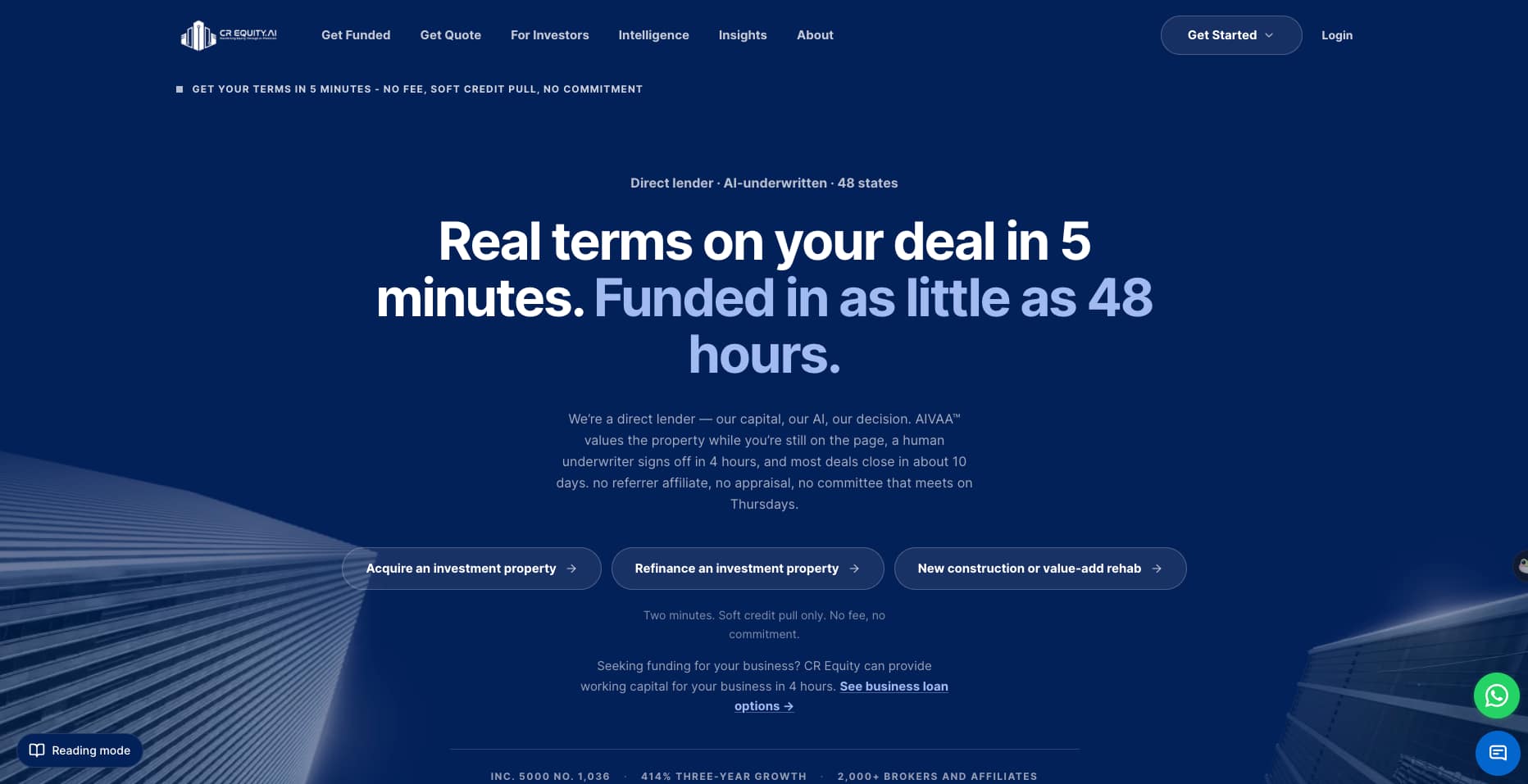
Decisions on qualifying deals can arrive in as little as four hours. To start, submit a deal directly through the broker and borrower portal and expect an initial response within that same window.
This article is general information, not a substitute for advice from a qualified financial advisor. Consult a qualified financial professional about your own circumstances before acting on anything here.
Sources
- When do I get a Closing Disclosure? | Consumer Financial Protection Bureau
- How Long Does Underwriting Take? Timeline by Type (2026) | Capstone Planet
- The New Standard: Submission Benchmarks for 2026 | SortSpoke
- The Accelerated Underwriting Path: 5 Ways Accelerated Underwriting Increases Speed to Quote | Appian
- Underwriting turnaround time: What determines speed | FurtherAI
FAQ
What are USDA underwriting turn times right now?
USDA loans generally take longer than conventional, FHA, or VA loans because the file passes through an additional agency-level review after the lender’s own underwriting approval. Exact current turn times vary by lender volume and agency staffing, and are not publicly published as a fixed figure, so borrowers should confirm the current estimate directly with their lender.
How long after underwriting do you get approved?
“Clear to close” is the underwriting approval itself, issued once every condition has been satisfied. From there, the Closing Disclosure must go out at least three business days before closing can occur, so approval and closing are separated by that fixed waiting period at minimum.
How often do underwriters reject mortgage applications?
There is no single published rejection rate that applies across all lenders and programs, since denial frequency depends heavily on file quality, program type, and documentation completeness. Files with incomplete documentation carry a materially higher risk of denial or delay than fully documented submissions.
Can you be denied after underwriting?
Yes. A loan can still be denied after underwriting begins if new conditions surface, such as a low appraisal, a title defect, or a change in the borrower’s income or credit profile before closing. This is why lenders recommend avoiding new credit accounts, job changes, or large deposits during the underwriting period.