The fastest path to approval on a vertical construction loan is a lender-ready, line-item sources-and-uses package with a reconciled draw schedule, complete subcontractor lien waivers, and an interest reserve sized to your actual draw S-curve. Most draw rejections and approval delays trace back to three failures: under-budgeted interest reserves, missing lien waivers, and budget mismatches between the owner’s project budget and the lender’s loan budget. Fix those three before you submit, and you remove the most common friction points in vertical construction loan best practices.
Here is the pre-submission checklist that experienced sponsors run before every application or draw:
- Reconcile the owner’s project budget to the lender’s approved loan budget line-by-line before signing the cover letter.
- Collect signed conditional lien waivers from every subcontractor and organize them per the Rabbet draw-package standard.
- Model monthly draws and size the interest reserve to the actual S-curve, not a flat 50% assumption. Vertical draw curves typically produce an average outstanding balance of 55–65%, which means a flat 50% assumption understates the reserve by 5–15% on front-loaded projects.
- Verify builder credentials: state license, general liability and workers’ compensation insurance, project portfolio, and references.
- Keep six months of interest reserves and a documented contingency fund accessible and visible in the package.
Pro Tip: The FDIC’s Five Cs framework maps directly to what construction lenders underwrite. Build your package to address all five: Character, Capacity, Capital, Collateral, and Conditions.
Key Takeaways
A lender-ready vertical construction loan package with a reconciled line-item budget, complete subcontractor lien waivers, and an interest reserve sized to the actual draw S-curve is the single most effective way to accelerate approval and eliminate draw holds.
| Point | Details |
|---|---|
| Size the interest reserve to the S-curve | Vertical draws average 55–65% outstanding balance; a flat 50% assumption understates the reserve on front-loaded projects. |
| Lien waivers are the top rejection trigger | Collect signed conditional waivers from every sub before each draw submission; missing waivers are the number one cause of draw holds. |
| Reconcile both budgets line-by-line | The owner’s project budget and the lender’s loan budget must match at the line-item level before signing the cover letter. |
| Contingency requires its own line item | Size hard-cost contingency at 10–15% for complex vertical builds; keep soft-cost contingency separate at 5–10%. |
| CR Equity Ai Inc | Publishes advance-rate grids before you apply and funds milestone draws on its own capital for qualified ground-up construction sponsors. |
Table of Contents
- What is a vertical construction loan and how does it fit your capital stack?
- What lenders really evaluate on vertical construction loans
- How to assemble a lender-ready loan package
- How to build a lender-ready budget and control costs
- Managing draw schedules, inspections, and lien waivers
- Mistakes that kill approvals or freeze draws
- How to choose the right construction lender and negotiate key terms
- When does a private/direct lender make sense for vertical construction?
- Practical habits that separate reliable closers from repeat reworks
- CR Equity Ai Inc funds milestone draws on your schedule, not a committee’s
- Sources
- FAQ
What is a vertical construction loan and how does it fit your capital stack?
A vertical construction loan, also called a ground-up construction loan, is a short-term, interest-only credit facility that funds the physical construction of a building from foundation to certificate of occupancy. Unlike a traditional mortgage, which is secured by a completed, income-producing asset, a vertical construction loan is secured by the land plus in-progress improvements. The lender advances funds in stages tied to verified construction milestones rather than releasing the full loan amount at closing.
Three primary structures cover most vertical projects:
- Construction-only loans are short-term and interest-only during the build. At completion, the borrower must either refinance into permanent financing or sell the asset. Freddie Mac describes these as requiring conversion or payoff at completion, which introduces refinance risk if market conditions shift.
- Construction-to-permanent (one-close) loans convert automatically to a permanent mortgage at completion, avoiding a second closing and a second set of closing costs. The tradeoff is that the permanent rate is locked at origination, which may be higher or lower than the rate available at completion.
- Milestone-draw ground-up loans are the structure most common among private and direct lenders. Draws are released against verified milestones and inspections, with retainage held until completion. This structure is standard for spec multifamily, mixed-use, and institutional ground-up projects.
Which structure fits depends on the project type and sponsor strategy. For-sale single-family builders often prefer construction-to-perm loans due to their rate certainty. Spec multifamily developers typically use construction-only or milestone-draw structures and plan for a DSCR refinance at stabilization. Mixed-use and institutional ground-up projects almost always use milestone-draw structures with institutional-grade draw controls. For developers evaluating mixed-use project financing types, the loan structure choice affects both the underwriting process and the post-construction exit.
Conventional construction programs typically require credit scores near 680 and down payments of 20–25% of total project cost. FHA construction-to-perm programs can allow lower credit floors and down payments but add mortgage insurance and lender overlays that increase total cost.
What lenders really evaluate on vertical construction loans
Lenders apply the Five Cs framework to every construction loan, but the weighting shifts significantly for vertical projects. Character and Collateral matter, but Capacity and Conditions carry more weight here than in a standard commercial mortgage.
How the Five Cs apply to vertical projects
Character covers the developer’s and builder’s track record. Lenders want to see completed projects of comparable size and complexity, not just a resume. Expect requests for a project history with addresses, completion dates, and lender references.
Capacity addresses whether the sponsor can absorb schedule delays and cost overruns without defaulting. Lenders want two to three years of personal and business financial statements, proof of liquid reserves beyond the interest reserve, and a credible repayment plan tied to either a sale or a stabilized refinance.
Capital is the equity at close plus documented reserves. Most lenders want to see the sponsor’s equity contribution verified before the first draw, not promised.
Collateral includes the land, the approved plans and specifications, the third-party appraisal (as-completed value), and the executed construction contract. A guaranteed maximum price (GMP) contract or GMP-like agreement materially strengthens the collateral position because it caps the lender’s exposure to cost overruns.
Conditions covers market risk, permit status, timing, and macroeconomic factors. Lenders underwrite the absorption assumptions in the appraisal and the permit timeline. A project with a full permit in hand closes faster and at better terms than one still in entitlement.
The AGC Guide to Construction Financing warns that lenders underwrite the contractor as thoroughly as the borrower. Developers who present weak builder documentation — missing licenses, expired insurance, no verifiable project history — face the same scrutiny as sponsors with credit issues. AGC also cautions against financing arrangements that ask contractors to fund work up-front, flagging these as potential red flags for fraud and triggers for heightened lender scrutiny.
Pre-submission checklist for underwriting clearance
Run this before submitting a term sheet request:
- Two to three years of sponsor personal and business financial statements or P&L
- Proof of liquid reserves (bank statements, brokerage statements)
- Executed GMP or GMP-like construction contract
- Third-party cost review or independent estimator’s report
- Contractor state license verification, general liability, and workers’ compensation certificates
- Contractor project resume with three to five comparable completed projects and lender references
- Approved plans and specifications, or at minimum design development drawings
- Third-party appraisal with as-completed value and absorption assumptions
- Full permit set or documented permit timeline
For a detailed walkthrough of the underwriting sequence, the step-by-step real estate underwriting guide covers how lenders move from term sheet to closing on construction deals.
How to assemble a lender-ready loan package
A properly structured draw package should be reviewable by an experienced lender in under two hours. Per the Rabbet draw-package standard, packages that take longer typically have missing documents, inconsistencies, or inadequate structure. The 10-item framework below is what lenders expect at every draw submission.
The 10-item draw package framework
- Cover letter — Signed by the borrower or authorized representative. States the draw number, draw amount requested, and certifies that work is complete and lien waivers are attached. Pre-signed or unsigned cover letters are a common rejection trigger.
- Table of contents — Organizes the package so the lender’s reviewer can locate each item without searching.
- Draw summary (sources and uses) — Shows the total loan budget, amounts drawn to date, the current draw request, and the remaining balance by line item. This is the document lenders reconcile against the approved loan budget.
- Pay application (AIA G702/G703 or sworn statement) — The GC’s certified statement of work completed and stored materials. AIA G702 is the schedule of values summary; G703 is the line-item continuation sheet.
- Invoice summary — A one-page reconciliation of all invoices in the current draw to the G703 line items.
- Supporting invoices — Organized by trade and mapped to the G703. Invoices that don’t map to an approved budget line are the second most common cause of draw delays.
- Change-order log — A running log of all approved and pending change orders, with lender approval status noted for each.
- Stored materials documentation — Receipts, delivery confirmations, and photos for materials stored on-site or off-site but not yet installed.
- Lien waivers — Conditional lien waivers from every subcontractor and supplier in the current draw, organized directly behind each sub’s pay application. Missing subcontractor lien waivers are the single most common cause of draw rejections.
- Insurance certificates and inspection/title updates — Current certificates of insurance for the GC and all named subs, plus the lender’s inspection report and any title endorsement updates.
Pro Tip: Reconcile the owner’s project budget to the lender’s approved loan budget before signing the cover letter. Line-item mismatches between the two budgets are the top cause of draw delays, and they are almost always preventable with a 30-minute pre-submission review.
How to build a lender-ready budget and control costs
A credible line-item budget is the document lenders use to underwrite the project’s financial feasibility. It must reconcile to the third-party appraisal’s cost assumptions and to the GC’s contract. Lenders who find gaps between the budget and the appraisal’s cost-to-complete will either require a revised budget or reduce the loan amount.
Line-item budget categories
Every lender-ready budget includes these categories:
- Hard costs by trade — Site work, concrete, framing, roofing, exterior envelope, MEP (mechanical, electrical, plumbing), interior finishes, and landscaping. Each trade should be a separate line item tied to a subcontractor bid or GMP contract.
- Soft costs — Architecture, engineering, permits, legal, title, survey, environmental, and developer overhead.
- Financing fees and interest reserve — Origination fees, lender legal, title insurance, and the fully modeled interest reserve.
- Developer fee — Typically 3–5% of total project cost for institutional deals; must be disclosed and approved by the lender.
- Contingency — A separate line item, not buried in hard costs.
Contingency sizing
| Project Type | Baseline Contingency | Notes |
|---|---|---|
| Smaller residential vertical | 10% of hard costs | Standard floor for most lenders |
| Complex vertical (multifamily, mixed-use) | 10–15% of hard costs | Higher for phased or urban infill projects |
| Institutional ground-up | 15%+ of hard costs | Lenders may require independent cost review |
| Soft-cost contingency | 5–10% of soft costs | Separate from hard-cost contingency |

Unused contingency at completion is typically returned to the borrower or applied to the loan payoff, depending on the loan agreement. Lenders rarely allow contingency draws for items outside the approved scope without a formal change-order approval.
Monthly cost-to-complete reconciliations are the operational control that keeps budgets credible. At each draw, the GC and the developer should update the cost-to-complete for every line item, not just the lines with current activity. A line that shows no movement for two consecutive draws while the schedule shows work in progress is a lender red flag.
Pro Tip: Separate soft-cost burn patterns from hard-cost S-curve draws when sizing cash flow and the interest reserve. Soft costs accrue continuously from day one; hard costs follow the S-curve. Blending them into a single draw model understates early-period interest accrual.
Managing draw schedules, inspections, and lien waivers
Most vertical construction projects run five to seven draws, aligned to major construction milestones. The exact number depends on project complexity and lender requirements, but the milestone sequence is consistent across most vertical builds.
Typical milestone draw schedule
| Draw | Milestone | Key Documents Required |
|---|---|---|
| 1 | Foundation complete | Permit, footing inspection, foundation survey, sub waivers |
| 2 | Framing / vertical shell | Framing inspection, updated schedule, sub waivers |
| 3 | Exterior envelope / roofing | Roof inspection, weather-tight certification, sub waivers |
| 4 | MEP rough-in | Rough-in inspections (mechanical, electrical, plumbing), sub waivers |
| 5 | Interior finishes | Drywall, flooring, millwork inspections, sub waivers |
| 6 | Punchlist / certificate of occupancy | CO or TCO, final inspection, unconditional lien waivers |
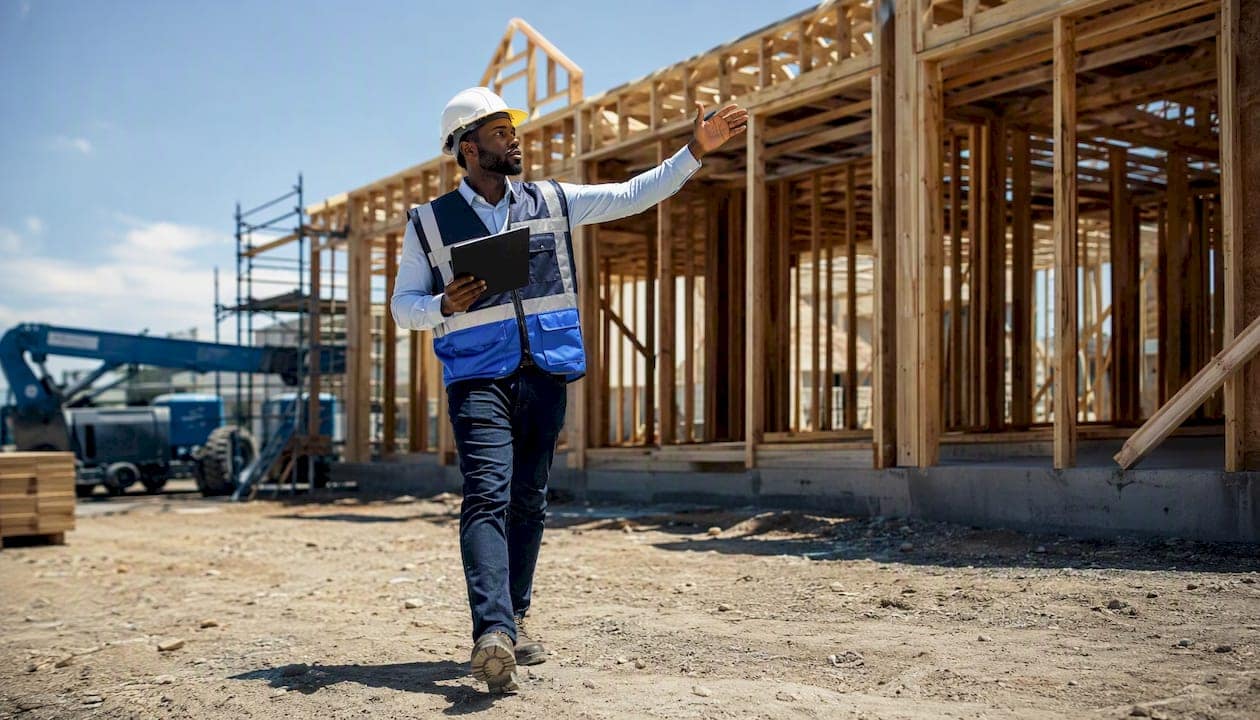
At each draw, submit the full 10-item package described above. The inspection report from the lender’s inspector must confirm that the work claimed in the G702/G703 is actually in place. Lenders will not fund a draw for work the inspector cannot verify.
Retainage and holdback
Retainage is the percentage of each draw the lender withholds until project completion, typically 5–10%. Its purpose is to ensure the GC and subcontractors complete all punchlist items before receiving final payment. Retainage release is triggered by the certificate of occupancy, final unconditional lien waivers from all subs, and lender confirmation that the project is complete.
Negotiate retainage release triggers before closing. Some lenders release retainage in stages (50% at substantial completion, 50% at CO), which improves GC cash flow and reduces the risk of contractor abandonment late in the project.
Common draw friction points
- Missing sub waivers — The most common single cause of draw rejection. Maintain a centralized waiver log and collect conditional waivers from every sub before submitting the draw.
- Invoice-to-budget mismatches — Invoices that don’t map to an approved G703 line item require a change order before the lender will fund them.
- Unsigned or pre-signed cover letters — The cover letter must be signed at the time of submission, not in advance.
- Inspection discrepancies — If the inspector’s report shows less work in place than the G702 claims, the draw will be reduced or held pending re-inspection.
Pro Tip: Organize conditional lien waivers directly behind each subcontractor’s pay application in the package. Lenders who have to search for waivers across a disorganized package take longer to review and are more likely to issue a hold.
Mistakes that kill approvals or freeze draws
Most draw holds and approval denials are preventable. The errors below account for the majority of lender friction on vertical construction loans.
Top mistakes to avoid
- Under-budgeting the interest reserve using the 50% trap. Sizing the reserve at 50% of the loan amount times the rate times the term ignores the S-curve. Because vertical draws average 55–65% outstanding balance, a flat 50% assumption leaves the reserve short on front-loaded projects.
- Submitting draws with missing subcontractor lien waivers. Per the Rabbet standard, this is the number one cause of draw rejections industry-wide.
- Presenting unreconciled invoices. Invoices that don’t map to an approved budget line require a change order. Submitting them without one signals poor cost controls to the lender.
- Weak builder documentation. Expired licenses, missing insurance certificates, or a contractor with no verifiable project history will trigger underwriting holds regardless of the sponsor’s credit profile.
- Last-minute budget reallocations without lender approval. Moving funds between line items without a formal change order and lender sign-off is a covenant violation on most construction loans.
What to do when a draw is held
- Request the lender’s hold notice in writing and identify every deficiency by line item.
- Reconcile disputed line items between the owner’s budget and the lender’s loan budget.
- Obtain and submit any missing subcontractor lien waivers.
- Supply signed change-order approvals for any invoices outside the approved scope.
- Provide an updated cost-to-complete and revised schedule if the hold involves a schedule or budget discrepancy.
- Confirm the lender’s inspector has re-inspected any work that was disputed in the original report.
How to choose the right construction lender and negotiate key terms
The lender type you choose determines not just pricing but the operational experience of the loan: how draws are reviewed, how fast funds move, and how much administrative friction you absorb on each milestone.
Decision criteria by lender type
- Regional banks and credit unions typically offer the lowest rates but the longest review timelines and the most rigid underwriting overlays. They work best for sponsors with strong banking relationships and projects that fit conventional parameters.
- Agency programs (FHA, Freddie Mac) add mortgage insurance and compliance requirements but can reduce down payment and credit thresholds. They suit for-sale residential and affordable multifamily developers who can absorb the processing timeline.
- Private and direct lenders publish advance-rate grids, fund on their own capital, and typically deliver faster decisions and draw reviews. Pricing is higher, but administrative delays are fewer. For experienced sponsors on time-sensitive projects, the speed premium often justifies the rate differential.
Terms worth negotiating before closing
- Interest reserve sizing method — Require the lender to model the reserve against your actual draw schedule, not a flat 50% assumption. The difference can be material on a 24-month vertical build.
- Extension fees and notice periods — Confirm the extension fee (typically 0.25–0.5% of the loan amount per extension) and the required notice period before the maturity date.
- Retainage percentage and release triggers — Negotiate staged release (50% at substantial completion) rather than 100% holdback until CO.
- Inspection fees and frequency — Confirm the per-inspection fee and whether the lender requires an independent inspector or accepts the GC’s self-certification for interim draws.
- Permitted contingency draws — Confirm the process for drawing contingency funds and whether lender approval is required for each contingency draw or only above a threshold.
Pro Tip: When speed matters, favor direct/private lenders that publish advance-rate grids and fund on their own capital. Verify the rate and covenant tradeoffs before closing, but don’t underestimate the cost of a 30-day draw review delay on a project with a tight completion schedule.
For a broader view of developer loan structures and underwriting considerations, the developer loans guide covers how lenders compare across deal types and capital stack positions.
When does a private/direct lender make sense for vertical construction?
The decision to use a private or direct lender over a bank comes down to four variables: project complexity, required speed, sponsor experience, and whether the lender underwrites the asset or the relationship.
Decision checklist
- Project size and complexity — Private lenders are generally more flexible on complex vertical builds (mixed-use, urban infill, phased construction) where bank overlays create friction.
- Speed requirement — If the construction timeline is tight or the land contract has a closing deadline, a lender that can deliver a term sheet in 24–48 hours and fund within days is operationally valuable.
- Sponsor experience — Private lenders that underwrite the deal rather than the borrower’s tax returns can be a better fit for experienced sponsors with strong project histories but non-traditional income documentation.
- Asset-based vs. relationship-based underwriting — A lender that underwrites the asset (land value, as-completed appraisal, project feasibility) rather than requiring a multi-year banking relationship gives experienced sponsors more flexibility.
What to request from any private lender before closing
- A sample sources-and-uses template showing how the lender structures the loan budget
- The published inspection fee schedule and expected draw review timeline
- A copy of the advance-rate grid showing LTV limits by project type and sponsor tier
- A sample loan closing checklist so you can prepare documents in parallel
CR Equity Ai Inc’s ground-up construction loan program publishes advance-rate grids before you apply and funds milestone draws on its own capital, which removes the administrative delay of third-party capital sourcing. That transparency is the operational signal to look for in any private lender.
Pro Tip: Require the lender to put advance-rate tables and inspection fee assumptions in writing before closing. Verbal commitments on these terms are not enforceable, and surprises during draws are far more disruptive than surprises at closing.
Practical habits that separate reliable closers from repeat reworks
Most draw friction is not a lender problem. It is an internal process problem that shows up at the lender’s desk.
The teams that close cleanly and draw without holds share a few operational habits that most developers underestimate until they’ve experienced a 30-day draw hold on a project with a tight GC payment schedule.
Institutionalize a monthly draw preflight. Forty-eight hours before each draw submission, the draw owner, GC, and project accountant should sit down and reconcile the G703 line items against the cost-to-complete, verify that every sub’s conditional lien waiver is collected and signed, and confirm that all invoices map to approved budget lines. This single ritual eliminates most hold triggers before the package leaves your office.
Assign a draw owner. One person is responsible for the draw package from assembly to lender confirmation. When draw ownership is distributed across the GC, the project manager, and the accounting team without a single accountable person, documents fall through the gaps.
Keep a centralized digital draw repository. Every invoice, waiver, change order, inspection report, and pay application for the project lives in one folder structure, organized by draw number. When a lender requests a document from draw 3 during draw 5, you retrieve it in two minutes, not two days.
Run a weekly schedule-versus-cost reconciliation. If the schedule shows framing at 80% complete but the cost-to-complete shows framing at 60% spent, one of those numbers is wrong. Catching that discrepancy internally before the inspector sees it prevents re-inspections and draw reductions.
Use a single change-order approver. Every scope change, regardless of dollar amount, goes through one person who has authority to approve, reject, or escalate. Unauthorized change orders that show up in a draw package without lender approval are a fast path to a hold.
These habits reduce re-inspections, accelerate lender reviews, and lower the amount of retainage held at any given milestone. For developers building in active luxury markets like Amelia Island’s $2M–$10M segment, where construction timelines directly affect absorption and pricing, draw efficiency has a measurable impact on project returns.
CR Equity Ai Inc funds milestone draws on your schedule, not a committee’s
Experienced sponsors who have managed the draw process know that the bottleneck is rarely the construction itself. It is the gap between work completed and funds received. CR Equity Ai Inc’s ground-up construction loan program is built to close that gap: milestone draws funded on the firm’s own capital, advance-rate grids published before you apply, and underwriting decisions that evaluate the asset and the deal, not just the borrower’s tax returns.
For developers who need to move from term sheet to funded draw without the administrative delays of committee-based lending, CR Equity Ai Inc offers a direct path. No income verification on most real estate programs, soft credit pull, and decisions in as little as 4 hours. Request a loan quote or review the construction program details to confirm your project fits the advance-rate grid before you apply.
Sources
Primary references developers should consult when assembling packages or negotiating terms:
- Construction loans draw schedules & interest reserves — Apers
- The construction draw package standard: what every lender-ready package must include — Rabbet
- AGC Guide to Construction Financing (2nd Edition) — Associated General Contractors
- Module 5 Small Business Financing — FDIC Instructor Guide
- Construction loan options for building your home — Freddie Mac
FAQ
What is a vertical construction loan?
A vertical construction loan is a short-term, interest-only credit facility that funds the physical construction of a building from foundation to certificate of occupancy, with funds advanced in stages tied to verified construction milestones rather than released in full at closing.
What are the Four Cs lenders evaluate on construction loans?
Lenders use the Five Cs framework: Character (developer and builder track record), Capacity (sponsor liquidity and ability to absorb overruns), Capital (equity at close and reserves), Collateral (plans, appraisal, and contract), and Conditions (market, permits, and timing). Construction lenders weight Capacity and Conditions more heavily than traditional mortgage lenders.
Do you need 20% down for a construction loan?
Conventional construction programs typically require 20–25% of total project cost as a down payment, though FHA construction-to-perm programs can allow lower down payments with mortgage insurance. Private and direct lenders vary by program and sponsor experience.
What is the most common reason a construction draw gets rejected?
Missing subcontractor lien waivers are the single most common cause of draw rejections, per the Rabbet draw-package standard. Collecting signed conditional waivers from every sub before submission eliminates this trigger.
How is the interest reserve calculated on a vertical construction loan?
The interest reserve should be modeled against the actual monthly draw schedule, not a flat 50% of the loan amount. Because vertical draw curves average 55–65% outstanding balance, a draw-by-draw monthly accrual calculation produces a more accurate reserve than the flat-average shortcut, and institutional practice adds a 15–20% contingency buffer to the central interest estimate.